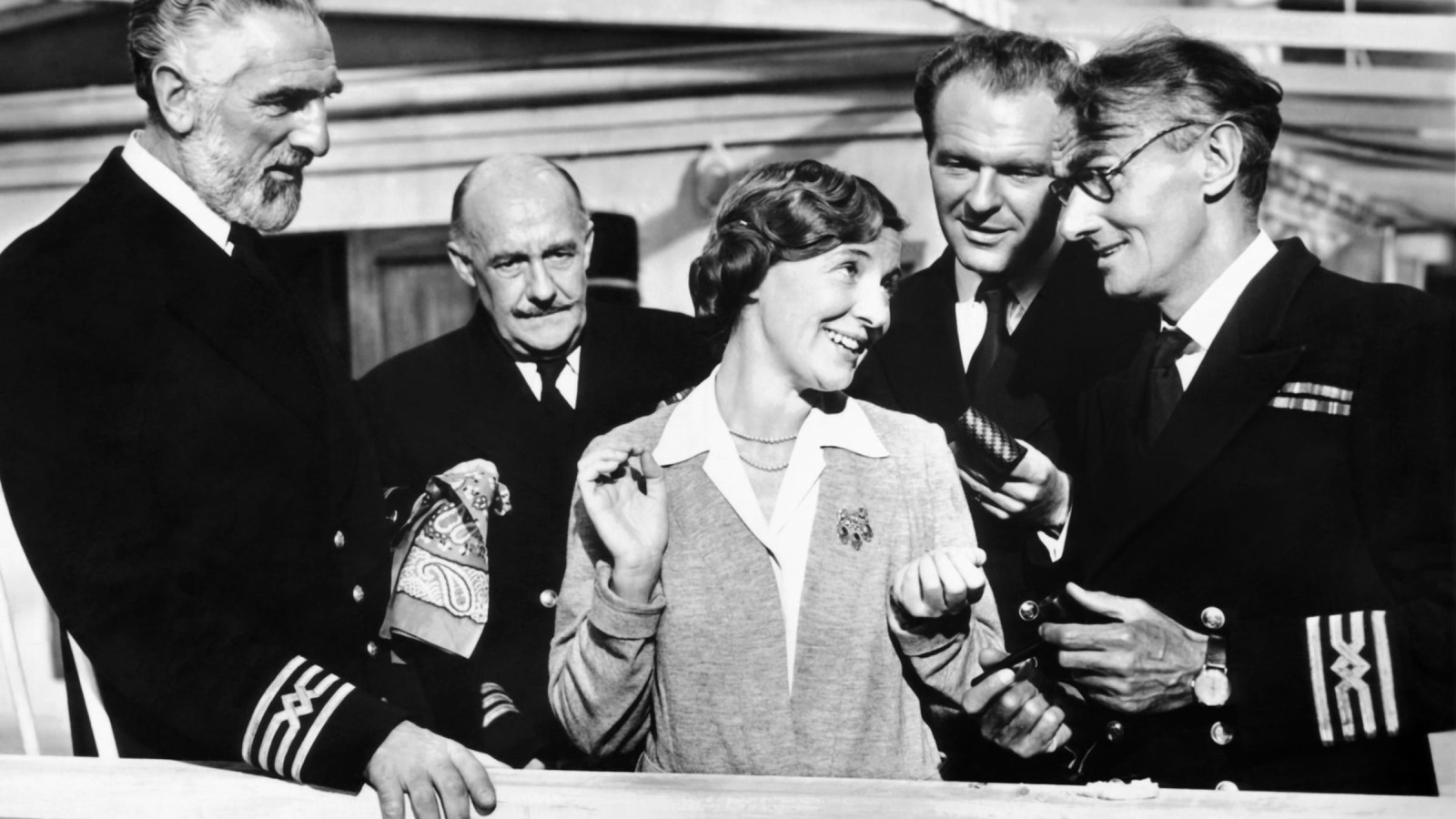





The infectiously Manhattan-centric cast of Roman Polanski’s Rosemary’s Baby is a treasure chest of sudden stars and cherished character actors, each of the film’s central and supporting parts filled with great deliberation and preproduction forethought, and every periphery teeming with fascinating faces, some now half remembered, others completely forgotten. You can begin to get a sense of this range of screen presences simply by examining the image above: that’s Sidney Blackmer front left, of course, and the great Hope Summers in blue (more about them in a moment). The identity of the woman in the rear remains unclear to us; the painting above her head depicts the story’s archwarlock, Adrian Marcato. Hard-core Russ Meyer fans stand a fleeting chance of recognizing the man wearing white and with his hands clasped at left rear: that’s Sebastian Brook, who appears briefly, flabbergasted and fuming, as a fashion photographer in Beyond the Valley of the Dolls (“Susan, I’m simply in a rage!”). And the man on the far right: Elmer Modlin, an actor who never went anywhere and almost certainly would have disappeared entirely from history had not a stash of his letters, photographs, and videotapes been discovered in a Madrid trash can by filmmaker Sergio Oksman, who turned his find into a fascinating short documentary released just this year: A Story for the Modlins (trailers can easily be found online). The story of Modlin and his wife, Margaret, a painter, could be one of the Bramford building’s urban legends. Such is the nature of Rosemary’s Baby: it is a place where the odd, the awful, the creepy, and the vaguely comic seem to coagulate with ease, a cinematic haunted house that’s also a perfectly preserved time capsule of the midsixties, when America suddenly appeared to be its own kind of horror movie and the story of the birth of a new Satan amid a generation of flower children proved as uneasily prophetic as it was instantly—and perhaps even infernally—profitable.
Born Maria de Lourdes Villiers Farrow in Los Angeles in 1945, Mia Farrow is the daughter of Hollywood royalty. Her father, John Farrow (The Big Clock, His Kind of Woman), was one of the great directors of Hollywood’s golden age; her mother, actress Maureen O’Sullivan, played Jane to Johnny Weissmuller’s Tarzan in the pre-Code days. No stranger to public scrutiny during the turbulent latter part of her career, Farrow is today largely remembered for her successful marriage and filmic relationship with Woody Allen during the eighties and early nineties, and even more so for the couple’s eventual high-profile breakup. But by the time Mia, raised Roman Catholic, essayed the Satan-seeded Rosemary, she’d already spent plenty of time in the entertainment news, both for her role on Peyton Place and for the apparent antinomies of her marriage to the somewhat older and much more straitlaced Frank Sinatra. It was Rosemary’s Baby that made her a star, however. In it—emaciated, Sassooned, exquisitely mascaraed—she gives one the greatest film performances of the sixties, her eyes a pair of luminous treasures, glinting with joy at the momentary illusion of boundlessness of young marriage or flaring in abject horror at the forked tongue she suddenly discovers licking at her soul. Sinatra had her served with divorce papers midshoot. It’s an enormous tribute to Farrow’s skills as an actress that she turned personal turmoil into a role that in many ways defines its era: that of a woman raped and robbed yet refusing to come unglued.
Keep your eyes on John Cassavetes’ sneakers: Polanski later groused that the moody Method actor could barely get into character without them on. The relationship between these two highly temperamental actor-directors on the set of Rosemary’s Baby was notoriously confrontational, but Polanski cannily used Cassavetes’ nervous attachment to his tennies to the film’s advantage; one of its most explosive scenes features the actor pacing particularly uncomfortably in a pair of straight brown lace-ups, as Cassavetes’ fumblingly Faustian thespian Guy awkwardly berates Rosemary in an apartment strewn with party wreckage . . . until suddenly she feels a tiny kick and announces, “It’s alive!” In the fifties, Cassavetes had specialized in playing juvenile-delinquent hard cases, in films like Don Siegel’s Crime in the Streets. As a director, he had Shadows and two studio-produced compromises—Too Late Blues and A Child Is Waiting—already behind him when he won the part in the Polanski picture. The proceeds from acting in 1967’s The Dirty Dozen (for which he was nominated for a best supporting actor Oscar) and Rosemary’s Baby helped pay for the making of his epochal Faces in 1968, beginning a string of Cassavetes-directed features—Husbands (1970), A Woman Under the Influence (1974), and The Killing of a Chinese Bookie (1976)—that are among the most celebrated American independent films ever made. The New York–born Cassavetes died in Los Angeles in 1989 at the age of fifty-nine.
As burnished as our memories may be of her ultra-hip oldster in Harold and Maude or her Oscar-winning next-door neighbor from hell Minnie Castavet in Rosemary’s Baby, it pays to keep in mind what David Thomson wrote long ago: “It is an error to find Ruth Gordon quaint or eccentric. She is the Queen of Hearts, Elektra, and Lilith all crammed into one small frame.” There was always much more to Gordon than readily met the eye. Did you know that she was three times nominated for Academy Awards . . . for screenwriting? With her husband, Garson Kanin, Gordon cowrote George Cukor’s A Double Life, Adam’s Rib, and Pat and Mike in the late forties and early fifties—the latter two featuring Spencer Tracy and Katharine Hepburn playing variations on the authors themselves. Gordon began as an extra in silent films, around the same time that she made her Broadway debut as one of the Lost Boys in a 1915 revival of Peter Pan. In the sixties, she won a Golden Globe for Inside Daisy Clover and dazzled in George Axelrod’s cult favorite Lord Love a Duck. In the seventies, she won an Emmy for a guest appearance on Taxi and hosted Saturday Night Live. And in 1983, she was given a Crystal Award by Women in Film, for her career-long “endurance and excellence”; Bette Davis was similarly awarded that year. Gordon, originally from Quincy, Massachusetts, died in 1985 at the age of eighty-eight, in Edgartown.
A North Carolina native (born 1895), Sidney Blackmer holds the somewhat dubious distinction of having played, onstage and on-screen, President Teddy Roosevelt at least a dozen times. His family ties to American history run even deeper than that: his grandfather was a signer at the Florida Secession Convention in 1861. Blackmer appeared, uncredited, in the seminal 1914 movie serial The Perils of Pauline (shot in Fort Lee, New Jersey), and debuted on Broadway in 1917. By the time he played the high-priest-of-Satan-down-the-hall Roman Castavet in Rosemary’s Baby, he had been in everything from Shirley Temple’s Heidi to installments of the Mr. Moto and Charlie Chan films. He even turns up as “The Lover,” shot dead by Herbert Marshall at the beginning of King Vidor’s ultra-lurid Duel in the Sun, in 1946, and appeared in Richard Quine’s screwball masterpiece How to Murder Your Wife in 1965. Blackmer continued on Broadway as well, winning a Tony for Come Back, Little Sheba in 1950. He died in New York City in 1973.
An exceptionally accomplished Shakespearean actor, both onstage, beginning in the twenties, and in numerous Hallmark Hall of Fame television productions during the fifties and sixties, Maurice Evans (born in Dorchester, Dorset, England, in 1901) is today primarily remembered as the ochre-garbed orangutan in charge of the Ministry of Science in Planet of the Apes: the learned and embittered Dr. Zaius. A winner of two Tonys and untold other accolades, Evans portrayed Sir Arthur Sullivan in the 1953 Gilbert and Sullivan, an essential precursor to Mike Leigh’s Topsy-Turvy. In the sixties, he maintained a recurring role as Elizabeth Montgomery’s warlock father on Bewitched and even turned up as one of Batman’s least-remembered villains, the Puzzler. As Rosemary’s ill-fated friend and mentor, Hutch, Evans plays Glinda the Good Witch to Sidney Blackmer’s Wicked Witch of the Upper West Side—and loses. Evans died in England in 1989.
With over one hundred films to his credit, Ralph Bellamy (born Chicago, 1904) was an old-school actor’s actor in golden age Hollywood, constantly at work, on-screen and off. One of the founders of the Screen Actors Guild, Bellamy served four terms as president of Actors’ Equity during the McCarthy era and into the midsixties. His presidential bearing stood him well in front of audiences, too; his most famous role was Franklin D. Roosevelt in Sunrise at Campobello, both on Broadway (where he won a Tony for it) and in author-producer Dore Schary’s screen version, and he later reprised the character in the TV miniseries The Winds of War. A frequently seen straitlaced secondario in genre films of the thirties and forties, Bellamy debuted as a gangster in 1931’s The Secret Six. As Rosemary’s Dr. Sapirstein, he is the avuncular embodiment of evil, the soothing sounds of his voice barely masking the infernal designs he has on his patient’s unborn son. Polanski named his prized dog after the character. Bellamy was awarded an honorary Academy Award for his lifetime of work and service in the acting community in 1987. He died in Los Angeles in 1991.
A child of Walt Disney and Lee Strasberg, Charles Grodin—born Grodinsky in Pittsburgh, 1935—made his uncredited screen debut in 20,000 Leagues Under the Sea in 1954, then went on to study with legendary Method masters Strasberg and Uta Hagen before debuting on Broadway, across from Anthony Quinn, in Tchin-Tchin in 1962. A screen role in 1964’s Sex and the College Girl and much television followed, until Grodin’s appearance as Rosemary’s blandly handsome and seemingly benign Dr. Hill opened the door to bigger screen opportunities. By 1978, he’d appeared in Mike Nichols’s Catch-22 and starred in Elaine May’s The Heartbreak Kid, the Dino De Laurentiis–produced remake of King Kong, and the Warren Beatty remake of Heaven Can Wait. Also a popular radio personality and desert-dry comedic pundit, the eternally straight-faced Grodin has shared the screen with everyone from Robert De Niro (in Midnight Run, 1988) and the Muppets to a family of enormous Saint Bernards (in the Beethoven films of the early nineties), treating each of them with his characteristic blend of blankly barbed scorn and warmly deployed derision.
“I thought you were the actress Victoria Vetri,” Rosemary awkwardly confesses during her laundry-room encounter with her ill-fated neighbor Terry. “A lot of people mistake me for Victoria,” admits Terry. And no wonder: the actress playing her, “Angela Dorian”—Playboy’s 1968 Playmate of the Year—in fact really is Victoria Vetri. Dorian was Vetri’s working name for much of her career, not only when appearing in pinups but on numerous sixties TV shows as well: Perry Mason, Wagon Master, Batman, Star Trek. But Vetri/Dorian’s film career stumbled at the beginning, when she lost the title role in Lolita that made Sue Lyon a star. The actress’s filmography for the seventies is short and far from stellar: she was saddled with a blonde wig in When Dinosaurs Ruled the Earth and part of an all-women seduction-and-death squad in Invasion of the Bee Girls. By 1975, she was out of the film business but still doing occasional nude work. In 2010, she was back in the news for the attempted murder of her husband during an argument. She’s currently serving a nine-year sentence in the California penal system.
Perennial pug-faced gun thug and twitchy sideman in thrillers and films noir of the latter half of the twentieth century, Elisha Cook Jr. was born in San Francisco in 1903, the son of an actress and a theater manager. He sold programs in theater lobbies and did walk-on bits onstage as a boy, and at seventeen he worked as assistant stage manager on a touring production of Thank You that ran 105 weeks. Picking up stage-acting work wherever and whenever he could, Cook even shared the boards of Broadway with Ruth Gordon in a 1933 production of Three-Cornered Moon; he got his big break later that year when he auditioned for Eugene O’Neill himself and was cast in Ah, Wilderness!. Cook appeared in hundreds of films and TV shows, perhaps most famously across from Humphrey Bogart in John Huston’s The Maltese Falcon (1941), though his sweating, grimacing performance as the speed-freak drummer in Robert Siodmak’s Phantom Lady (1944) has long been a favorite among noir connoisseurs. As the fastidious Bramford building manager in bloodred shoes in Rosemary’s Baby, Cook opens the film on a note both quaint and curious, nervously ushering Guy and Rosemary Woodhouse into their new dream home . . . and their darkest hours. Cook died in Big Pine, California, in 1995.
A quintessential cross-generational actor who moved confidently from the usually servile and secondary roles available to African Americans in sixties Hollywood to the brazen anarchy of the seventies’ wildest blaxploitation flicks, D’Urville Martin (born New York City, 1939) worked and played hard, dying of a heart attack at just forty-five. Widely seen on sixties television shows like Dr. Kildare, Daniel Boone, The Man from U.N.C.L.E., The Monkees, The Invaders, Ironside, and Love, American Style, Martin even appeared as the original Lionel Jefferson in two unaired pilots for All in the Family. He also featured in that decade’s defining mainstream race-relations film romance, Guess Who’s Coming to Dinner, the year before his turn as the vaguely menacing elevator operator Diego in Rosemary’s Baby. As the seventies ignited, he costarred with Fred Williamson in the two Nigger Charley films and Boss Nigger, as well as appearing in Larry Cohen’s thirties-gangster-flick rethinks Black Caesar and Hell Up in Harlem and, alongside Pam Grier, in Sheba, Baby. In 1975, he stepped behind the camera to direct Rudy Ray Moore’s iconic super-pimp satire, Dolemite. Though a lifelong New Yorker, Moore died in Los Angeles in 1984.
Is Patsy Kelly the only openly gay golden age screen actress with a star on Hollywood’s Walk of Fame? Born Bridget Sarah Veronica Rose Kelly in Brooklyn in 1910, she began on Broadway but quickly broke into films, costarring with Thelma Todd in a series of comic two-reelers for producer Hal Roach in the early thirties. Always out of the closet, Kelly nevertheless managed to work steadily until about 1945, when opportunities for her at the major studios began to dry up. In the midfifties and sixties, she worked mainly on TV, with occasional bit parts on the big screen, including in Samuel Fuller’s The Naked Kiss and the beach-party curio The Ghost in the Invisible Bikini. Kelly’s gloriously grating turn as Rosemary’s coven busybody Laura-Louise began something of a career resurrection for her. She returned to Broadway in 1971 to win a Tony for best supporting actress in No, No, Nanette (she costarred with Ruby Keeler); further accolades and award nominations for her work with Debbie Reynolds in a revival of Irene came the following year. She continued working, in Freaky Friday and elsewhere, through the 1970s, and passed away in Los Angeles in 1981.
Born in 1896 (or 1901, or 1902) in Mattoon, Illinois, Hope Summers began as a vocal instructor at that state’s Bradley University before moving into regional theater, where she wrote and appeared in a number of one-woman shows. She also worked in radio, on the serious-minded Author’s Playhouse and soaps like Ma Perkins. She didn’t begin in Hollywood until she was over fifty, but by the end of the fifties, she was working steadily on television shows like The Rifleman, Dennis the Menace, and Petticoat Junction, often playing nattering landladies or nosy neighbors. Best remembered by boomer babies as Aunt Clara on The Andy Griffith Show, Summers also had numerous (if usually uncredited) roles in sixties movie melodramas like Parrish, Rome Adventure, and Spencer’s Mountain for director Delmer Daves. Don Siegel also cast her often over the years; she’s in his Edge of Eternity, Hound-Dog Man, and Charley Varrick. Summers died in Los Angeles in 1979.
When Tony Curtis, one of the biggest movie stars of the twentieth century, reunited with his Sweet Smell of Success director Alexander Mackendrick in 1967 for the seasick comedy Don’t Make Waves, he made a connection with a slice of Hollywood darkness that not even the Boston Strangler (whom Curtis played for director Richard Fleischer the same year Rosemary’s Baby was released) could have imagined. His Waves costar Sharon Tate was just beginning to make waves of her own, and Curtis became friends with her and her then boyfriend, Polanski. As the voice over the telephone of the mysteriously blinded actor Donald Baumgart in Rosemary’s Baby, Curtis gives one of the screen’s most brilliant invisible performances, managing in less than two minutes to convey a complex mix of the bitter and the sardonic, needling the demonically distracted Rosemary even as he politely lets her off the hook. Who better than the astonishingly successful Curtis, born Bernard Schwartz in the Bronx in 1925, to (dis)embody a just as astonishingly failed New York actor? Curtis died in Henderson, Nevada, in 2010.
Teutophones will know how short a leap the New York native William Schloss (born 1914) made when he, at the age of fifteen, changed his name to William Castle and began to reinvent himself as an all-purpose Broadway hand. He moved to Hollywood at twenty-three and eventually found himself assistant to Orson Welles at Columbia, shooting second unit on The Lady from Shanghai in 1947. Mainly remembered as a poor man’s Hitchcock, Castle was an extremely successful producer who pioneered a series of masterful exploitation-film gimmicks and promotions in the fifties and sixties—most famously, his Percepto process, which electrified theater seats to give audience members a jolt during screenings of the 1959 Vincent Price chiller The Tingler. Castle had bought the rights to Ira Levin’s novel Rosemary’s Baby hoping to direct, but he remained as the film’s producer when Paramount insisted on Polanski. Director Joe Dante paid loving tribute to Castle with 1993’s Matinee, with John Goodman playing a version of the larger-than-life cine-huckster. And Dante had already quoted Castle’s cameo in Rosemary’s phone booth scene in The Howling (1981), using his old employer and notorious cheapskate Roger Corman, who’s less interested in making a call than in checking the coin return slot for change. Castle died in Los Angeles in 1977.
Constructed in a remote and sparsely populated bit of countryside (on what is now the northwest corner of Seventy-second Street and Central Park West) between 1880 and 1884, the Dakota is one of the most famous apartment buildings in the world. It was designated a national historic landmark in 1976, and it has been home to Broadway and Hollywood celebrities throughout much of its history: Lillian Gish, Lauren Bacall, Judy Garland, Boris Karloff, and Jack Palance all lived or live there, as have many others. John Lennon and Yoko Ono rented their apartment in the Dakota from actor Robert Ryan in 1973, and bought it after Ryan’s death. Ono still lives there; her next-door neighbor is Roberta Flack. Lennon, of course, was slain in the entranceway to the building’s inner courtyard in 1980. The fictional setting of a variety of novels and movies (including Vanilla Sky), the Dakota appears as Rosemary’s Baby’s Bramford building, its ornate wrought iron and perilously multipeaked roof menacingly marking it as the only suitable address in Manhattan at which the Prince of Darkness might reside.
Chuck Stephens lives and teaches in Nashville, Tennessee.
Intro
The infectiously Manhattan-centric cast of Roman Polanski’s Rosemary’s Baby is a treasure chest of sudden stars and cherished character actors, each of the film’s central and supporting parts filled with great deliberation and preproduction forethought, and every periphery teeming with fascinating faces, some now half remembered, others completely forgotten. You can begin to get a sense of this range of screen presences simply by examining the image above: that’s Sidney Blackmer front left, of course, and the great Hope Summers in blue (more about them in a moment). The identity of the woman in the rear remains unclear to us; the painting above her head depicts the story’s archwarlock, Adrian Marcato. Hard-core Russ Meyer fans stand a fleeting chance of recognizing the man wearing white and with his hands clasped at left rear: that’s Sebastian Brook, who appears briefly, flabbergasted and fuming, as a fashion photographer in Beyond the Valley of the Dolls (“Susan, I’m simply in a rage!”). And the man on the far right: Elmer Modlin, an actor who never went anywhere and almost certainly would have disappeared entirely from history had not a stash of his letters, photographs, and videotapes been discovered in a Madrid trash can by filmmaker Sergio Oksman, who turned his find into a fascinating short documentary released just this year: A Story for the Modlins (trailers can easily be found online). The story of Modlin and his wife, Margaret, a painter, could be one of the Bramford building’s urban legends. Such is the nature of Rosemary’s Baby: it is a place where the odd, the awful, the creepy, and the vaguely comic seem to coagulate with ease, a cinematic haunted house that’s also a perfectly preserved time capsule of the midsixties, when America suddenly appeared to be its own kind of horror movie and the story of the birth of a new Satan amid a generation of flower children proved as uneasily prophetic as it was instantly—and perhaps even infernally—profitable.
10 comments
By patricia
November 06, 2012
06:27 PM
Or log in and post using your Criterion.com account.
You are logged in to your Criterion.com account as . Log out.
By Bob
November 09, 2012
06:37 AM
By Rick Hillbrant
November 06, 2012
06:52 PM
Or log in and post using your Criterion.com account.
You are logged in to your Criterion.com account as . Log out.
By Drew Phillips
November 06, 2012
06:58 PM
Or log in and post using your Criterion.com account.
You are logged in to your Criterion.com account as . Log out.
By JustinDW
November 29, 2012
07:04 PM
By Steve Reynolds
November 07, 2012
01:28 AM
Or log in and post using your Criterion.com account.
You are logged in to your Criterion.com account as . Log out.
By Gene
December 05, 2012
10:29 AM
By rich
November 07, 2012
08:48 PM
Or log in and post using your Criterion.com account.
You are logged in to your Criterion.com account as . Log out.
By Marc
November 15, 2012
07:29 PM
Or log in and post using your Criterion.com account.
You are logged in to your Criterion.com account as . Log out.
By Marc
November 20, 2012
09:40 PM
Or log in and post using your Criterion.com account.
You are logged in to your Criterion.com account as . Log out.
Or log in and post using your Criterion.com account.
You are logged in to your Criterion.com account as . Log out.