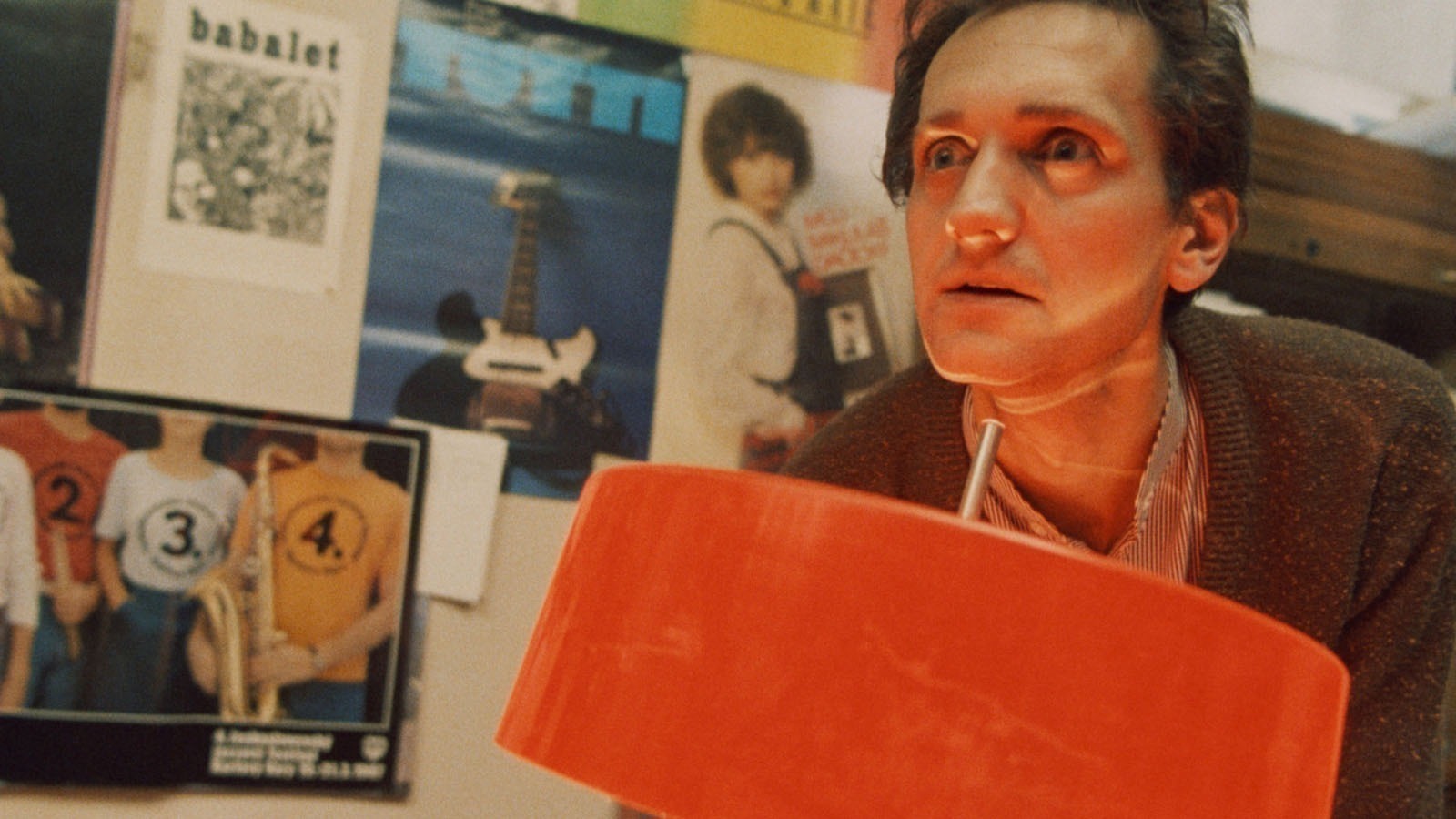
David Vávra in Věra Chytilová’s Tainted Horseplay (1988)
It’s easy to imagine that Věra Chytilová and her editor, Ivana Kačírková, might have cut an inconsequential scene from Tainted Horseplay if it weren’t guaranteed to draw a laugh in 1988. A Czech bureaucrat is dully outlining a vision of the glorious socialist future at an under-attended meeting when a squealing woman races through the drab hall. Never mind why, but she’s cowering under a huge American flag she’s draped over herself. When they dreamed up this visual gag, Chytilová and her cowriter, Pavel Skapík, could not have known that within about a year’s time, the Berlin Wall would fall, the Warsaw Pact would be unraveling, and the Velvet Revolution would eventually lead to the splitting of Czechoslovakia into two sovereign states, the Czech Republic and Slovakia.
The scene plays differently in 2026, but it still sparked a hearty round of laughter in Karlovy Vary on Sunday when the festival hosted the world premiere of a new restoration of Tainted Horseplay, the film that wrapped Chytilová’s “infantile libertine” cycle—after The Apple Game (1976) and The Very Late Afternoon of a Faun (1983)—and was known for a while in the English-speaking world as A Hoof Here, a Hoof There. It is an awfully goofy movie for most of its first half, but it takes a turn, lobbing a few emotionally gutting twists before raising spirits at least halfway again by the end.
Before Sunday’s screening, Karlovy Vary artistic director Karel Och brought out a parade of restoration funders and surviving cast and crew members, and the three leading players immediately stole the show. Nearly forty years on, Tomáš Hanák, Milan Šteindler, and David Vávra—who star as three friends in their thirties who booze it up, womanize, and stage elaborate practical jokes together—still know how to win over a crowd.
The actors’ antics were all in good harmless fun, but that does not necessarily go for what their characters got up to during the era of Communist Party rule. When one of their bosses is tempted to allow himself to be maybe just a little bit seduced by the men’s rowdy rebelliousness, he says something to the effect of being all for thinking differently—as long as we all think differently in the same way.
When all 1,131 seats in the Grand Hall were filled and the lights came down, it was time for one of the festival’s justifiably famous trailers. Since 2008, Ivan Zachariáš has been shooting these black-and-white comedic shorts featuring such stars as Helen Mirren, Harvey Keitel, and John Malkovich or directors like Miloš Forman, all of them recipients of the festival’s unwieldy award, a statuette of a woman holding high a hefty crystal sphere. The joke at the heart of all these trailers is that the awardee has no idea what to do with this thing.
For the Tainted Horseplay screening, the festival naturally chose the trailer shot for its 2008 edition. A frustrated Věra Chytilová tries to piece together the shards of her shattered crystal globe with glue and Scotch tape. Six years later, Chytilová would be gone, but a few years before agreeing to appear in the trailer, she took a long and ruminative look back on her life and career in Jasmina Blaževič’s Journey: A Portrait of Vera Chytilová, an hour-long 2004 documentary available on the Criterion Channel. At one point, Chytilová grumbles that she’s tired of being asked why she doesn’t make another Daisies (1966).
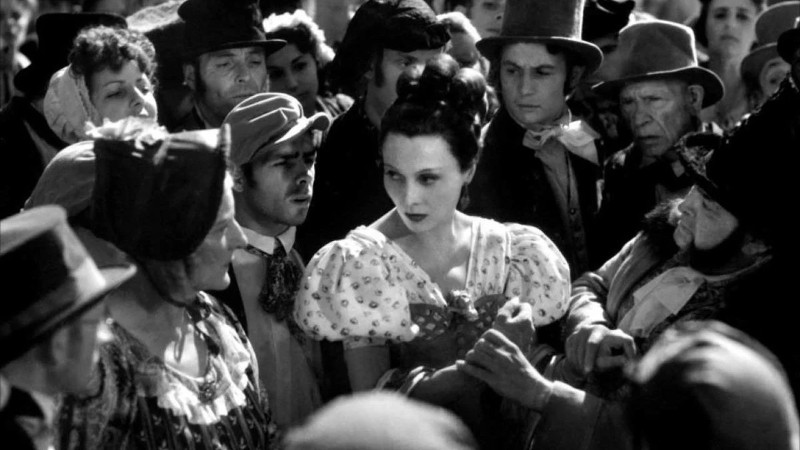
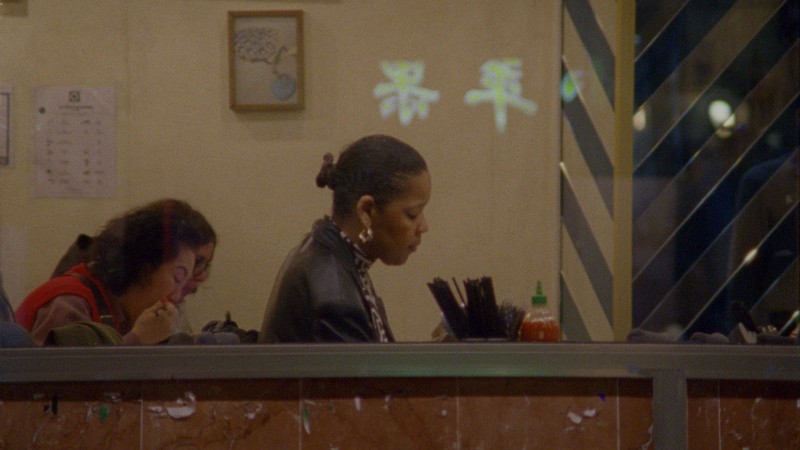
Before that international breakthrough—Carmen Gray calls Daisies “the most formally radical and one of the most politically subversive films of what is now known as the Czechoslovak New Wave”—Chytilová made intricate and incisive studies of outsiders in such shorts as A Bagful of Fleas (1962) and The Restaurant the World, her contribution to the 1966 anthology film Pearls of the Deep, as well as in her first feature, Something Different (1963). Daisies may be formally playful and thematically provocative, but cinematographer Jaroslav Kučera’s camera remains respectful of right angles. The upper and lower borders of the frame are steadily leveled.
Tainted Horseplay is giddy with Dutch angles. One of the costars is Karlovy Vary itself, the spa city where the film was shot, taking in the pastel-hued nineteenth-century architecture that somehow flirts with wedding-cake ornamentation while remaining just this side of majestic. Jaroslav Brabec’s camera is thrilled and woozy with each of the three friends’ moves to conquer nearly every woman they meet only to discover that another friend has already staked his flag.
“I think most of Věra Chytilová’s body of work can be categorized as moral farces,” wrote Boris Nelepo on the occasion of a 2017 retrospective. “The aesthetics of buffoonery is so apt for Chytilová’s works, making the agitated camera spin from character to character as they chase each other for sex, profit, or pleasure, yelling and gesticulating in a Tom-and-Jerry-like frenzy.”
All the party balloons pop when one of them falls ill. It’s the late 1980s, and so, it is decided—in a rather fumbling, almost accidental manner—that the friends’ entire circle is to be tested for AIDS. And that circle is wide. The tests are anonymous, and when just one turns up positive, there’s suddenly a mystery to be solved, and camaraderie gives way to recriminations.
“Not even an alien invasion [in 1987’s Wolf’s Hole] can bring people together in solidarity,” noted Nelepo. “Can we call Chytilová a misanthrope, though? Absolutely not. For many years, she watched the abiding human comedy unfold. She once called Something Different ‘a drama about the eternal struggle for immortality amidst the finality of human powers.’ If we replaced ‘drama’ with ‘comedy,’ this definition would apply to all of her films without exception.”
Don’t miss out on your Daily briefing! Subscribe to the RSS feed.