





11Nov09

Of Time and Shadows

“If American independent cinema could be said to have a birthday, November 11 is as good a date to celebrate as any,” writes Elbert Ventura in a terrific new article in Slate. The occasion is the fortieth anniversary of the release of John Cassavetes’s Shadows, that most unassuming and unpolished of trailblazers, which, writes Ventura, “isn’t just a historical curio or an academic footnote. The surprise is that it still surprises.” Ventura digs into this low-budget, highly inventive classic, describing Cassavetes’s workshop process, detailing the controversy surrounding the film’s cuts and reedits, and making the case that Shadows “not only anticipated Mean Streets, Stranger Than Paradise, She’s Gotta Have It, and Slacker, among countless others—it helped will them into being.” As a bonus, Ventura’s insightful piece is supplemented by three eye-catching clips from the film.

Film_251w_shadows_w160

Shadows

John Cassavetes

1959

81 min

Black and White

1.33:1

0 Comments

11Nov09

Master of Disguise:
Paul Robeson and The Emperor Jones
BY HILTON ALS

297-294

Eugene O’Neill’s groundbreaking The Emperor Jones is making waves again. The controversial 1920 play is back, in a heralded new off-Broadway production starring John Douglas Thompson as Brutus Jones, the Pullman porter turned Caribbean island despot. Its a role Paul Robeson made famous, onstage and evenutally on-screen, and that in turn made him the most popular African-American actor of the first half of the twentieth century, despite his initial misgivings about its racial politics—as explained here in an essay written for the Criterion collector’s set Paul Robeson: Portraits of the Artist by New Yorker theater critic Hilton Als. The revival, which is directed by Ciaran O’Reilly and has been getting rave reviews (Thompson is “wondrous,” writes New York Times theater critic Ben Brantley), is now playing at New York’s Irish Repertory Theater and has been extended through December 6.


When, in 1920, Eugene O’Neill’s expressionistic The Emperor Jones was to be first performed, at the Provincetown Playhouse, the show’s original director, George “Jig” Cook, was determined to find a black actor who could bring the title character of Brutus Jones to life; before that time, major black characters were played by white actors in blackface. So Cook cast the brilliant, erratic Charles Gilpin in the title role. But Gilpin drank, and he also didn’t take easily to O’Neill’s portrayal of black life, specifically his use of the word nigger. For the 1924 revival, then, Cook and O’Neill turned to the titanic Paul Robeson.

As a member of the Harlem Amateur Players, Robeson had heard a great deal about Brutus Jones from the Playhouse’s set designer, Cleo Throckmorton. Moved by Robeson’s performances with the Manhattan-based troupe, Throckmorton was the first to approach him about donning the emperor’s clothes. But the Harlem Amateur Players’ star performer did not like what he heard. “You may know this kind of person, and Mr. O’Neill may know this kind of person, but I don’t,” Robeson said. (There were other “race men” who were less conflicted about O’Neill’s take on race and power. In a piece written for the 1923–24 season of the Provincetown Playhouse, W. E. B. DuBois said that O’Neill was “bursting through” black stereotypes onstage and giving us “Negro blood.”) In the end, however, Robeson, convinced of the play’s worth, accepted the assignment.  

Film_370w_emperorjones_w160

The Emperor Jones

Dudley Murphy

1933

105 min

Black and White

1.33:1

1979

30 min

Color & Black and White

1.33:1

0 Comments

11Nov09

DOWNHILL, ILLUSTRATED

Michael Ritchie’s Downhill Racer, which arrives on Criterion special-edition DVD next week, is remembered today primarily for its winning star performance. Yet as evidenced by this November 1969 piece from the Sports Illustrated archives by author and sports columnist Dan Jenkins, when the film came out, its male lead, some young whippersnapper named Robert Redford, was an unknown entity, an actor “who may be more familiar to moviegoers as the subtly humorous sidekick of Paul Newman in the new western Butch Cassidy and the Sundance Kid.” Geared toward skiers, Jenkins’s piece profiles the soon-to-be megastar but is mostly about his love of the sport (Redford studied Alpine racing in Europe) and his determination to get a movie about it made.

Film_downhillracer_w160

Downhill Racer

Michael Ritchie

1969

101 min

Color

1.78:1

0 Comments

11Nov09

CITIZEN AND FATHER

When one thinks of Orson Welles, one can’t help but imagine a genius alone, monolithic—an image perhaps fostered by his greatest creation, the colossus Citizen Kane. Yet as the new book In My Father’s Shadow: A Daughter Remembers Orson Welles, by his eldest child, Chris Welles Feder, reminds us, he was also a dad and husband. In a lengthy Bright Lights Film Journal review of this “beautifully written, disturbing, and painfully sad memoir,” Joseph McBride describes the author’s revelations about the difficult relationship she had with Welles growing up. The daughter of the first of the filmmaker’s three wives, she writes about Welles’s “chaotic” parenting, long absences, and inability to exist within any domestic parameters, and McBride does a terrific job of summarizing all the trying years the child spent—or didn’t spend—with her father. But McBride proposes a light at the end of this dark tunnel, ultimately calling In My Father’s Shadow “a poignant account of a girl and woman struggling to carve out her own personality and triumphantly succeeding, despite great odds, unlike many children of Hollywood figures who wind up being crushed into oblivion by their parents’ shadows.”

Thirdmanw_w160

The Third Man

Carol Reed

1949

104 min

Black and White

1.33:1

1955

105 min

Black and White

1.33:1

Film_288w_ffake_w160

F for Fake

Orson Welles

1975

87 min

Color

1.66:1

0 Comments

9Nov09

On Wings of Desire BY WIM WENDERS

1238_054

The following essay originally appeared in The Logic of Images, a collection of Wim Wenders’s writing that was published in 1992.

In the last few years, since Paris, Texas, Berlin has been the place where I’ve stopped off. I started to feel at home there, in spite of the fact that I see the city with the eyes of someone who’s spent a lot of time away.

Up until now, the stories in my films were always told from the point of view of a main character. This time, I rejected the idea of some returning hero who rediscovers Berlin and Germany for himself. I couldn’t imagine the character through whose eyes I would see Berlin; such a person could only have been another version of myself. Besides, Travis had been a man returning to a city.

I really don’t know what gave me the idea of angels. One day I wrote “angels” in my notebook, and the next day “the unemployed.” Maybe it was because I was reading Rilke at the time—nothing to do with films—and realizing as I read how much of his writing is inhabited by angels. Reading Rilke every night, perhaps I got used to the idea of angels being around.

After a while, I began to doubt whether it would amount to a film. I tried to push the idea away, but it was never quite extinguished.  

Film_490w_wingsdesire_w160

Wings of Desire

Wim Wenders

1987

127 min

Color & Black and White

1.66:1

0 Comments

5Nov09

Z PRESS NOTES

Critics are rallying around the Criterion special edition DVD of Costa-Gavras’s benchmark political thriller Z. As Film.com’s Amanda Mae Meyncke cries, “This 1970 Academy Award best foreign film winner is a simultaneous declaration against tyranny and call to arms.” The Dallas Morning News’ Chris Vognar exclaims, “Costa-Gavras’s frenetic masterpiece is no less startling today than it was forty years ago . . . After you watch Criterion’s new edition of Z, delivered in one of the distributor’s customary pristine digital transfers, you might be tempted to stay put, return to the menu, and soak it all in a second time.” And DVD Talk’s Jamie S. Rich writes that this is “a remarkable re-creation of a volatile political tragedy” and “an important, influential picture.”

Leonard Lopate interviewed Costa-Gavras on public radio about Z earlier this year. We told you about it at the time, and you can listen to it again here.

Film_491w_z_w160

Z

Costa-Gavras

1969

127 min

Color

1.66:1

0 Comments

4Nov09

ASQUITH BACK FROM UNDERGROUND

Anthony Asquith is remembered primarily as the director of Pygmalion, The Browning Version, and The Importance of Being Earnest, all stage-to-screen adaptations comfortable flaunting their own theatricality. Yet as critic Jay Weissberg writes in the latest issue of Sight and Sound, a new BFI restoration of Asquith’s 1928 silent film Underground proves that the son of a prime minister was not, as his detractors claimed, “an aristocrat without a proper feel for realism” but a maker of vivid, socially engaged cinema. This film, his first solo effort as director, is a populist love triangle; Weissberg writes that it is “about the social interactions that can only exist in the confined, democratic spaces of the London Underground” and is marked by “thrilling location work.” Also in the piece, Weissberg delves into the restoration process that brought Underground (which played on October 23 at the BFI’s London Film Festival) to shimmering new life, and composer Neil Brand, who contributed a new musical score, sings the film’s praises.

P_w160

Pygmalion

Anthony Asquith and Leslie Howard

1938

96 min

Black and White

1.33:1

Film_294w_browningversion_w160

The Browning Version

Anthony Asquith

1951

90 min

Black and White

1.33:1

1952

95 min

Color

1.33:1

0 Comments

3Nov09

Wings of Desire: Watch the Skies BY MICHAEL ATKINSON

1238_087

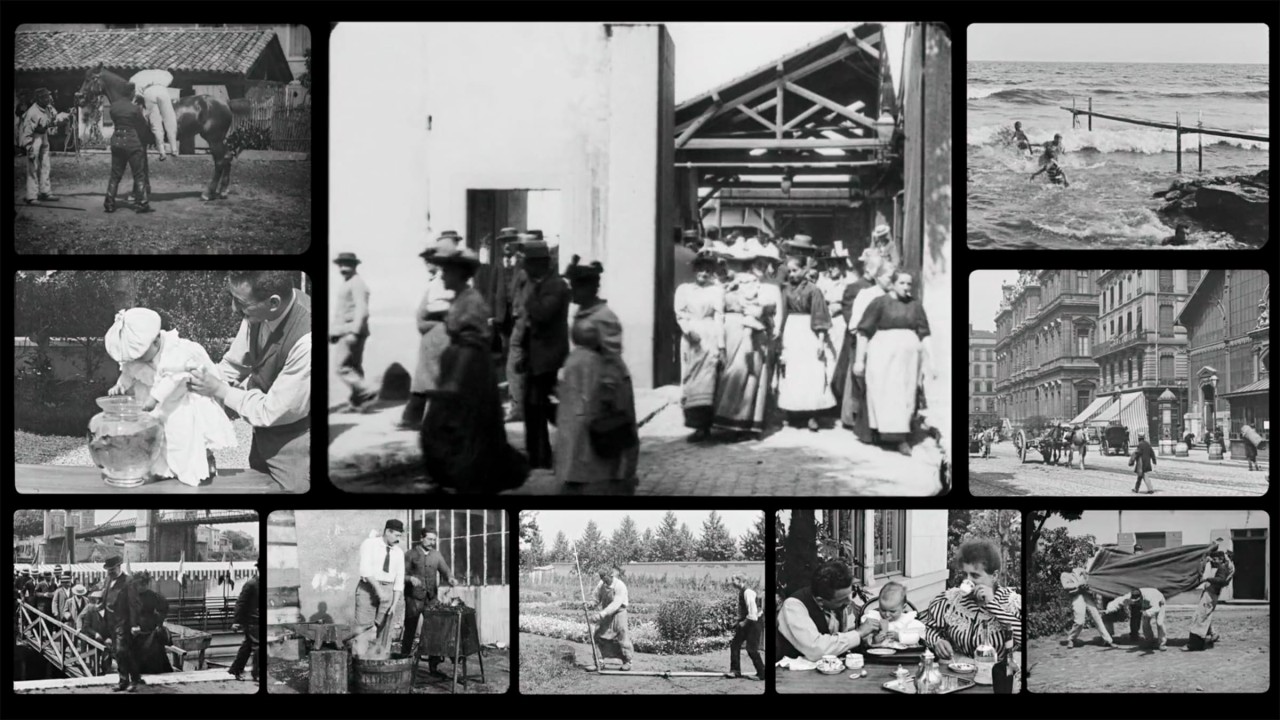
If ever there was a European art film that could be all things to all people, it’s Wim Wenders’s Wings of Desire (1987). Marking Wenders’s career midpoint like a lightning strike cutting across tree rings, the movie is at once audience-seductive and demanding, holistic and aestheticized. It has beguiled the Wenders aficionado as reliably as it’s absorbed the spiritually hungry civilian, the rogue filmhead, the bookish square, and the nondenominational seeker. It seemed upon its release closer to the effervescent fantasias of Michael Powell, Maya Deren, Georges Méliès, and Jean Vigo, as well as Victorian postcards, than to Wenders’s earlier New German Cinema existentialism, or to the troubled legacy of German cinema as a whole. Even after the two-decades-plus of global exploration that has followed for the filmmaker, it appears to be sui generis, born from its own shadowy nitrate soup.

So, let’s think subjectively, you and I, about possible ways to look at the movie, and if none suit you, others are not hard to find. In thumbnail, Wings of Desire belongs to a trafficked subgenre, the angel-on-earth ballade (Victorian, modern-comedic, or otherwise, and usually trifling), but it’s clear we’re a world away from Raoul Walsh’s goofy 1945 Jack Benny comedy The Horn Blows at Midnight (though perhaps closer, in the first half, to the sylphlike angel presences chaperoning the sermonic fables in Lois Weber’s 1915 dream film Hypocrites). There’s little doubt as to the originality of the experience from the very first airborne camera patrols of autumnal cold-war Berlin. In Wenders’s silvery black-and-white view, this is the paradigmatic city wasteland of its age, still war-torn and withstanding a historicized physical and political schizophrenia like no other, symbolized, like the elephant in the parlor, by the wall itself, snaking through the urban spaces covered with graffiti, obliterating your view, wherever you stand, of the city’s other half. This cognitively dissonant urban experiment had frequently been the grim arena for sixties spy noir, but never had we seen Berlin become Berlin so clearly, so eloquently before. (The more sober and evocative German title translates as The Sky over Berlin.) Of course the city is haunted.  

Film_490w_wingsdesire_w160

Wings of Desire

Wim Wenders

1987

127 min

Color & Black and White

1.66:1

2 Comments

3Nov09

’TIS THE SEASON

The term holiday movie doesn’t have to conjure Christmas carols or miracles at Macy’s. Case in point: the personal, even skewed, films chosen by a few filmmakers as their holiday favorites for a seasonal special section in the New York Times; a couple of them hail from the Criterion catalogue. Jan Chapman, the producer of Jane Campion’s The Piano and Holy Smoke, is particularly enamored of Mira Nair’s Monsoon Wedding—not a holiday film per se, but its family gathering and celebration invoke the spirit of the season (“All the tragic and comedic misunderstandings and misadventures of a Shakespearean comedy, with a fresh and knowing eye,” Chapman rejoices). Rebecca Miller, director of the upcoming The Private Lives of Pippa Lee, takes the opposite tack, choosing Ang Lee’s The Ice Storm, perhaps an anti-holiday film, or, as she writes with affection, “the sort of holiday film that makes you never want to go home again.”

Film_426w_icestorm_w160

The Ice Storm

Ang Lee

1997

113 min

Color

1.85:1

Film_489w_monsoonwedding_w160

Monsoon Wedding

Mira Nair

2001

114 min

Color

1.85:1

0 Comments

2Nov09

An Attempted Description
of an Indescribable Film
BY WIM WENDERS

1238_074

The following, written in 1986, is from the first treatment for Wings of Desire.


And we, spectators always, everywhere,

looking at, never out of, everything!
—Rilke, “The Eighth Elegy”


At first it’s not possible to describe anything beyond a wish or a desire.

That’s how it begins, making a film, writing a book, painting a picture, composing a tune, generally creating something.

You have a wish.

You wish that something might exist, and then you work on it until it does. You want to give something to the world, something truer, more beautiful, more painstaking, more serviceable, or simply something other than what already exists. And right at the start, simultaneous with the wish, you imagine what that “something other” might be like, or at least you see something flash by. And then you set off in the direction of the flash, and you hope you don’t lose your orientation, or forget or betray the wish you had at the beginning.

And in the end, you have a picture or pictures of something, you have music, or something that operates in some new way, or a story, or this quite extraordinary combination of all these things: a film. Only with a film—as opposed to paintings, novels, music, or inventions—you have to present an account of your desire; more, you even have to describe in advance the path you want to go with your film. No wonder, then, that so many films lose their first flash, their comet.

The thing I wished for and saw flashing was a film in and about Berlin.

A film that might convey something of the history of the city since 1945. A film that might succeed in capturing what I miss in so many films that are set here, something that seems to be so palpably there when you arrive in Berlin: a feeling in the air and under your feet and in people’s faces that makes life in this city so different from life in other cities.  

Film_490w_wingsdesire_w160

Wings of Desire

Wim Wenders

1987

127 min

Color & Black and White

1.66:1

6 Comments

2009 01 02 03 04 05 06 07 08 09 10 11 12

2008 01 02 03 04 05 06 07 08 09 10 11 12

2007 01 02 03 04 05 06 07 08 09 10 11 12

2006 01 02 03 04 05 06 07 08 09 10 11 12

2005 01 02 03 04 05 06 07 08 09 10 11 12

2004 01 02 03 04 05 06 07 08 09 10 11 12

2003 01 02 03 04 05 06 07 08 09 10 11 12

2002 01 02 03 04 05 06 07 08 09 10 11 12

2001 01 02 03 04 05 06 07 08 09 10 11 12

2000 01 02 03 04 05 06 07 08 09 10 11 12

1999 01 02 03 04 05 06 07 08 09 10 11 12

1998 01 02 03 04 05 06 07 08 09 10 11 12

1997 01 02 03 04 05 06 07 08 09 10 11 12

1996 01 02 03 04 05 06 07 08 09 10 11 12

1995 01 02 03 04 05 06 07 08 09 10 11 12

1994 01 02 03 04 05 06 07 08 09 10 11 12

1993 01 02 03 04 05 06 07 08 09 10 11 12

1992 01 02 03 04 05 06 07 08 09 10 11 12

1991 01 02 03 04 05 06 07 08 09 10 11 12

1990 01 02 03 04 05 06 07 08 09 10 11 12

1989 01 02 03 04 05 06 07 08 09 10 11 12

1988 01 02 03 04 05 06 07 08 09 10 11 12

1987 01 02 03 04 05 06 07 08 09 10 11 12

1986 01 02 03 04 05 06 07 08 09 10 11 12

1985 01 02 03 04 05 06 07 08 09 10 11 12

1984 01 02 03 04 05 06 07 08 09 10 11 12