Louis Malle: Portraits of America
Share
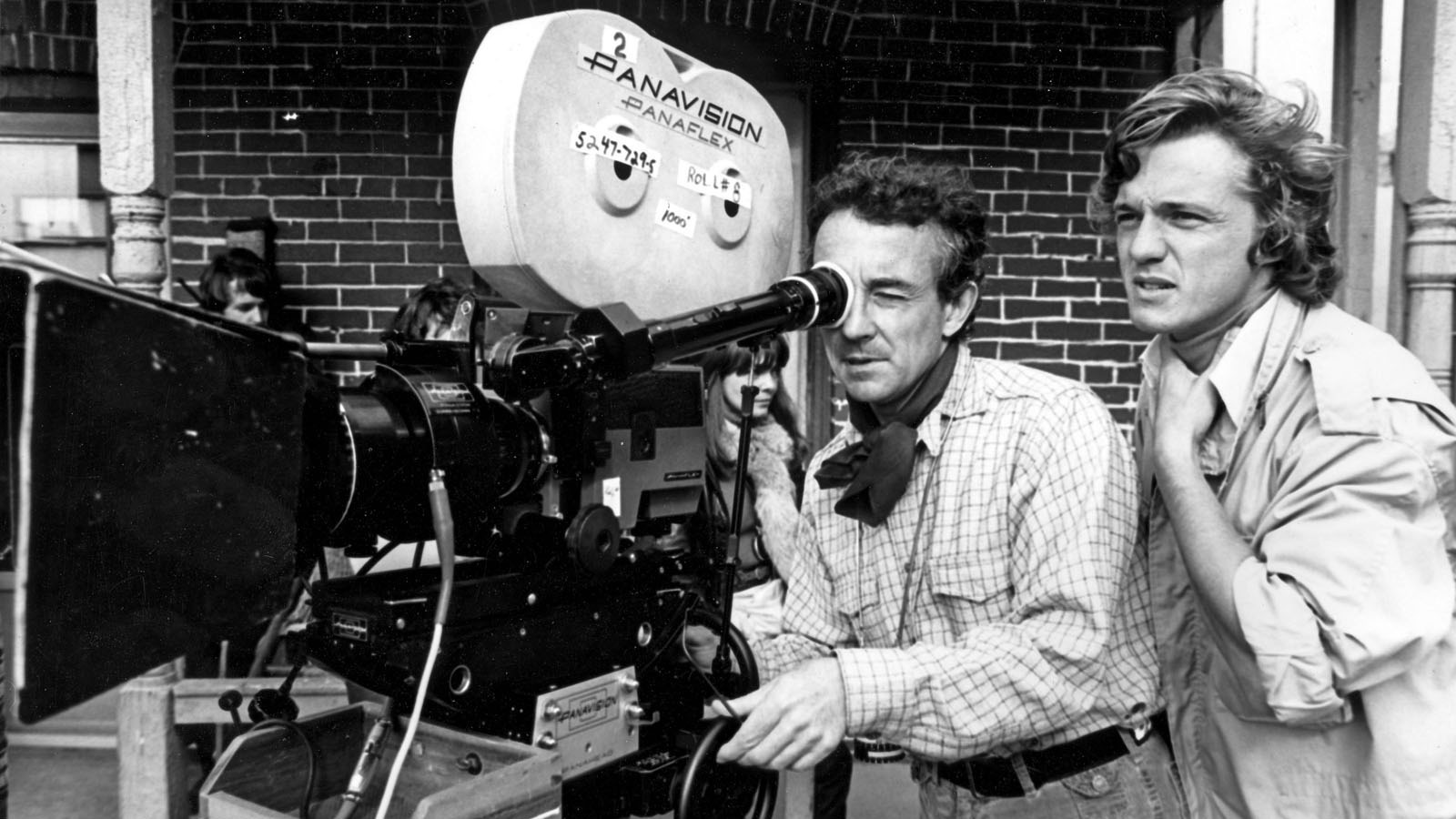
Claire Duguet’s Louis Malle, le Révolté is the ideal curtain-raiser for Louis Malle: Portraits of America, the series opening today at Metrograph in New York. In just over an hour, Duguet takes us on a brisk tour of the life and work of a restless artist. Born into a wealthy family in northern France, Malle ditched his studies to join Jacques Cousteau and his crew as they made The Silent World (1956), an undersea documentary that won both the Palme d’Or in Cannes and an Oscar. Cousteau generously gave Malle codirecting credit.
Malle’s first feature, Elevator to the Gallows (1957), starring Jeanne Moreau and famously featuring an improvised soundtrack by Miles Davis, was a hit with critics and audiences alike. Elevator screens in Berkeley on Saturday and then again on August 28, when it wraps the BAMPFA series French Noir: From the Shadows into the Light.
“Malle spent the four decades of his filmmaking life saying, ‘Been there, done that,’ over and over again, searching constantly for somewhere he hadn’t been and something he hadn’t done,” wrote Terrence Rafferty in 2006. “From the chilly elegance of Elevator to the Gallows, in 1957, he moved quickly to the humid romanticism of The Lovers (1958) and then to the frenetic zaniness of Zazie dans le métro (1960). Next came A Very Private Affair, in 1962, a caustic film à clef about and with Brigitte Bardot, which was followed immediately by the melancholic, Fitzgerald-like The Fire Within (1963).”
Malle welcomed the occasional flop. Rejection offered an opportunity for a reset, and in 1968, Malle left France for India, where he shot two documentaries. He returned to Paris just in time for May ’68; he was the Cannes jury member who announced that that year’s festival was shutting down early, and within a few weeks, he joined François Truffaut and other directors in the founding of the Société des Réalisateurs de Films, which launched the Directors’ Fortnight the following year.
A few years later, it was off to the U.S., where he made the films screening in the Metrograph series, met Candice Bergen, and married her in 1980. “I married America a little bit, too,” he says in one of the expertly selected and placed archival clips in Duguet’s portrait. In 1995, Malle passed away far too young; he was sixty-three.
At Air Mail, writer (The Price of Illusion), actor (Julie & Julia), and former French Vogue editor Joan Juliet Buck writes appreciatively about the documentary and its subject, whom she considered a friend. “In later interviews,” she writes, “he’s loquacious, assured, and candid, his dark eyes sincere, trusting, confessional, delighted, sometimes sheepish, fully engaged with the camera and the person behind it.”
Tonight’s screening will be followed by a Q&A with Duguet and an introduction to Vanya on 42nd Street (1994), Malle’s final film, from one of his daughters, Chloe Malle. Renowned stage director André Gregory and his cast, including Wallace Shawn as Vanya, had been rehearsing David Mamet’s adaptation of Chekhov’s play for four years before Gregory asked Malle to bring in the cameras. “Malle was the ideal director for the project, which strips down Chekhov’s late-nineteenth-century story about Russian intellectuals in the provinces and reimagines it as a text for Stanislavski-trained American actors,” wrote Steven Vineberg in 2012.
On Sunday, Duguet will introduce two documentaries. God’s Country (1985) is an exploration of the farming community of Glencoe, Minnesota, which in 1979 had a population of around five thousand. Malle revisited the town five years later and discovered that Reaganomics was taking its toll. “Malle burrows beneath the fairs and bingo nights to get past the stereotypes of the narrow Midwesterner,” wrote Michael Koresky in 2007, “and, in interviewing a wide array of locals, discovers some hidden cultural vibrancy (there’s even a progressive theater group, staging a play titled Much Ado About Corn) and openness of thought, as well as the lingering pain and divisiveness of Vietnam’s legacy, illustrated both by disillusioned war veterans and parents of former protestors.”
For . . . And the Pursuit of Happiness (1986), Malle interviewed recent immigrants to the U.S., including, as Koresky wrote, “Cambodian refugees arriving at JFK airport unable to speak English, a Pakistani schoolteacher-turned–Elizabeth Arden salesperson, an Ethiopian cabdriver, a Costa Rican NASA astronaut, a Vietnamese family practitioner living and working in Nebraska, an El Salvadoran family seeking political asylum, and West Indian poet Derek Walcott, who would go on to win a Nobel Prize. What he discovered, despite all the tensions in the country over border control and immigration restrictions, was an inspiring optimism and sense of pride at being new Americans.”
Atlantic City (1980), screening on Sunday and June 14, “caught the town on an upswing, thanks to the then-recent legalization of gambling and construction of casinos on the boardwalk,” wrote Sean Burns a few years ago for Crooked Marquee. “None of this new business sits well with Lou Pascal, an old-school numbers runner and relic from the mob’s 1940s heyday, touchingly played by Burt Lancaster in one of his great ‘leopard in winter’ performances.”
Susan Sarandon costars as Sara, “an oyster house waitress from Saskatchewan who dreams of being a blackjack dealer in Monaco,” wrote Burns. “With his usual wry reserve, Malle makes a study of the crumbling old tourist traps against the antiseptic new corporate emporiums, the margins bustling with colorful characters like Michel Piccoli’s blustery cardsharp and the director’s future My Dinner with André star playing a mispronunciation-prone waiter, billed as ‘Wally’ Shawn.”
And speaking of My Dinner with André (1981), this “deceptively simple two-hander,” as Amy Taubin called it in 2015, screens on June 12. Shawn and André Gregory play fictionalized versions of themselves, once-close friends meeting up again after the years André spent wandering the earth seeking enlightenment while Wally stayed planted in New York with both feet on the ground. Malle’s “enthusiasm for the project might have had to do with the challenge of making two men talking over dinner into a compelling cinematic experience,” writes Taubin. “That is to say, it was a perfect fit for a seriously eclectic career. As much as Steven Soderbergh today, Malle seemed determined to try something new with every film.”
Don’t miss out on your Daily briefing! Subscribe to the RSS feed.