Shifting POVs
Share

Thursday morning brought the shocking news that Marjane Satrapi, who told her life story in the graphic novel Persepolis and its animated adaptation, was gone at fifty-six. She “died of sadness a little over a year after the death of Mattias Ripa, her husband and the love of her life,” reads a statement released by those close to her.
Satrapi grew up in Tehran, where she attended French-language schools and wore the sort of clothes and listened to the kinds of music that had her parents worrying that she would run into trouble with Islamist authorities. They sent her to study in Vienna, and in 1994, Satrapi moved to France. She was an outspoken supporter of the Women, Life, Freedom movement in Iran, and after her husband’s death, she set up the Mattias and Marjane Ripa-Satrapi Cinema Foundation to support foreign students studying film in Paris.
Nominated for an Oscar and the winner of a Jury Prize in Cannes and a César for Best First Film, Persepolis is “the chronicle of a young girl’s coming of age in difficult times, a tale that unfolds with such grace, intelligence, and charm that you almost take the wondrous aspects of its execution for granted,” wrote A. O. Scott in the New York Times in 2007. “And Persepolis, austere as it may look, is full of warmth and surprise, alive with humor and a fierce independence of spirit.”
At RogerEbert.com, Matt Zoller Seitz remembers editor Marcia Lucas, who worked with her first husband, George Lucas, on THX 1138 (1971), American Graffiti (1973), and the first Star Wars trilogy and with Martin Scorsese on Alice Doesn’t Live Here Anymore (1974), Taxi Driver (1976), and New York, New York (1977). Marcia Lucas passed away last week at the age of eighty.
“Winning an Oscar for cutting the original Star Wars with Richard Chew and Paul Hirsch is often marked as her career peak,” writes Seitz, “but personally, I’d put Taxi Driver alongside it. It mixes multiple film genres together—vigilante thriller, character study, screwball comedy, film noir, and ’70s style sleaze-pit exploitation, plus a bit of French New Wave–inspired jump-cutting—particularly in the driving sequences and the ‘You talkin’ to me?’ scene, a collage of behavioral bits invented on the set by star Robert De Niro.”
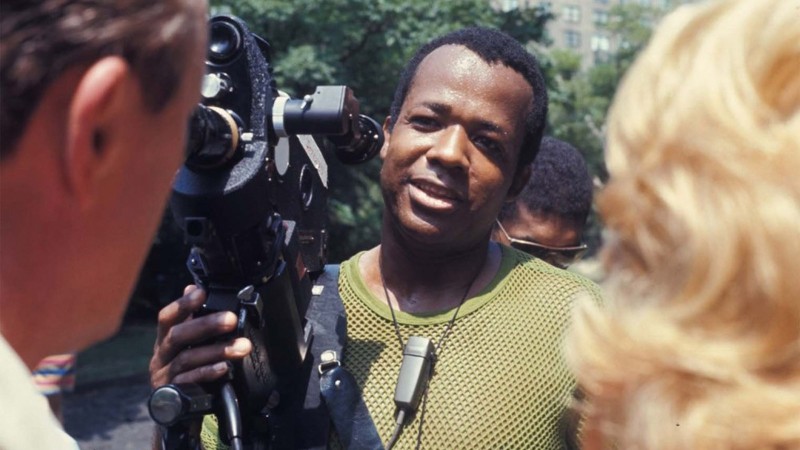
In memory of sociologist and philosopher Edgar Morin, who died last Friday at the age of 104, e-flux has posted an excerpt from his 1956 book The Cinema, or The Imaginary Man. Having coined the term cinéma vérité in his 1957 book The Stars, Morin teamed up with Jean Rouch to make Chronicle of a Summer (1961), “a film whose radical immediacy is still ahead of its time,” as Sam Di Iorio wrote in 2013. In his obituary for the New York Times, Adam Nossiter calls Morin “an autodidact sharpshooter at the edges of academia in France.”
In festival news, Karlovy Vary has unveiled lineups for its Crystal Globe Competition, the Proxima competition for “progressive works of cinema,” and thirteen Special Screenings. The Hollywood Reporter’s Georg Szalai is particularly looking forward to Nader Saeivar’s Hijamat, a family drama coproduced and edited by Jafar Panahi. KVIFF will celebrate its eightieth anniversary with the sixtieth edition running from July 3 through 11.
Two festivals spotlighting Iranian cinema open today, one in Los Angeles, the other in Chicago. And in New York, the Museum of Modern Art is presenting a series of Universal Westerns featuring films by John Ford, Anthony Mann, Allan Dwan, Budd Boetticher, King Vidor, Jacques Tourneur, and Clint Eastwood. There are several screenings of 35 mm prints, and talking to R. Emmet Sweeney, MoMA curator Dave Kehr notes that Universal has been extraordinarily helpful. “They listen to people like us and do the work, which is not what I’m used to,” says Kehr. “We’re doing this in coordination with Narrow Margin magazine, who to me represent a really solid kind of historical criticism that we haven’t seen in a while.”
Before turning to this week’s highlights, let’s note that we must sadly prepare to say goodbye to Slate’s Culture Gabfest. For eighteen years, Stephen Metcalf, Dana Stevens, and Julia Turner’s conversations about music, movies, TV, books, fashion, controversy-sparking essays, and the occasional recipe have enlightened and entertained. With just a few more episodes to go, we’re already dreading the absence of their sane and sober contribution to the discourse.
- On Sunday, Tribeca will present a thirtieth-anniversary screening of Lana and Lilly Wachowski’s Bound, followed by a conversation with Lilly Wachowski, Jennifer Tilly, Gina Gershon, Joe Pantoliano, and Christopher Meloni moderated by Julie Klausner. Bound is “sexy and dangerous, and it has queer characters who are villains you root for,” says King Princess. For IndieWire, Nick Newman talks with Lilly Wachowski, who recalls a pre-release screening in San Francisco. “The Castro was packed with seven hundred queer women, lesbians, and from the very first reel, they were roaring,” she says. “I have never, to this day, seen one of our films get that kind of reaction in front of an audience. So the folks who we made that film for embraced it entirely.”
- A new restoration of Shunji Iwai’s first feature, Love Letter (1995), opens a four-film showcase of his work at New York’s Metrograph this evening, and Iwai will be there through the weekend. “His sensibility—which pairs J-pop music with classical recordings, and delicate compositions with free-flowing camerawork—sees internal emotion heightened in the external world,” writes Alex Lei at Screen Slate. “So palpable are the inner realities of his characters that his films become intimate examinations of contemporary existence,” writes Joshua Minsoo Kim in Metrograph’s Journal. Iwai’s April Story (1998), “about a college student struggling with loneliness, is delicate and wistful, while the feature that followed it, 2001’s All About Lily Chou-Chou, is an oppressively bleak gauntlet of teenage angst,” writes Katie Rife for Letterboxd. “Interestingly, Iwai describes all his films as comedies.”
- “Our cinematographic memories of one great artist’s work reverberate across the landscapes, spaces, actors, and colors that mix in our minds so we can speak of the feeling of ‘Ozu’ as one as multifaceted as the word ‘logos,’” writes Greg Gerke in Liberties Journal. “An astute but unheralded commentator on a film website said of Ozu’s films that his characters demonstrate one truism—the older one gets, the more they sense the coming of nothing and they push away from it. I refer to this because unlike many of those characters I was not pushing away, I let it happen, and in terms of the Faulknerian equation, I took grief rather than nothing. And even if his characters did not take grief all the time, Ozu certainly did.”
- It’s been quite a week at the BFI. Sight and Sound has posted Farran Smith Nehme’s cover story on Marilyn Monroe and Quentin Tarantino’s ode to Joe Carnahan’s The Rip, and the series Revolutionary Cinema: The Passion of Ritwik Ghatak is on though the end of the month. In an introductory primer, curator Sanghita Sen notes that Ghatak has been described as “a passionate and intensely national filmmaker.” While that’s “especially true of Ghatak’s powerful depiction of the Partition of Bengal and its enduring trauma, his films also speak to much larger global realities shaped by colonial and imperial oppression, constant war, genocide, and displacement.”
- For Notebook, Matthew Thrift talks with “prodigious multi-hyphenate” Tsui Hark. “As director,” writes Thrift, “he leaps between comedy (Aces Go Places 3, 1984; The Chinese Feast, 1995) and time-bending romance (Love in the Time of Twilight, 1995), between fantastical melodrama (Green Snake, 1993), dizzying action (The Blade, 1995; Time and Tide, 2000), and whatever Tri-Star (1996) is. As a producer, he quickly became notorious for his meddlesome oversight, while simultaneously scoring smash hit after smash hit.” The conversation touches on action sequences, Leni Riefenstahl, AI, and gender roles. “Every time you go to see a movie, you should be getting a new perspective on who you are,” says Tsui.
Don’t miss out on your Daily briefing! Subscribe to the RSS feed.