

30Jun09

MOON TONES

80_009

With the fortieth anniversary of the first lunar landing nearly upon us (which we’re celebrating at Criterion with new DVD and Blu-ray special editions of the 1989 documentary For All Mankind), the brave men of the Apollo missions are once again making headlines. And as a recent New York Times profile by James C. McKinley Jr. reminds us, few have stood out for their postspace lives like Apollo 12 moon walker Alan L. Bean, who hung up his astro-boots in 1981 (after eighteen years with NASA) to become a full-time painter. The article—written on the occasion of a show of his work in July, during the Smithsonian Air and Space Museum’s anniversary commemoration—looks back at Bean’s artistic aspirations and how they finally coincided with his outer space experiences, and also provides a slide show of his canvasses and images of him at work in his studio. (Our new For All Mankind releases also include a video program about Bean’s artwork, with its own gallery of paintings.)

Also read about another out-of-this-world guy in a short and sweet Q&A with Buzz Aldrin from the New York Times Magazine, in which the second man to walk on the moon chats about the future of NASA and his new memoir, Magnificent Desolation.

Fam_still_scaled_w160

For All Mankind

Al Reinert

1989

79 min

1.33:1

0 Comments

30Jun09

WELCOME (BACK) TO THE JUNGLE

Quick, how many directors can you name who have pulled a 320-ton steamship over a mountain? Yes, that megalomaniacal masterpiece Fitzcarraldo is just further proof that Werner Herzog stands alone in the annals of filmmaking. And though this tireless artist is still regularly creating vital works, that 1982 film’s legendary production continues to fascinate like no other. Now you can learn all about it firsthand with Herzog’s new book, Conquest of the Useless: Reflections from the Making of “Fitzcarraldo,” a diary of his three-year journey in the Amazon to realize his outsize vision. Read more about the book, and Herzog, from the Los Angeles Times’s Lawrence Levi, who writes that Conquest “reveals him to be witty, compassionate, microscopically observant, and—your call—either maniacally determined or admirably persevering.” (And Janet Maslin just posted her review at the New York Times, along with an excerpt from this “mesmerizingly bizarre account.”) And, of course, you can see for yourself the arduousness of the Fitzcarraldo shoot, as documented in Les Blank’s extraordinary Burden of Dreams.

Burdenofdreams_w160

Burden of Dreams

Les Blank

1982

95 min

Color

1.33:1

0 Comments

26Jun09

My Dinner with André:
Long, Strange Trips
BY AMY TAUBIN

702_152 (frame grab)

Seemingly nonchalant, impeccably crafted, borderline delirious, My Dinner with André is the result of an inspired collaboration among its actor-writers, Wallace Shawn and André Gregory, and its director, Louis Malle. In the nearly three decades since its 1981 debut, this tiny independent movie has inspired myriad prose pieces and a slew of witticisms that riff on its title. Nothing, however, captures its eccentricity and perhaps the reason for its effect on viewers as neatly as this line from Vincent Canby’s New York Times review: “At times,” Canby wrote, “My Dinner with André suggests a reunion of Christopher Robin (Mr. Gregory) and Winnie-the-Pooh (Mr. Shawn) thirty years after each has left the nursery to pursue separate careers in the theater.” And, indeed, the film evokes the exalted space of childhood friendship, where confidences are exchanged and imaginations run wild without fear of judgment.

The film is a deceptively simple two-hander. A playwright and actor named Wallace Shawn (played by playwright and actor Wallace Shawn) walks through the dilapidated streets of a not-yet-gentrified SoHo on his way uptown to have dinner with the theater director André Gregory (played by the theater director André Gregory) in a sleekly appointed restaurant of André’s choosing. On his way to this meeting with a man he once regarded as a close friend and his most valued colleague in the theater but whom he hasn’t seen in many years, Wally, as he is known to his friends, muses about how much he dreads seeing André again. He’s heard that the director is in a bad way; having spent the last few years traveling around the world in search of transcendent experiences, he has recently been seen sobbing on the street and talking to trees.  

Film_479_mydinnerandre_w160

My Dinner with André

Louis Malle

1981

110 min

Color

1.66:1

6 Comments

25Jun09

Summer 2009 Cineaste: Bardem, Maysles

Robert Koehler takes a long “second look” at Death of a Cyclist in the summer 2009 issue of Cineaste, sizing up Juan Antonio Bardem’s 1955 political melodrama in terms of Spain’s national identity and the legacy of neorealism. Check it out on the magazine’s website. And while you’re there, also worth a read is David Sterritt’s web-exclusive book review of Joe McElhaney’s Albert Maysles, which examines the idea of Maysles as an auteur.

Film_427w_deathofcyclist_w160

Death of a Cyclist

Juan Antonio Bardem

1955

87 min

Black and White

1.33:1

Gimmeshelterw_w160

Gimme Shelter

David Maysles, Albert Maysles and Charlotte Zwerin

1970

91 min

Color

1.33:1

Salesmanw_w160

Salesman

Albert Maysles, David Maysles and Charlotte Zwerin

1968

91 min

Black and White

1.33:1

Grey_gardens_still_w160

Grey Gardens

Albert Maysles, David Maysles, Ellen Hovde…

1976

94 min

Color

1.33:1

0 Comments

24Jun09

Behind the Scenes of The Seventh Seal

Gallery_39a

Gallery_39b

Gallery_39c

Gallery_39d

1 Comments

24Jun09

The Elegance of Sacha Vierny BY ALAIN RESNAIS

1268_090

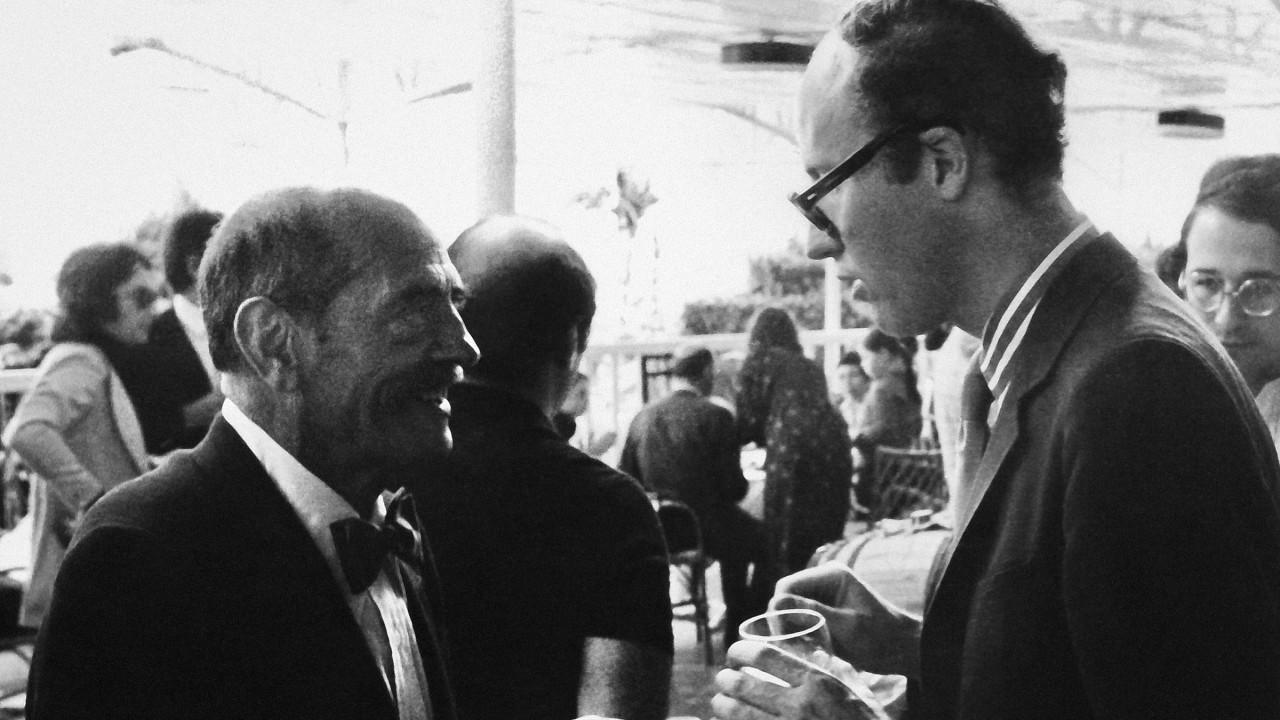
The following tribute to Sacha Vierny by Alain Resnais (pictured together above, Resnais left) was published in the October 2001 issue of Positif. It is based on an interview conducted by François Thomas and was translated for Criterion by Nicholas Elliott. Vierny, one of the most influential European cinematographers of the past fifty years, shot seven of Resnais’ features, including Last Year at Marienbad, Stavisky . . . , and L’amour à mort, and was also a faithful collaborator of Raoul Ruiz’s and Peter Greenaway’s. He died in May 2001.

My earliest memories of Sacha Vierny go back more than half a century, to our first meeting in 1948 or 1949. I can’t remember if we met through a phone call, a chance encounter in a stairwell, or at the counter of a brasserie. I had shot a few 16 mm films in Kodachrome, one of the first monopack color processes, which combined three ultrathin emulsion layers on a single strip of film (this was before Eastmancolor). So Vierny introduced himself with: “We won’t have Kodachrome in professional 35 mm for several months. I’d like to talk with you about the ups and downs of your experience with color film.” He was exaggerating—my knowledge was empirical but limited—and I was truly flattered that someone in the business wanted to talk shop with me. Probably I was a little sorry that I wasn’t a cameraman. Had I been in better health, I would have applied to the cinematography department at the IDHEC [Institut des hautes études cinématographiques, the French state film school] rather than the editing department. But to be a cameraman you had to be able to climb up Mont Ventoux carrying a 35 mm camera and its tripod on your shoulder, with cartridges and batteries in tow. In any case, we hit it off right away. When I made some short films a few years later with the great cinematographer Ghislain Cloquet, Vierny served as his assistant. Then I asked him to shoot Le chant du styrène in color CinemaScope. I even asked him to appear in a scene, as the only human being you really see—face on, shot from the waist up. He was very photogenic.  

Film_478_lastyearmarienbad_w160

Last Year at Marienbad

Alain Resnais

1961

94 min

Black and White

2.35:1

1 Comments

23Jun09

Last Year at Marienbad:
Which Year at Where?
BY MARK POLIZZOTTI

1268 frame grab

So much critical ink has been shed over Last Year at Marienbad that one might wonder if the flood of commentary, once receded, would take the film along with it. Alain Resnais’ second feature has been lavishly praised and royally slammed; awarded the Golden Lion at the 1961 Venice Film Festival and nominated for an Oscar, but also branded an “aimless disaster” by Pauline Kael; lauded by some as a great leap forward in the battle against linear storytelling and a worthy successor to Hoffmann, Proust, and Borges, dismissed by others as hopelessly old-fashioned.

The ambivalence is understandable. Marienbad blatantly toys with our expectations regarding plotline, character development, continuity, conflict, resolution—all those elements we’ve come to expect from a satisfying motion picture. Like its nameless hero, the film relentlessly pursues us with a barrage of assertions while giving us little to hold on to as convincingly true, until in the end, we, like Delphine Seyrig’s equally nameless heroine, have only two choices: remain steadfast in our resistance to the seduction or just plain submit.

The plot is disarmingly simple: At a retreat for the Other Half located somewhere in Europe, a man (referred to in the screenplay as X, and played by Italian heartthrob Giorgio Albertazzi) tries to convince a woman (A, Seyrig’s character) that they had fallen in love the previous summer, “in Karlstadt, Marienbad, or Baden-Salsa. Or even here in this salon.” In his telling, the putative couple had planned to run away together, but she had asked him to wait one year. The woman at first refutes X’s claim but is gradually swayed by his insistence. After several episodes of muted sparring between X and A’s cooler-than-thou husband-guardian, M (Sacha Pitoëff), mainly over hands of the game Nim that M always wins, A finally agrees to leave with X.

So far, it’s still the same old story, a fight for love and bragging rights. The devil, as always, lurks in the details. Indeed, the more evidence X provides as proof of veracity, the more discrepancies emerge, and the more the enigma thickens. As the film progresses, the image on-screen appears almost willfully to clash with X’s voice-over description, sometimes prompting him to shout at it like an exasperated director with an especially temperamental star. Incidents and settings frequently repeat, but their details change disconcertingly between one iteration and the next: A’s remembered bedroom veers from bare to baroque; the hotel gardens sometimes boast a maze of shrubbery, sometimes grand alleys as stiff and straight as the gentlemen’s tuxedos. (Resnais obtained this effect by shooting at three different palaces—none actually located in Marienbad.) Added to the narrator’s stalkerlike pursuit of the reticent heroine, these inconsistencies imbue the film with an atmosphere of uncertainty, instability, and threat.  

Film_478_lastyearmarienbad_w160

Last Year at Marienbad

Alain Resnais

1961

94 min

Black and White

2.35:1

2 Comments

23Jun09

Mulvey on Max

The summer 2009 issue of Film Quarterly (now in its fiftieth year!) is out, and in it renowned professor and film theorist Laura Mulvey presents a close reading of Max Ophuls’s The Earrings of Madame de . . . , looking at the film in terms of repetition—both thematic and with regard to those elements that Ophuls borrowed from his own earlier work—and, unsurprisingly, gender politics: the story’s “opposing iconographies of masculinity,” as played out in its two main male characters, and representation of the “inequalities of gendered power relations.” Needless to say, it’s worth a read, and you can download the article from Film Quarterly here.

1953

100 min

Black and White

1.33:1

1 Comments

19Jun09

STEALING FROM THE BEST

Just this week a man, armed with a handgun, attempted to rob what is almost certainly (based on local accounts and a little detective work on our part) the very same Dedham, Massachusetts, bank that was the setting of the first big heist in 1973’s The Friends of Eddie Coyle. If this is indeed the place, it still stands intact thirty-six years later, though it’s now a branch of Citizens Bank. Talk about life imitating art . . .  Thankfully no one was hurt in the incident, though as in the film, crime didn’t pay.

1973

102 min

Color

1.85:1

0 Comments

19Jun09

Remembering Marienbad BY PETER COWIE

Forty-six years ago, Last Year at Marienbad opened in London. Resnais and Robbe-Grillet came over for the press screening, and I chatted to them in the lobby of the now defunct Cameo-Poly art house on London’s Upper Regent Street. Resnais was already forty years of age, a full decade older than Truffaut or Godard. Infinitely patient and courteous, he answered questions with a distinctive ease and lack of hesitation. Robbe-Grillet, known up to that point only for his experimental novels, such as The Voyeur and Jealousy, was far more mercurial and voluble, gesticulating furiously to emphasize a fact or opinion.

Robbe-Grillet claimed that the cryptic initials of the characters in Marienbad (A, X, M) had no special significance, “just as in Hiroshima mon amour, the lovers have no names.” He admitted that although many of the tracking shots in the film were outlined in his script, Resnais made them at once more complicated and practical. Robbe-Grillet’s opinions were precise and dogmatic—he hated Bergman (“too metaphysical”), loved Orson Welles, and thought Jacques Demy’s Lola the best film of 1961. On the literary side, he admired James Joyce (though Resnais smiled and admitted he had never read him) and Virginia Woolf, and immensely enjoyed the detective fiction of Graham Greene.

Resnais said that he traveled to Germany in search of a suitably baroque hotel for Marienbad. “We were very excited by the châteaux of Schleissheim and Nymphenburg, outside Munich, and as Robbe-Grillet could not accompany us, I sent him various photos of the rooms and gardens, and he chose the settings [he preferred] from those.”

Resnais also waxed enthusiastic about the 2.35:1 widescreen format, which he had used for the first time in a feature with Marienbad. “I like this better than the normal gauge because it’s less cramped and destroys any impression that the film is a documentary,” he explained. He talked of his pet project, The Adventures of Harry Dickson, based on the American dime-novel detective, which in hindsight remains an unrealized dream. Muriel, his ensuing film, would be shot in color: “Both Hiroshima and Marienbad have worked on a mental level,” he observed, “and I think one can only use color when a film is down-to-earth. And Muriel will be in a realistic key, so—in color!”

Robbe-Grillet passed on last year, but Resnais continues to make features (Les herbes folles was just screened at Cannes, to much acclaim) and still arrives for interviews in the same style of quilt coat that he used on that chilly London morning back in 1962.

Film_478_lastyearmarienbad_w160

Last Year at Marienbad

Alain Resnais

1961

94 min

Black and White

2.35:1

1 Comments

2009 01 02 03 04 05 06 07 08 09 10 11 12

2008 01 02 03 04 05 06 07 08 09 10 11 12

2007 01 02 03 04 05 06 07 08 09 10 11 12

2006 01 02 03 04 05 06 07 08 09 10 11 12

2005 01 02 03 04 05 06 07 08 09 10 11 12

2004 01 02 03 04 05 06 07 08 09 10 11 12

2003 01 02 03 04 05 06 07 08 09 10 11 12

2002 01 02 03 04 05 06 07 08 09 10 11 12

2001 01 02 03 04 05 06 07 08 09 10 11 12

2000 01 02 03 04 05 06 07 08 09 10 11 12

1999 01 02 03 04 05 06 07 08 09 10 11 12

1998 01 02 03 04 05 06 07 08 09 10 11 12

1997 01 02 03 04 05 06 07 08 09 10 11 12

1996 01 02 03 04 05 06 07 08 09 10 11 12

1995 01 02 03 04 05 06 07 08 09 10 11 12

1994 01 02 03 04 05 06 07 08 09 10 11 12

1993 01 02 03 04 05 06 07 08 09 10 11 12

1992 01 02 03 04 05 06 07 08 09 10 11 12

1991 01 02 03 04 05 06 07 08 09 10 11 12

1990 01 02 03 04 05 06 07 08 09 10 11 12

1989 01 02 03 04 05 06 07 08 09 10 11 12

1988 01 02 03 04 05 06 07 08 09 10 11 12

1987 01 02 03 04 05 06 07 08 09 10 11 12

1986 01 02 03 04 05 06 07 08 09 10 11 12

1985 01 02 03 04 05 06 07 08 09 10 11 12

1984 01 02 03 04 05 06 07 08 09 10 11 12