


25Apr05

A Generation: Wajda on War BY EWA MAZIERSKA

Andrzej Wajda’s first feature film, A Generation, made in 1954, marks the beginning of the Polish School, the paradigm of Polish cinema that arose from the political and cultural thaw of the mid-1950s. It is also the first chapter in what has come to be known as the director’s “war trilogy,” a series of films—continuing with Kanal and Ashes and Diamonds—tracing the history of Poland during World War Two. These films stand together as sharing not just a historical subject but a historical moment of creation, between 1954 and 1958—a volatile time when the nation was struggling to shed the legacy of Stalinist oppression. They also have in common a visual style and thematic preoccupations unique to this period of Wajda’s work, shot expressionistically in black-and-white and heavy with symbolism rooted in Polish Romanticism.

Wajda would continue to tackle the topic of the Second World War throughout his career, but his interests and approaches changed significantly over the almost half century that spanned A Generation and The Condemnation of Franciszek Klos (2000), his last film on the subject. In his earlier works, he tended to focus on Polish patriotism and heroism, and he was not afraid to display deep empathy for his noble characters. Later, however, his protagonists become more morally ambiguous, and we observe a growing distance between the film author and his characters. Klos, for example, is a Polish policeman who collaborates with the Nazis by betraying Jews and Polish underground fighters simply to earn his living. There is also a political and even geographical shift in the reality represented. Wajda’s early films on the subject of war, most importantly the “trilogy,” concentrated on the most dramatic and crucial events of the years 1939–45—the Ghetto Uprising (A Generation), the Warsaw Uprising (Kanal), the end of the war (Ashes and Diamonds)—taking place principally in Warsaw. By contrast, The Condemnation of Franciszek Klos depicts “ordinary” life in provincial Poland under Nazi rule. The style changes, too, from expressionistic to realistic.  

Film_283w_generation_w160

A Generation

Andrzej Wajda

1955

87 min

Black and White

1.33:1

0 Comments

25Apr05

Kanal BY JOHN SIMON

There was also, let it not be forgotten, a Polish New Wave, even if not so labeled. One of its big billows for our imagination to surf on was Andrzej Wajda’s Kanal, made in 1956 and released in 1957. It was the centerpiece of the so-called war trilogy, though not too much need be made of that. Almost half a century later, the film is still self-sufficient and unique: an antiwar movie in which we see scarcely a single combat death. But the dark radiance of doom haloes one and all. Most films are about the unexpected; Kanal blends it with the inevitable.

It is September 1944, the fifty-sixth day of the fateful Warsaw Uprising against the Nazi occupiers. The citizens of Warsaw had begun their rebellion on August 1, and for sixty-three days this Home Army fought valiantly in deadly street combat, hoping that the Russians, by now on the other bank of the Vistula, would come to their aid. Polish bravery is proverbial, but so too, alas, is Polish foolhardiness, whose master image is the cavalry charge of Polish uhlans against German tanks. The Soviets, however, with their anti-Polish agenda—they would have just as gladly annexed all of Poland—were perfectly happy to let as many Poles as possible perish, and even shot down some Western planes carrying desperately needed supplies for the rebels. Such aid, though urged by Churchill, was further curtailed by Roosevelt upon pressure from Stalin. It is against this background that Wajda’s film unfurls.  

Film_284w_kanal_w160

Kanal

Andrzej Wajda

1957

96 min

Black and White

1.33:1

0 Comments

25Apr05

Orson Welles’s Purloined Letter: F For Fake BY JONATHAN ROSENBAUM

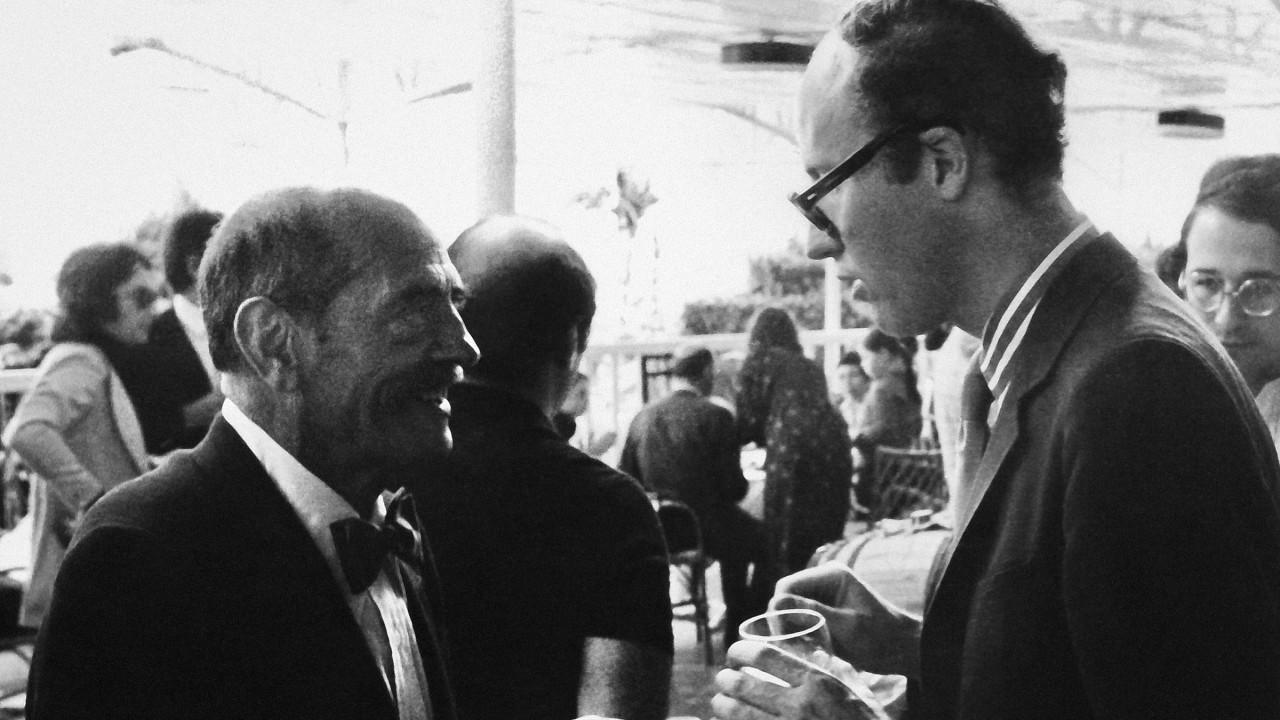
There were plenty of advantages to living in Paris in the early 1970s, especially if one was a movie buff with time on one’s hands. The Parisian film world is relatively small, and simply being on the fringes of it afforded some exciting opportunities, even for a writer like myself who’d barely published. Leaving the Cinémathèque at the Palais de Chaillot one night, I was invited to be an extra in a Robert Bresson film that was being shot a few blocks away. And in early July 1972, while writing for Film Comment about Orson Welles’s first Hollywood project, Heart of Darkness, I learned Welles was in town and sent a letter to him at Antégor, the editing studio where he was working, asking a few simple questions—only to find myself getting a call from one of his assistants two days later: “Mr. Welles was wondering if you could have lunch with him today.”

I met him at La Méditerranée—the same seafood restaurant that would figure prominently in the film he was editing—and when I began by expressing my amazement that he’d invited me, he cordially explained that this was because he didn’t have time to answer my letter. The film he was working on was then called Hoax, and he said it had something to do with the art forger Elmyr de Hory and the recent scandal involving Clifford Irving and Howard Hughes. “A documentary?” “No, not a documentary—a new kind of film,” he replied, though he didn’t elaborate.  

Film_288w_ffake_w160

F for Fake

Orson Welles

1975

87 min

Color

1.66:1

1 Comments

25Apr05

Divorce Italian Style:
The Facts (and Fancies) of Murder
BY STUART KLAWANS

654_014

Trains frame the story and provide its turning point; cars advance the plot. Through these vehicles, Pietro Germi offers locomotive relief in Divorce Italian Style, a comedy about the horrors of inertia.

More precisely, it is a film that wrings laughter from Fefè (Marcello Mastroianni), a man who has nothing to do and nowhere to go. By virtue of being the Baron Cefalù, Fefè is not merely a resident but a structural member of the town of Agramonte, where the only acceptable change from year to year is a fluctuation in the murder rate. Convention keeps him jobless; circumstances make him childless on the brink of middle age; and now mounting debt has confined him to a few rooms of decaying splendor in the old Cefalù palace. He’s as stuck as stuck can be—and since the law forbids divorce, the stickiest of all his predicaments is his marriage to Rosalia (Daniela Rocca).

She is a baked apple of a woman, oozing overripe sweetness, and as oppressive to Fefè as the Sicilian climate. You can easily imagine the mugginess of the air, because Germi puts a table fan in the foreground whenever he shows Fefè in his study. The more the fan turns, the hotter you feel; the hotter you feel, the more you share in Fefè’s exasperation at Rosalia’s clinginess. Germi has her relentlessly switch off the fan when she breaks into the study with hot, sugary coffee for Fefè. With some determination, Fefè can get the fan turned back on—but he can’t stop Rosalia from snuggling in to cadge just a teensy sip from his cup.  

Film_286w_divorceitalianstyle_w160

Divorce Italian Style

Pietro Germi

1961

104 min

Black and White

1.85:1

0 Comments

15Apr05

Ashes and Diamonds BY PAUL COATES

Ashes and Diamonds has rightly been lauded as one of the finest of postwar East-Central European films, and the most vital work of the Polish School. It is salutary, however, to remember how much controversy has dogged the film within Poland itself, and that this is more than a matter of regime-led misgivings about a work with potentially subversive accents. It stems from the film’s pursuit of conflicting goals: to deal with the Polish Home Army’s resistance against the incoming, Soviet-backed Communist regime and yet satisfy both the Polish populace who held that army dear and a Communist party that wielded powers of censorship, even though it had renounced a Stalinist rigor of repression. Criticize the Home Army too strongly and the audience will turn on you; offend the regime, and your film might be amputated or aborted. (Wajda himself reports efforts to remove Maciek’s death scene going right down to the wire of the first screening.)

This tightrope balance had been central to the Jerzy Andrzejewski novel upon which Wajda’s film was based. It is worth reflecting, therefore, on why more Poles took Wajda’s film to heart than had embraced Andrzejewski’s novel. Did visuals offer more leeway for an ambiguity that could fool the censors, as Wajda himself has argued? Was Zbigniew Cybulski’s electrifying performance the key factor? Or was it Wajda’s transformation of Cybulski’s role into the undisputed focal point of the ironic tragedy whose twenty-four-hour period was the hinge connecting the end of one (world) war to the start of a new (civil) one? Perhaps the distinguished novelist Maria Dabrowska was right to say at the time that it told as much of the truth as could be told in the circumstances. Such praise may suggest a work partially tainted at source, and Wajda himself appears to endorse this view in his post-1989 The Ring with a Crowned Eagle (1993), a corrective echo of the earlier endeavor.  

P_w160

Ashes and Diamonds

Andrzej Wajda

1958

103 min

Black and White

1.66:1

0 Comments

2009 01 02 03 04 05 06 07 08 09 10 11 12

2008 01 02 03 04 05 06 07 08 09 10 11 12

2007 01 02 03 04 05 06 07 08 09 10 11 12

2006 01 02 03 04 05 06 07 08 09 10 11 12

2005 01 02 03 04 05 06 07 08 09 10 11 12

2004 01 02 03 04 05 06 07 08 09 10 11 12

2003 01 02 03 04 05 06 07 08 09 10 11 12

2002 01 02 03 04 05 06 07 08 09 10 11 12

2001 01 02 03 04 05 06 07 08 09 10 11 12

2000 01 02 03 04 05 06 07 08 09 10 11 12

1999 01 02 03 04 05 06 07 08 09 10 11 12

1998 01 02 03 04 05 06 07 08 09 10 11 12

1997 01 02 03 04 05 06 07 08 09 10 11 12

1996 01 02 03 04 05 06 07 08 09 10 11 12

1995 01 02 03 04 05 06 07 08 09 10 11 12

1994 01 02 03 04 05 06 07 08 09 10 11 12

1993 01 02 03 04 05 06 07 08 09 10 11 12

1992 01 02 03 04 05 06 07 08 09 10 11 12

1991 01 02 03 04 05 06 07 08 09 10 11 12

1990 01 02 03 04 05 06 07 08 09 10 11 12

1989 01 02 03 04 05 06 07 08 09 10 11 12

1988 01 02 03 04 05 06 07 08 09 10 11 12

1987 01 02 03 04 05 06 07 08 09 10 11 12

1986 01 02 03 04 05 06 07 08 09 10 11 12

1985 01 02 03 04 05 06 07 08 09 10 11 12

1984 01 02 03 04 05 06 07 08 09 10 11 12