




21Feb07
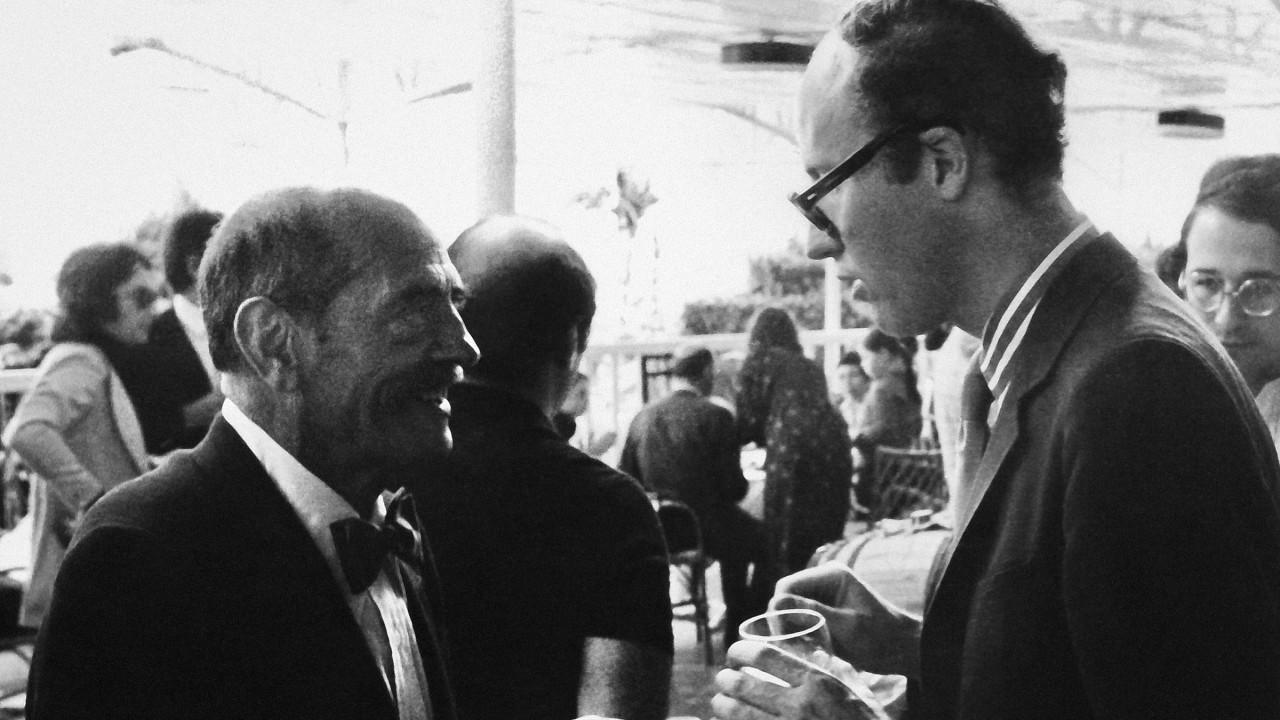
It was bound to happen. After a good start for the blog, a quiet stretch. The year has gotten off to a busy start. Every minute there seems to be a meeting with a new player about a new technology or a new way to use an old technology. We've been to warehouses and sales conferences and film festivals and memorial services. We've been to Paris and Los Angeles and Chicago and Berlin. We've shipped the first release in the Eclipse line and suddenly realize we need to scramble to put together an Eclipse website. We've been running numbers, making plans, negotiating new deals, extending old ones, and in the midst of it all, as always, we've been seeing movies. Last night it was William Klein's Mr. Freedom and Who Are You, Polly Magoo?, which are weirdly contemporary and timeless for films that are so totally a reflection of their era. Before that there was a long slog through stuff that we knew we probably wouldn't do but had to screen anyway. And before that, of course, there was one of the most intense film experiences any of us have ever had—the Berlin Alexanderplatz marathon at the Volksbühne during the Berlinale.
Fumiko, Issa, Johanna, and I had seen the first two and a half hours as part of a huge gala evening at the newly opened Admiralspalast two nights before. The screening was preceded by a live orchestra playing the fabulous 1920s and 1930s song stylings of Max Raabe. Then of course there were speeches. By the time the first two episodes finally let out, it was already 1 a.m., and I have to admit that all I wanted was a beer from the bar. I wasn't looking forward to the Sunday event, a back-to-back screening of all fifteen hours. The first two episodes of Berlin Alexanderplatz get the film off to a solid start, but it's like watching the first twenty minutes of another film—and not a Bond film. It's an awkward place to stop, or, rather, stopping and escaping at that point is enough of a relief that it’s hard to imagine going back into the theater, especially knowing that there’s another twelve and a half hours to come. In the lobby afterward, as we happily stood around drinking and soaking up the vibe of satisfaction that surrounded the achievement of a longstanding dream for Juliane Lorenz of the Rainer Werner Fassbinder Foundation, there was a good deal of conversation about the “right way” to see the film—one episode a week, like a miniseries? Or all in one go? All I can say is that I can't think of a better way to have seen it than the experience we had two days later. Read more 
Categories:
On Five
19Feb07
The posthumous international triumph of Mikio Naruse is one of the most unique corrections in film history. During his lifetime (1905–69), Naruse toiled away at his craft largely unsung, though respected by his peers, making more than eighty pictures. After he died, retrospectives of his work began to tour Europe and America; they excited the enthusiasm of knowledgeable cinephiles and were repeated in periodic cycles; a body of criticism grew around him, and now his films are issued worldwide on DVD. What is it about Naruse’s films that touches this belated responsive chord? They are not flashy, but they ring true, they appeal to our demanding intelligence, our sense of the rigor of daily life; and, seen in bulk, they draw us into an astonishingly consistent, psychologically resonant universe. His work, almost all of which is set in the contemporary era, is about people (very often women) of limited means trying to keep their heads above water, escape domestic quagmires, and realize their dreams in a world rife with betrayals and self-betrayals. As he famously said about his characters: “If they move even a little they quickly hit the wall.” That this rather grim vision should prove delightful in the viewing remains an enigma. Perhaps Naruse’s refusal to employ cheap, feel-good shortcuts (or, for that matter, facile apocalyptic bleakness) comes as such a relief in contrast to the usual box office fare.
When a Woman Ascends the Stairs, made in 1959, is the culmination of a run of masterpieces Naruse reeled off in the 1950s. After Mother (1952), Late Chrysanthemums (1954), Floating Clouds (1955), and Flowing (1956), he was ready to tackle the newly prosperous, go-getter Japan. And though he had been making films starting from the silent era, Naruse had no trouble adjusting his objective style to a cooler, sixties mode. The crisp black-and-white CinemaScope, xylophone-inflected jazz score, and modernist bar interiors give When a Woman Ascends the Stairs a glamorous, International Style sheen; its taste of gin and bitters goes down like a dry martini. A departure of sorts from the usually drab, lower-middle-class, scarcity environments, but the preference for enlightened stoicism over glib redemption is pure Naruse. Read more 
Categories:
Film Essays
19Feb07
From Contraband in 1940 to A Matter of Life and Death in 1946, Michael Powell and Emeric Pressburger applied themselves single-mindedly to making films—eight of them in all—in direct and indirect support of the British war effort and its aftermath. Although they maintained a close and friendly liaison with the Ministry of Information’s Films Division, under its directors Kenneth Clark and then, for most of the war, Jack Beddington, only two films out of the eight had financial backing from the government, the others being funded in the normal commercial way by British National Films or J. Arthur Rank. These two exceptions, 49th Parallel (1941) and The Volunteer (1943), are brought together on this DVD. They could hardly be more different, in scale or in style.
Few of Powell and Pressburger’s admirers would rate 49th Parallel on a par with the great achievements that were to follow, but it is a key film in several ways: it consolidated their partnership, its bold example showed a way forward for British cinema in terms both of ambition and of funding, and it did a skillful job of topical propaganda. Read more 
Categories:
Film Essays
12Feb07
Bicycle Thieves is truly one of my favorite films. I could watch it over and over again, and in truth, I have. It’s a complicated and eloquent story in spite of its simple plot. The first time I saw Bicycle Thieves was in a class on neorealism, and I was immediately struck by how seamless and real it was, as if a camera were fortunate enough to be present in capturing an actual event. Bicycle Thieves gives meaning to the common man. And, as is often the case in life, reality here doesn’t have a happy resolution. It was the same where I grew up: life was basically a continuous struggle. You endure, as William Faulkner points out. The people from the housing projects near where I used to live had a lot in common with those in Bicycle Thieves. In trying to find answers to what I experienced, I read a lot of Depression-era literature and studied the works of the photojournalists who focused on families struggling to make ends meet—slave narratives and books like Richard Wright’s Native Son and James Agee’s Let Us Now Praise Famous Men, which share the sensibility that produced neorealism. To tell a story without imposing your values is very challenging.
There is a group of filmmakers like myself who wanted to counter the distorted narratives and stereotyped images of Hollywood, and on seeing Bicycle Thieves, I was moved by how ordinary people were able to express so much humanity. The story achieved in very simple terms what I was looking to do in film: humanize those watching. Bicycle Thieves has the quality and intention of a documentary. It is totally unromantic. The characters are just ordinary people, and the film gives the impression you are watching life unfold before you. It is entertaining, but that is not the goal. Its goal is to make audiences aware of a particular social condition that needs a political solution. It is clear that it was made as a tool for change. Read more 
Categories:
Film Essays
12Feb07
Green for Danger is an escapist entertainment made just after the close of World War II—a classical whodunit with an impeccably droll Scotland Yard inspector in charge of the proceedings—and it is at the same time a film pervaded by the war just ended, whose wreckage was everywhere evident to the film’s audience. Indeed, the terrors of German air raids provide both the occasion and the motive for the murder around which the plot is built, and the defection of a British citizen to the Nazis plays a small but crucial role in the narrative. (To say more would be to betray too much of a very elegantly constructed screenplay.) The film remains a thoroughly entertaining mixture of suspense and eccentric comedy, but it carries a deeper emotional weight as a remnant of the British wartime experience, all the more effective because it steers clear of anything like overt nationalism or morale boosting in its evocation of the trials just passed. Life must go on, so it becomes something like a patriotic duty to keep up two distinct national traditions: the Agatha Christie–style detective novel and the zany comic mode represented by the incomparable Alastair Sim as Inspector Cockrill.
Christianna Brand’s novel, published in 1944, was an above-average specimen of the classic English murder mystery, managing to adhere faithfully to the genre’s gamelike rules while incorporating a higher-than-usual quotient of realistic detail. Brand creates a hothouse atmosphere as she tracks the interactions of a contingent of doctors and volunteer nurses at a provincial hospital, and manages with skill—and with a good deal of forensic bluntness—a plot in which swirling sexual frustrations and resentments find expression not in bed but on the operating table, in a series of apparently motiveless murders. Like most such novels, Brand’s book thrives on false leads and complications within complications, often hinging on the minutest (and least filmable) of clues; in reducing it to a ninety-minute movie, Sidney Gilliat provides an object lesson in the elimination of technical detail, backstory, subplots, and unnecessary characters, leaving him with a quite austere emotional drama that does not sacrifice any of the book’s certified moments of high drama. Read more 
Categories:
Film Essays
12Feb07
Called by some the Great Forerunner and others the Tallest Tree in Our Forest, Paul Robeson is without peer in the annals of modern American civilization. His was a life rich with intellectual and emotional complexity and poignancy, unfolding during the United States’ most eventful times, a long and troubled era to which he contributed his talent and his willingness to challenge the prevailing conventions of racism, imperialism, and social injustice.
His trailblazing career in film, during the 1920s and 1930s, was only one of the many facets of his extraordinary life, but it was pivotal to the emergence of a black film aesthetic and, by extension, an African-American cultural identity. Indeed, it is virtually impossible to understand the intersection of racism, colonialist influences on popular culture, and black artistic concerns without considering what Paul Robeson accomplished as a singer, stage and film star, and activist and, alas, what he left undone because of the tenor of his times.
Over the course of Robeson’s life, 1898 to 1976, the far-reaching legacies of both African enslavement and racial mythology in modern America were acknowledged on an unprecedented level and met with increasingly determined resistance by two generations of African-Americans. Robeson was at the forefront of that resistance. He was also among those who paid dearly for their own beliefs at a time when civil rights advocacy, labor activism, and kinship with the Soviet Union were hardly popular causes. Read more 
Categories:
Film Essays
12Feb07
Viewed in retrospect, much of modern cinema can seem to flow from twin fountainheads: Orson Welles’s Citizen Kane (1941) and Vittorio De Sica’s Bicycle Thieves (1948). Though separated by World War II, the two movies symbolize the cardinal impulses that came to captivate serious audiences, critics, and filmmakers after the war. The tendencies they signaled—ones soon fused into a singular aesthetic by the French new wave—are not so much divergent as complementary.
Where Citizen Kane heralded the age of the auteur and a cinema of passionate individual vision, Bicycle Thieves renounced “egoism” for collective concern, envisioning a cinema of impassioned social conscience. Both films reflect their directors’ personal formal gifts, and their distinct approaches to “the real” transmute the very different production circumstances under which they were created. While Welles’s use of deep-focus and other innovations brought a hyperrealist sophistication to the elaborate fantasy mechanics of the Hollywood studio film, De Sica’s uncommon skills as a visual stylist and director of actors imbued the purist tropes of Italian neorealism—social themes, the use of real locations and nonprofessional performers—with a degree of poetic eloquence and seductive dramatic power seldom equaled in his era. Read more 
Categories:
Film Essays
Recent Comments
“HOUSE: DONT WALK...RUN! HOUSE: Jeepers, its a Creeper HOUSE: The Red or Blue pill? Make your choice... The Magician: IngMirage Bergmans Trickery The Magician: Seriously its a Bergman film...need . . .”
—Brian Lasley on Criterion Caption Contest, about 4 hours ago
“Paths of Glory: the one where Kirk Douglas got shot in the chin”
—A.P. Saget on Criterion Caption Contest, about 5 hours ago
“Paths of Glory: MASTERS OF WAR Paths of Glory: BY YOUR COMMAND The Darjeeling Limited: TEA AND SYMPATHY”
—Emily on Criterion Caption Contest, about 6 hours ago
“The Darjeeling Limited: Mystery Train Has that been taken, yet?”
—A.P. Saget on Criterion Caption Contest, about 6 hours ago
“The Magician: "Are You Watching Closely?" / "I'll Need a Volunteer..." Paths of Glory: "Inglourious Bastard" / "How I Learned to Start Worrying" House: "Home Sweet Home" / "Enter at Your Own Risk . . .”
—Donald.Barthelme on Criterion Caption Contest, about 6 hours ago