





21Feb06
Kind Hearts and Coronets (1949) is an Ealing comedy in name only. True, it’s undeniably a comedy and was made by (though largely not at) Ealing. But in virtually every other respect, it deviates startlingly from the commonly accepted stereotype. Ealing comedies, it’s widely agreed, are cozy, even complacent; Kind Hearts and Coronets is callous and amoral. The humor of Ealing comedy is essentially good-natured and folksy; Kind Hearts and Coronets is cool, ironic, and witty. Sex in Ealing comedies is mostly avoided or, if inevitable, treated with embarrassed jocularity; several scenes in Kind Hearts and Coronets carry a potent erotic charge. In Ealing comedies, the criminals—even the lovable ones, like Alec Guinness in The Lavender Hill Mob (1951)—eventually pay for their crimes; the hero of Kind Hearts and Coronets is a calculating serial killer who, in the final reel, stands a good chance of getting away scot-free.
None of which is so surprising, given that Kind Hearts and Coronets was created by the maverick Robert Hamer, of all Ealing directors the one who found it hardest to conform to the studio’s upbeat, wholesome ethos. And unlike Alexander Mackendrick, Ealing’s other great maverick director, Hamer never had the patience—or the cunning—to slip his subversive notions into his work under the guise of innocuous comedy. Hamer openly fought for his ideas and, in the cautious atmosphere of post–World War II British cinema, usually lost.
13Feb06
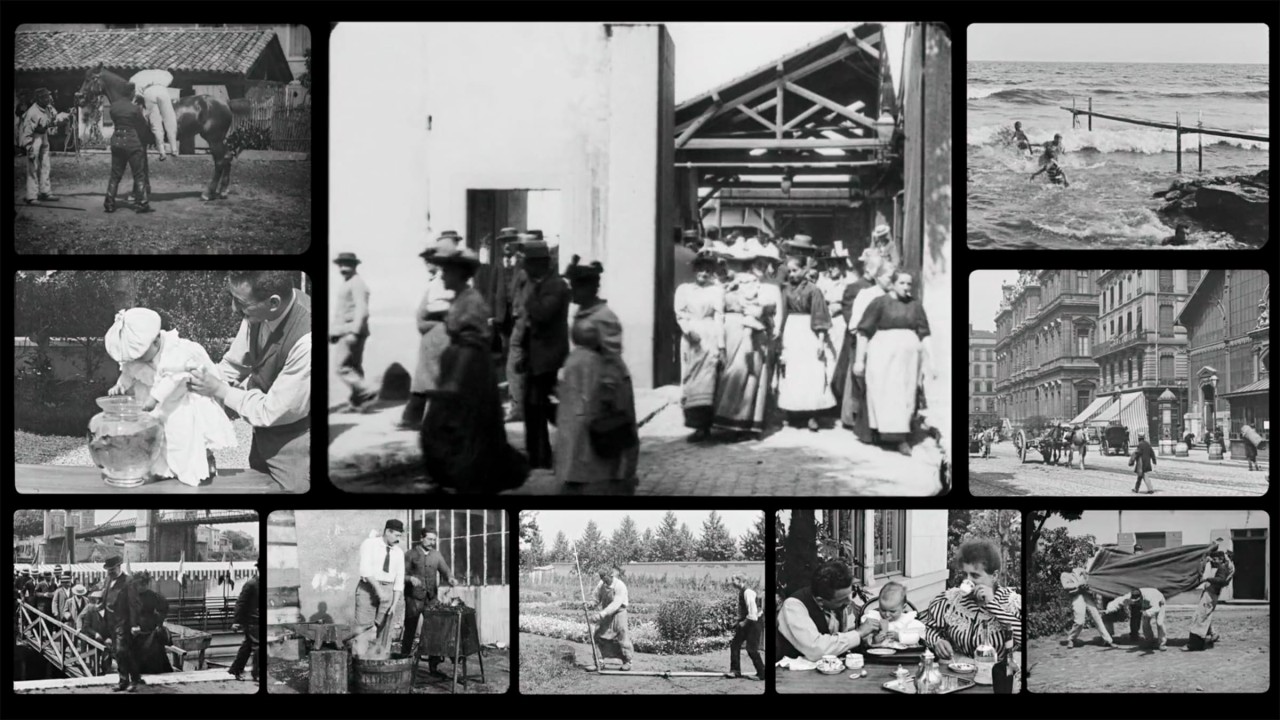
The opening minutes of La bête humaine (1938) are a bracing plunge into the materiality of the world. The flames of a locomotive’s furnace, the engineer and stoker utterly absorbed in their work, the landscape speeding by, as seen from the moving train: we have the sensation not of observing reality but of being caught up in it, a sensation that is prolonged as we experience, as if for the first time, the shock of suddenly emerging from a tunnel, a moment before pulling into the geometric splendors of an immense rail yard. Forty years after the invention of movies, Jean Renoir managed to re-create the astonishment that greeted the 1898 Lumière movie of a train arriving in a station. La bête humaine is often described as an exemplar of the pessimistic poetic realism of the thirties in France, and as a precursor of forties film noir, but it begins on a note of heroic exhilaration, in which the natural world and the power of technology are wedded through the closely coordinated labor—effected through glances and sign language—of two men.
The speed of the train establishes the relentless rhythm that characterizes the whole film. Renoir has taken a convoluted and sometimes ponderous Émile Zola novel and reduced it to a series of quick sketches. The cadence is of work and of the all-too-brief moments stolen from work. It is a film of restless transitions, where everybody seems to be forever turning a door handle or walking downstairs or leaning forward to look out the window; one remembers Séverine (Simone Simon) being welcomed into the study of her lecherous godfather, while the door is discreetly closed behind her, or a desperate Jacques Lantier (Jean Gabin) slipping out of the dance hall unnoticed by the dancers, lost in their enjoyment. Murders and seductions occur offscreen; we see the moments before and after. The long passages of emotional description in the Zola are translated into brief exchanges of glances, or the absence of such exchanges: the bruising aftermath of a wife’s accidental confession is rendered in the way Séverine and Roubaud (Fernand Ledoux) can’t stand to look each other in the eyes.
13Feb06
As a movie about debutantes and their dates, Whit Stillman’s Metropolitan came into the world, in 1990, looking lonely—and now, well, it looks lonelier yet. At the time, the idea of putting the American upper class on film—The Philadelphia Story aside—seemed like a sure way to keep theaters pleasantly uncrowded. Before the movie came out, it was hard to imagine anyone but its subjects wanting to see such a thing, and as for its subjects—did they really exist? America fancied itself a classless society, and old money assisted the illusion by concealing itself and shunning anecdote. Nowadays, you might wonder whether there is anyone left on Park Avenue whose fortune antedates the second Reagan administration. New money is so loud and so insistent that old money has either slipped discreetly away to ancestral hideouts or has, as it were, gone native. Metropolitan, which looked like a perverse bit of daring in 1990, today seems like an artifact from an earlier century.
But it’s a lot more than a curiosity. Metropolitan, Stillman’s first movie, is as unexpectedly irresistible as ever: funny, moving, and entertaining, with a wonderful cast of unknowns (who have remained unknown) and quite a number of ideas, served up seamlessly and unassumingly. The story takes place in New York, during Christmas vacation, a hectic time filled with gala soirees. In the center of the composition is a group of friends who call themselves the Sally Fowler Rat Pack, after the one of their number who hosts the postdance skull sessions that supply the setting for much of the picture. As the movie begins, the seven members annex an eighth, a lone wolf named Tom Townsend, to even the gender balance in the face of “a severe escort shortage.” Tom acts as both the story’s catalyst and the audience’s knothole viewpoint.
13Feb06
In Young Mr. Lincoln, John Ford achieves the perfection of his art. Never were his matter and his method more aptly fitted, and never were his tendencies toward sprawl and overemphasis more rigorously controlled. It is a masterpiece of concision in which every element in every shot, every ratio, every movement, every shift of viewpoint seems dense with significance, yet it breathes an air of casual improvisation. While its surfaces paint, with relaxed humor and effortless nostalgic charm, an imaginary antebellum America, it sustains an underlying note of somber apprehension, all the more powerful for being held in check.
Ford finds a mood that avoids the clutter and ponderousness of most Hollywood history movies, a mood more of parable than of textbook chronicle. That preoccupation with history and its contradictions—the variance between actual human experience and the official version that will be constructed after the fact—that suffuses films as different as They Were Expendable (1945), Fort Apache (1948), and The Man Who Shot Liberty Valance (1962) resonates troublingly at the heart of this film, for all its apparent serenity. Nothing here is as uncomplicated as it seems designed to appear, which may be why the editors of Cahiers du cinéma, in a celebrated, if by now scarcely readable, special issue of 1970, brought the full force of their post-’68 Althusserian-Lacanian rhetoric to bear on the film in a scene-by-scene analysis, as if here the secret mechanisms of the American ideology itself might be decoded and exposed. In trying to pin down the meanings of Ford’s art, however, Cahiers du cinéma missed his mercurial—and, admittedly, sometimes infuriating––ability to be in two places at once. If Ford’s Lincoln exhibits at once a radiant sincerity and the devious subtlety of a trickster, he is to that extent the director’s mirror image.
Bertrand Tavernier described Young Mr. Lincoln as “worthy of Plutarch,” and there is indeed something ancient in the bareness with which Ford and his screenwriter, Lamar Trotti, lay out their episodes, allowing each scene its independent life and leaving much unspoken. As history, it is on many points not much more accurate than Plutarch; like the Greek historian, Ford relies freely on anecdote, rumor, and imaginative reconstruction to fill out his portrait. But, in a way, that is the point: he carves out a space beneath or before history in which past events, not yet ossified into the stuff of monuments, retain the lithe flexibility of what is not yet formed. The myth of the Great Man is subverted by presenting a hero who has not yet become himself, who is all the more admirable for still being in a state of pure potentiality. The film radiates a youthful joy, while at the same time insistently implying that the hero’s destiny—the moment when the weight of history becomes unavoidable—will necessarily mean the loss of all joy.