





14Feb05

Tout va bien Revisited BY J. HOBERMAN

The first, fantastically inventive stage of Jean-Luc Godard’s career ended with the flaming apocalypse of Weekend (1967) and the events of May ’68, in which he participated both as a demonstrator and (anonymous) filmmaker. Over the next five years, he would strive to reinvent movies again, both on his own and with erstwhile student activist Jean-Pierre Gorin, as the Dziga Vertov Group. His mantra: “The problem is not to make political films but to make films politically.”

A revolutionary maker of documentaries, Vertov was invoked in opposition to both commercial Hollywood cinema and the Soviet fictions identified with Sergei Eisenstein. The Dziga Vertov Group films—A Movie Like All the Others (1968); British Sounds and Pravda (1969); Wind from the East, Struggle in Italy, the unfinished Until Victory (1970); Vladimir and Rosa (1971)—were made on 16mm or for television (or both). These films were openly tendentious in their more or less Maoist analysis of the political situation in various countries, including the United Kingdom, Czechoslovakia, Jordan, Italy, and the United States. Save for small groups of committed militants or abstruse theoreticians, however, most audiences found the combination of recondite ideological hectoring and austere formal rigor all but unwatchable. In early 1971, making an attempt to appeal to a wider audience, Godard and Gorin returned to a more populist—and less sectarian—political mode. “We were in a kind of ghetto, and we really wanted to go outside,” Gorin explained a few years later. “That was both a matter of strategy and economy.”

Tout va bien’s announced purpose was to “consider the class struggle in France four years on from 1968.” And as the culmination of Godard’s political period, the movie is highly reflexive. Indeed, Tout va bien’s autocritique begins almost before the movie itself. “If you use stars, people will give you money,” an off-screen voice opines amid a flurry of filmed check-signing. True: Thanks to the participation of Jane Fonda, who plays an American radio journalist in France, and Yves Montand, as her filmmaker husband, Tout va bien was financed by Gaumont. (For a time, Paramount was interested as well.) To drive home the point, Fonda and Montand are introduced quoting lines from Godard’s previous star-driven commercial feature, Contempt—a parody for which Gorin later took credit.  

Film_275w_toutvabien_w160

Tout va bien

Jean-Luc Godard and Jean-Pierre Gorin

1972

96 min

Color

1.66:1

0 Comments

31Jan05

Thieves’ Highway: Dangerous Fruit BY MICHAEL SRAGOW

Like the movie’s rattletrap trucks lurching down the highway as they carry way-too-heavy loads, the characters in Jules Dassin’s brilliantly volatile Thieves’ Highway struggle under psychological and moral baggage until they can lay their burdens down. Working from a novel and script by A.I. Bezzerides, Dassin made this swift, fluid melodrama in 1949, after Brute Force and The Naked City. Thieves’ Highway is his best American movie. It breathes the same air of risk and desperation as his made-in-Europe masterpieces, London’s Night and the City (1950) and the Paris-set Rififi (1954). But it has a rich sensuality all its own.

The film’s hero, Nick Garcos (Richard Conte), is a World War II veteran just back from a moneymaking stint as a ship’s mechanic on a Far East voyage. Apparently, he has sailed around the world without ever getting worldly. He aims to marry his Fresno sweetheart, Polly (Barbara Lawrence), and go into business with her father. When he arrives at his childhood home he wants nothing more than to shower his loved ones with gifts: Javanese earrings for his mother (Tamara Shayne), a geisha doll with an engagement band on its ring finger for Polly. Only when he gives his father (Morris Carnovsky) a pair of Mandarin slippers does reality intrude.  

Film_273w_thieveshighway_w160

Thieves’ Highway

Jules Dassin

1949

94 min

Black and White

1.33:1

0 Comments

31Jan05

Night and the City: In the Labyrinth BY PAUL ARTHUR

Within film noir’s unparalleled roster of resonant titles—Kiss of Death, Out of the Past, Where Danger Lives, to name three—none is more emblematic or iconographically cogent than Night and the City. Juxtaposing two of noir’s essential, virtually ontological qualities, the title of Jules Dassin’s underrated elegy for a self-annihilating hustler reminds us not only that darkness is the visual corollary of almost all consequent action in noir—the idea of a “daylight” noir being as perverse as a “nocturnal” Western—but that nighttime functions throughout the series as a sort of Platonic entity, embracing a host of nonliteral meanings. Along with common associations of mystery and moral ambiguity, darkness takes on a specifically urban coloration. Indeed, film noir caps a long-standing cultural tradition in which cities are cast as a dominion of shadows and corruption. And perhaps no noir city is quite so hellish, so imbued with the stench of mortality, as the London depicted in Night and the City.

In a celebrated 1948 essay, “The Gangster as Tragic Hero,” Robert Warshow declared that “for the gangster there is only the city,” adding that the metropolis in films such as Scarface and Little Caesar is “not the real city, but that dangerous and sad city of the imagination...which is the modern world.” Ironically, at the moment Warshow was dissecting the backdrops of landmark thirties crime dramas, film noir was unleashing the menacing face and symbolic disorder of “real” American cities, filmed on location in the aftermath of World War II, yet bearing the metaphoric imprint of urban decimation, past and future. Working in and around London’s Soho district, rather than the familiar haunts of New York or Los Angeles, Dassin and company did not have to subtly evoke lingering effects of wartime bombing; they are clearly inscribed in blasted, nightmarish landscapes recruited for the film’s climactic scenes. Contra Warshow, only in film noir is the underbelly of the “modern world”—postwar, pre-apocalyptic, and bereft of hope—truly on display. Like The Third Man, made in Vienna the previous year, Night and the City maps the downward journey of an unabashedly American adventurer against a prime locus of European destruction, yielding the specter of the “secret” city to which all film noir, regardless of actual setting, pays unspoken tribute.  

Film_274w_nightcity_w160

Night and the City

Jules Dassin

1950

101 min

Black and White

1.33:1

0 Comments

31Jan05

La commare secca BY DAVID THOMPSON

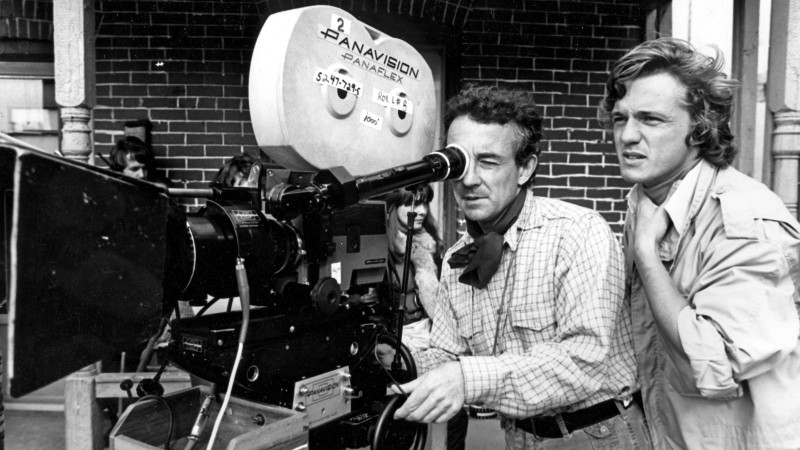
How many filmmakers not only get to assist one of the great poets of cinema in his debut as director but also make their own first feature by the age of twenty-one? To be sure, Bernardo Bertolucci had grown up with certain advantages, including close relationships with the likes of Pier Paolo Pasolini, but the enormously talented young director quickly took off on his own. Within ten years of unveiling La commare secca at the Venice Film Festival in 1962 (not with any critical success, it must be noted), he had also made the audacious Before the Revolution and the visually seductive The Conformist and was shooting the film that would make him virtually a household name, Last Tango in Paris.

Born in Parma in 1941, he was the elder son of Attilio Bertolucci, a major Italian poet. When the family moved to Rome, Bertolucci’s father befriended Pasolini, already an established poet and novelist, who was beginning to make inroads into filmmaking through writing screenplays. He was also an outspoken Marxist and openly homosexual, with well-known close connections to the Roman underworld and a fascination for the moral cynicism and sensual freedom of the “ragazzi di vita,” the “boys from life,” who came from the streets.  

Film_272w_commaresecca_w160

La commare secca

Bernardo Bertolucci

1962

93 min

Black and White

1.66:1

0 Comments

2009 01 02 03 04 05 06 07 08 09 10 11 12

2008 01 02 03 04 05 06 07 08 09 10 11 12

2007 01 02 03 04 05 06 07 08 09 10 11 12

2006 01 02 03 04 05 06 07 08 09 10 11 12

2005 01 02 03 04 05 06 07 08 09 10 11 12

2004 01 02 03 04 05 06 07 08 09 10 11 12

2003 01 02 03 04 05 06 07 08 09 10 11 12

2002 01 02 03 04 05 06 07 08 09 10 11 12

2001 01 02 03 04 05 06 07 08 09 10 11 12

2000 01 02 03 04 05 06 07 08 09 10 11 12

1999 01 02 03 04 05 06 07 08 09 10 11 12

1998 01 02 03 04 05 06 07 08 09 10 11 12

1997 01 02 03 04 05 06 07 08 09 10 11 12

1996 01 02 03 04 05 06 07 08 09 10 11 12

1995 01 02 03 04 05 06 07 08 09 10 11 12

1994 01 02 03 04 05 06 07 08 09 10 11 12

1993 01 02 03 04 05 06 07 08 09 10 11 12

1992 01 02 03 04 05 06 07 08 09 10 11 12

1991 01 02 03 04 05 06 07 08 09 10 11 12

1990 01 02 03 04 05 06 07 08 09 10 11 12

1989 01 02 03 04 05 06 07 08 09 10 11 12

1988 01 02 03 04 05 06 07 08 09 10 11 12

1987 01 02 03 04 05 06 07 08 09 10 11 12

1986 01 02 03 04 05 06 07 08 09 10 11 12

1985 01 02 03 04 05 06 07 08 09 10 11 12

1984 01 02 03 04 05 06 07 08 09 10 11 12