November Books
Share
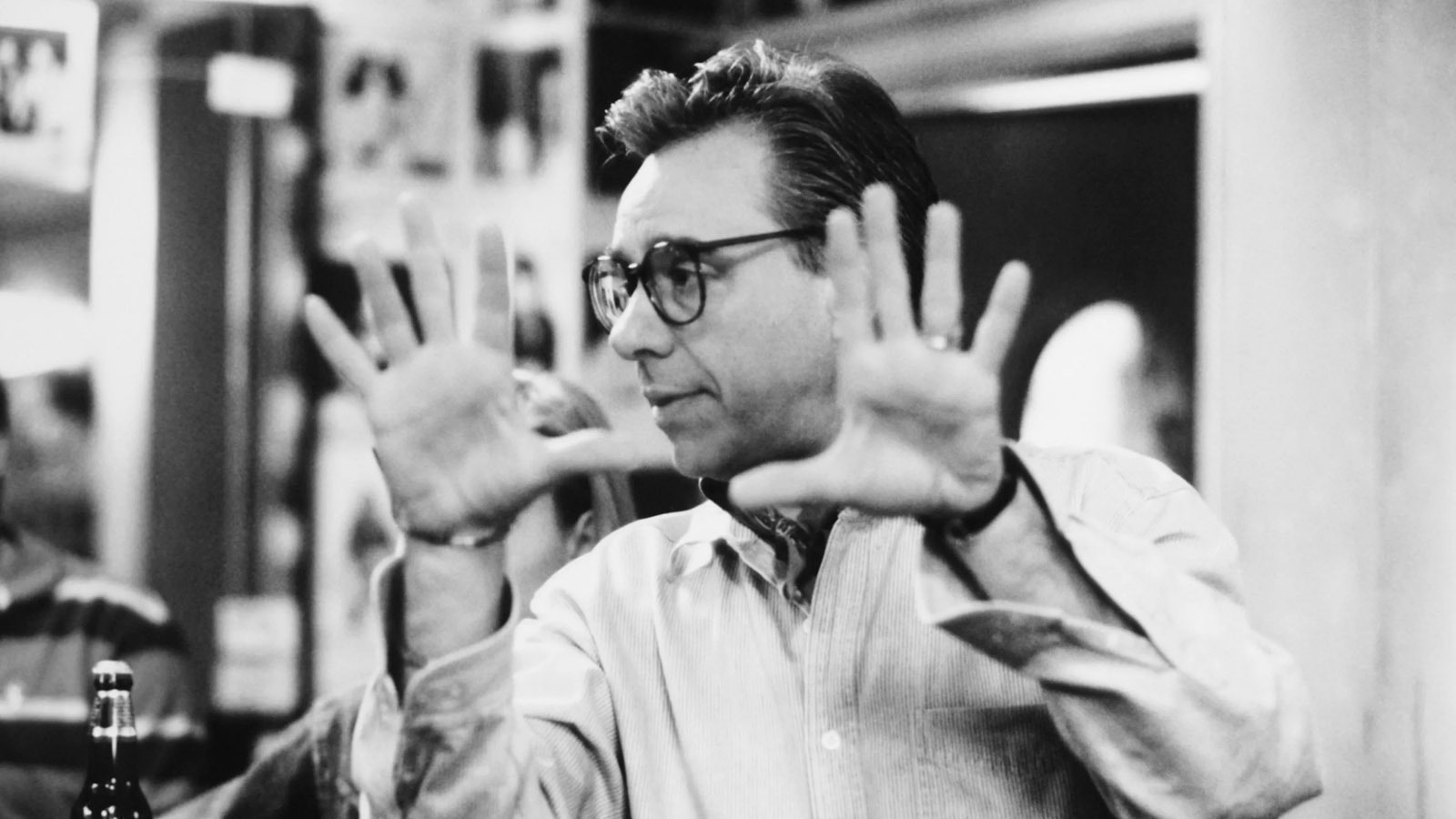
Since 2018, the online magazine Sabzian and the Brussels arts center Bozar have been hosting an annual talk on the state of cinema. Past speakers have included Isabelle Huppert, Sergei Loznitsa, Alice Diop, Wang Bing, and Olivier Assayas. This year’s guest is Nicolas Philibert, who won the Prix Louis Dulac and the European Film Award for Best Documentary for To Be and to Have (2002) and the Golden Bear in Berlin for On the Adamant (2023).
Following his address next Monday, Philibert will present My Childhood (1972), the first film in Bill Douglas’s landmark trilogy. The event will be accompanied by a program that runs through December 13 and begins tomorrow with a screening of To Be and to Have and the presentation of Sabzian’s third book, What Am I Doing Here? 7 Texts by Nicolas Philibert: “What connects these texts is the deliberate sensitivity and precision of a filmmaker who is constantly searching for the ‘right distance’ in his work. Even before the question of how a film should be made, another question arises for him: What am I doing here?”
What They Were Doing There
But What I Really Want to Do Is Direct: My First Picture Shows: 1965–1971 gathers diary entries that Peter Bogdanovich was shaping into a book when he died in 2022. Hollywood historian Sam Wasson has completed the job, and the New Yorker’s Richard Brody finds that the book tells “the story of an aesthetic education and a sentimental one; it’s a work of history and a real-time bildungsroman.” Bogdanovich’s “frequent swings between excitement and despair reflect another noteworthy quality of the book and of Bogdanovich’s personality: his endearing, identifiable ordinariness. Throughout his diaries, he gives the sense of being a regular guy thrust into extraordinary situations—essentially, a Hitchcock character.”
Nick Pinkerton, writing for Bookforum, is less impressed. But What I Really Want picks up just after Bogdanovich and his wife, the production designer and future producer Polly Platt, moved from New York to California and covers Bogdanovich’s apprenticeship with Roger Corman; the making of his first feature, Targets (1968); the writing about and interviews with Golden Age directors such as John Ford and Howard Hawks; and the completion of The Last Picture Show (1971).
“Such ruthless, rise-and-grind determination doesn’t particularly lend itself to profound contemplation,” writes Pinkerton, but “any appearance by Orson Welles—whose genius for extemporaneous speech is set down for posterity in Bogdanovich’s invaluable, Jonathan Rosenbaum–edited interview book This Is Orson Welles—reliably livens up proceedings, dragging our otherwise relatively abstemious narrator to bars in Mexico and Rome to reel off catty comments and nuggets of gossip concerning William Randolph Hearst’s supposed role in the murder of Thomas Ince (later the subject of Bogdanovich’s 2001 The Cat’s Meow) and ‘how he took Marlene Dietrich to the abortionist when Jimmy Stewart knocked her up on Destry Rides Again. Things you can’t print.’”
Speaking of Welles, Joseph McBride discusses the newly revised and expanded edition of his book Orson Welles on the New Books Network. Other recent guests on the podcast include Mark D. Cunningham, the author of Once Upon a Time in South Central LA: John Singleton’s Hood Trilogy, and William Andrews, who aims to clear up a few misconceptions about the subject of his latest book, Pink Auteur, Red Outlaw: Adachi Masao and Japan’s Cinema of Revolution, in a piece for Notebook.
On March 9, Inpatient Press will release Cinema + Revolution: The Life and Work of Masao Adachi, a collection of interviews conducted and edited by Go Hirasawa and Ethan Spigland. First, though, on December 29, Inpatient will release Reflections from a Cinematic Cesspool, a memoir by George Kuchar and Mike Kuchar that features a foreword by John Waters.
On Radio Prague International and the Writers on Film podcast, Andreas Halskov talks about his latest book, Directed by Miloš Forman: An Oral History of His Life and Films, which opens with a touching anecdote from Courtney Love. Once a quarter of a million dollars in insurance was ponied up, Love was cast as Hustler copublisher Althea Leasure in The People vs. Larry Flynt (1996).
Christine Leteux’s Maurice Tourneur: Weaver of Dreams is “a much-needed critical study of a major, if underrecognized, filmmaker,” writes David Cairns for Film Comment. Tourneur, father of Jacques, “doesn’t make for a sympathetic protagonist,” notes Cairns, but by the end, “visiting his unmarked tomb, which seems to symbolize the critical neglect Tourneur has suffered, the author evinces a hard-won affection for him alongside obvious respect.”
In Films That Explode Like Grenades: Robert Kramer and the Search for a Radical Cinema, Whitney Strub “presents Kramer’s life as thoroughly intertwined with his films,” writes Dylan Adamson for the Los Angeles Review of Books. “As Kramer progresses from angry young existentialist to washed-up revolutionary, his perspective opens a door out of the narrow confines of biography and into the world. Kramer’s life becomes a history in miniature of the American New Left and independent filmmaking, and a document of his lifelong effort to realize the old truism that no man is an island.”
Before we move from behind to in front of the camera, let’s note that Casey Schwartz profiles Sam Wasson in the New York Times. The occasion is the publication of Wasson’s Frank Capra: A Life, which is “fond and admiring, even gushing at times,” finds Julia M. Klein in the Los Angeles Times.
Five Actors
“It was a terrible experience making the movie that changed my life,” writes Dustin Hoffman in an excerpt up at the New Yorker from his new memoir, Look at Me. The movie was Mike Nichols’s The Graduate (1967), and years would go by before the director and his lead would understand why its making was such tough going. Nichols “was looking for an alter ego,” writes Hoffmann, “that’s why Benjamin had taken years to cast, and maybe that’s why he was so hard on me. I was a stand-in, there to absorb Mike’s own self-loathing.”
For the New York Times’ Alexandra Jacobs, Look at Me “has a glancing, elliptical quality such that one wants to append ‘. . . but Not Too Closely’ to that commanding title.” In the Los Angeles Times, Julia M. Klein reminds us that in 2017, Hoffman “found himself in the crosshairs of #MeToo” and notes that he now “admits to having ‘made some women uncomfortable’ and perhaps being ‘guilty of insufficient empathy.’ But ‘taking something from someone sexually that they didn’t want to give,’ he writes, ‘it’s just not something I’ve ever done.’” The Guardian’s Peter Bradshaw finds Hoffman to be “a garrulous, grandfatherly, un-self-aware figure in this book,” but also “a brilliant, intuitive, era-defining screen actor.”
Writing in the London Review of Books about Shawn Levy’s Clint: The Man and the Movies, “a comprehensive and steadily appreciative biography,” David Bromwich observes that “the consistency of a good actor is a supple thing—tense or relaxed in unpredictable variations—whereas Eastwood’s steadiness is all in one register. The limitation became, with him, a point of ironic ownership. When his characters swing into action after a drawn-out and expressionless prelude, they don’t spill the secret of an underlying motive. They are what they inscrutably always were.”
In his prime, Alain Delon was “as renowned for his ravishing beauty as for his inscrutable, almost viper-like coldness,” writes Christopher Bollen in the New York Times. That reputation only became more pronounced when Delon was suspected of having more than a little to do with “a real-life murder whose fallout was so explosive that it threatened the powerful sectors of French cinema, the Parisian criminal underworld, and even the French presidency.” Edward Chisholm’s “riveting and disturbingly fun” Murder in Paris ’68: A True Story of Death and Glamour “digs into this lurid murder mystery with an exciting, youthful insouciance rare in the staid true-crime genre.”
In the Guardian, Kathryn Hughes finds that Jasper Rees’s Michael Gambon: The Authorized Biography is “probably as near as anyone will get to a definitive account of Gambon’s life and career, although you would not want to bet on one or two of the actor’s misdirections slipping through undetected.” And Fiona Sturges reviews Judi Dench’s Is It Too Late to Make a Run for It? “Her eyesight is now poor,” writes Sturges, “but her memories are pin-sharp, relayed through a prism of amused self-deprecation and passion for her job.”
Essaying a Few Essayists
The late writer, teacher, and filmmaker Peter Wollen—best known for his 1969 book Signs and Meaning in the Cinema and his 1987 film Friendship’s Death—“was, more than anything else, a historian,” proposes Adrian Martin in the Los Angeles Review of Books. The new anthology Arrows of Desire: Selected Writings 1963–2002, the first of three volumes, covers “subjects as diverse as Vladimir Mayakovsky’s unfilmed screenplays, Mexican art, music video in the 1990s, the rise of feminist film theory and practice, Chris Welsby’s landscape films, and Jean-Luc Godard’s Maoist period.”
Martin adds that “as Nicolas Helm-Grovas (one of the coeditors of this Verso book series alongside Kodwo Eshun and Oliver Fuke) points out, [Wollen] would frequently return to certain, beloved topics—Sergei Eisenstein is a prominent example—but ‘from a different direction.’ As a historian, Wollen was a born storyteller. And, as [art historian Chon] Noriega comments, his goal was not to ‘overlay’ or impose a theory upon his subject, but to ‘tell a story wherein the theoretical and political investments were in the story itself.’”
“Coursing with erudition and enthusiasm, Arrows of Desire serves as an antidote to the arid professionalism, pervasive amnesia, and chronic unseriousness that is ubiquitous today,” writes Erika Balsom for the New Left Review. “Wollen’s intelligence was inseparable from playfulness and experimentation, and he was ever faithful to what Eshun aptly describes as ‘Pandora’s virtues: compulsive curiosity, inveterate epistemophilia, indefatigable interdisciplinarity, joy in learning, le gai savoir.’”
Balsom discusses her own new collection, The Edges of Cinema: Essays on Twenty-First Century Film Culture, on the New Books Network and the Film Comment Podcast, where she appears with Genevieve Yue. Tomorrow evening, Yue will be in Los Angeles to present Richard Fleischer’s The Narrow Margin (1952) and Abbas Kiarostami’s Tickets (2005) and to sign copies of her new book, Trains.
Film Comment, in the meantime, is preparing to host J. Hoberman, whose latest collection is Across the Movi-verse: Writing on Film, 2011–2021. In New York on December 8, Hoberman will present Betty Boop for President (1932), the animated short directed by Dave Fleischer, and Gregory La Cava’s Gabriel over the White House (1933), a feature Hoberman first wrote about for Film Comment in 2012.
December 8 will also see the release of Lives of Eminent Sorcerers: And Other Readings, a collection of “literary ephemera” from Ed Halter. And Totally Spies, a collection of seven essays on espionage in the movies, is out now from Cinema Year Zero.
Old and New Fictions
Pedro Almodóvar’s kaleidoscopic first novel, El hombre que solo escribía en los aviones (The Man Who Only Wrote on Airplanes), is out now in Spain, and it’s slated to be published in the U.S.—in Spanish—in February. For Vanity Fair, Ianko López asks Almodóvar why he’s decided to tell the story of “a very multifaceted character named Flavio Guijarro” in “the form of a novel rather than a movie, but he appears to have not heard my question and answers instead as if I’d asked him why it took him so long to publish a novel, which is undoubtedly much more interesting: ‘I think the reason I hadn’t written a novel until now was that I wasn’t sure I’d be able to, even though I’d wanted to write one since I was a young man . . . I started with a simple anecdote about an acting coach and an actor, and that opened the floodgates; the story began to pour out.’”
Sight and Sound is revisiting a set of interviews Jan Dawson conducted with Claude Miller and Wim Wenders for its Winter 1977–1978 issue. Both directors had just completed adaptations of novels by Patricia Highsmith, Miller with This Sweet Sickness and Wenders with The American Friend, which is based on Ripley’s Game. “Both self-confessed pessimists,” wrote Dawson, “Miller and Wenders are alike afflicted by a contagious liking for their characters. Both have subtly done away with the ethical poles of Patricia Highsmith’s somewhat puritan morality, and at the same time they have no less subtly done away with the norm that the novelist so carefully establishes as lying at the surface center of her Manichean universe.”
Last week we took a first look at early reviews of Jane Schoenbrun’s first novel, Public Access Afterworld. In the Guardian, Sandra Newman finds that “in the treatment of their core theme—the relationship between the attention economy and its victims—Schoenbrun is wonderfully brutal, passionate, and astute. They powerfully draw out the horror of screen culture, making us feel how, in some way, the ugliest content on YouTube inhabits the same nightmare subreality as the catchphrases and laugh track of an ’80s sitcom. They also capture our perverse longing to enter that world, to leave human life and become the story: to flee to the other side of the screen.”
Behind the Scenes
In Born to Lose: The Misfits Who Made Dog Day Afternoon, Rachel Walther “digs into every aspect of one of the great New York movies and a quintessential true-crime drama with verve and sensitivity,” writes Vince Keenan.Todd Berliner is on the New Books Network, talking about his new book, Hollywood Renegade: Elaine May, Mikey and Nicky, and the Making of a Masterpiece, and Illeana Douglas discusses her latest, Jungle Red! The Making of MGM’s The Women, with Writers on Film host John Bleasdale, Reel Pages host Caroline Breder-Watts, and Maureen Dowd of the New York Times.
David Koenig has drawn from “hundreds of scripts, studio records, censorship files, and other rare sources” to put together The Uncut Marx Brothers: Lost Gags, Routines & Scenes from Their Classic Films, and he joins Mike White in the Projection Booth to talk about the project. The Hollywood Reporter is running an excerpt from The Making of Quentin Tarantino’s Inglourious Basterds, written by Jay Glennie and featuring an introduction by Tarantino and a foreword by Brad Pitt. And in January, Mack will release Werwulf, a companion to the Robert Eggers movie set to hit theaters on Christmas Day.
Endnotes
“Things that currently interest John Cusack include politics, fringe philosopher-artists, and graphic novels, one of which he recently published,” writes Emma Allen in the New Yorker. “Momo, illustrated by Ignacio Noé, is Cusack’s noirish 1970s road-trip romp about the philosopher-artist Antonin Artaud (per Cusack: ‘sovereign of the absurd, master of the irrational, lord of the permanent rebellion’), who spent years in French mental institutions. Cusack’s book imagines a scenario in which Artaud fakes his own death and is sprung from an asylum by Jackie Gleason, who then accompanies him and Richard Nixon to the Homestead Air Force Base to check out embalmed alien heads. After that, things get really weird.”
Launching on January 21, Cinema: Tony Stella, edited by Tony Nourmand, will celebrate the late great movie poster artist. And at the Film Stage, Christopher Schobert spotlights what he considers to be the best film books of the year, including a few mentioned above as well as Scott Ryan’s The Road to David Lynch’s Wild at Heart, Scott Meslow’s A Place Both Wonderful and Strange: The Extraordinary Untold History of Twin Peaks, and Kyle MacLachlan’s memoir, Fictional Selves.
Don’t miss out on your Daily briefing! Subscribe to the RSS feed.