Nikkatsu’s Golden Age of Eros
Share
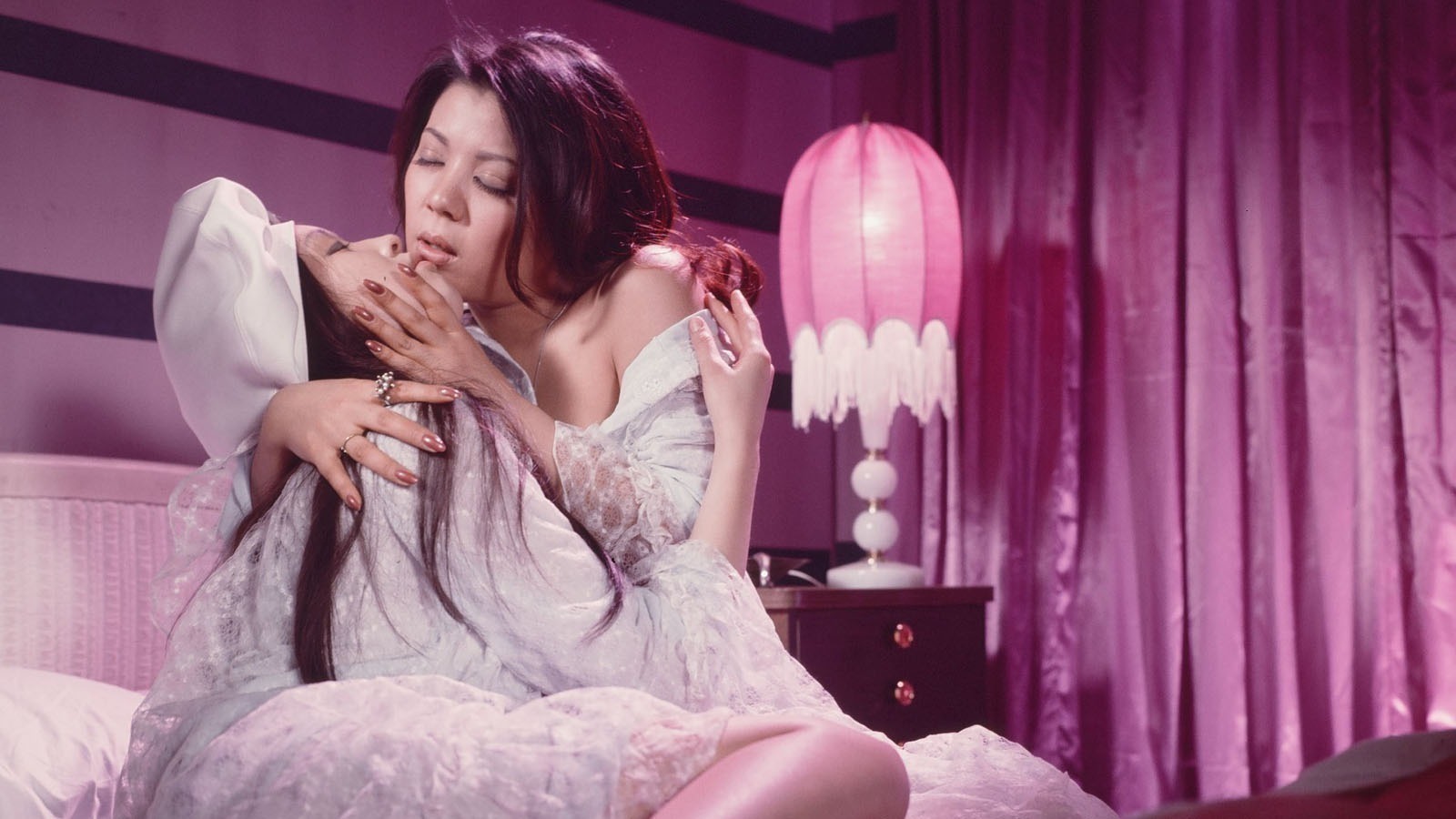
Japan’s oldest major film studio, Nikkatsu, founded in 1912, shut down production during the Second World War. When it revved itself back up again in 1954 to concentrate on movies that would appeal to a burgeoning audience of viewers eager to see their defiant young selves on the screen, it attracted such innovative directors as Shohei Imamura and Seijun Suzuki.
Nikkatsu thrived until it faced its second existential crisis in the late 1960s. As television took hold, ticket sales plummeted, and studio heads noticed that independent studios specializing in pinku eiga—erotic dramas and thrillers—were still going gangbusters.
With Apartment Wife: Affair in the Afternoon (1971)—directed by Shogoro Nishimura and starring Kazuko Shirakawa, it was such a big hit that it spawned twenty sequels over the next seven years—Nikkatsu launched Roman Porno, a branded series of sexploitation movies that ran until 1988 and produced well over eight hundred features. From Friday through December 6, Japan Society in New York will present Nikkatsu’s Golden Age of Eros, a selection of twelve of the most significant Roman Porno films.
Nikkatsu’s hard swerve from socially conscious dramas of disenchanted youth to sex is “not so surprising if one looks at the global situation around 1971,” Jasper Sharp told Roger Batty this summer. A cofounder of Midnight Eye, the first English-language site dedicated solely to Japanese cinema, and the author of Behind the Pink Curtain: The Complete History of Japanese Sex Cinema, Sharp notes that it was in the 1970s that “censorship really broke down, and this is what people in the pre–home video days were going to see at the cinema. You only have to look at Britain, when you had all those dreadful Confessions of a Window Cleaner–type sex comedies . . . The first thing you’ll notice about Roman Porno is that they are far better made, and there’s a lot more going on intellectually with them.”
Sharp also noted that in these films, the focus shifted from male to female leads, and the stories were “written to reflect that change. It was a big social phenomenon, because the other thing to remember is that Japanese audiences preferred to watch Japanese films than foreign ones. Japanese-produced films of whatever genre had over half the overall market share up until the mid-1970s, so Nikkatsu's switch to Roman Porno had quite a big social impact.”
Back in 2001, Sharp wrote a Midnight Eye review of the film that opens the Japan Society series, Noboru Tanaka’s A Woman Called Sada Abe (1975). Abe was a real-life geisha caught up in a violently passionate affair with a Tokyo restaurateur. On May 18, 1936, she strangled him, cut off his penis and testicles, and carried them in her kimono for three days before she was arrested.
“Reams have been written about Nagisa Oshima’s groundbreakingly explicit rendition of this bizarre true story, In the Realm of the Senses (1976),” wrote Sharp. “Tanaka’s version is certainly the more accessible of the two. Aside from being less sexually explicit, it is also smaller scale, more intimate, more cinematically stylized, and arguably more erotic.”
A total of four films in the series were directed by Tanaka, “whose literary passions would lead him to the grotesque work of author Edogawa Ranpo,” as James Balmont noted in a 2024 Dazed feature on Roman Porno. “Ranpo, a famed mystery writer whose pen name was taken from The Raven author Edgar Allan Poe, would be the inspiration for all sorts of cult films in Japan across the years,” and “the voyeuristic nature of Watcher in the Attic [1976] fit the Roman Porno mould perfectly—and Tanaka wasn’t afraid to make his adaption as surreal as the source material demanded. The film concerns the owner of a large manor house (Junko Miyashita) and her peeping tom tenant, played by Renji Ishibashi (Audition). From the attic space, amidst bizarre scenes of frog-eating and body-painting, he watches as a polka-dot-adorned clown” engages in oral sex with “his veiled, well-dressed landlady—and soon decides he quite fancies her for himself.”
The other two Tanakas are Woman on the Night Train (1972), which the programmers call “a baroque fantasy by way of Vadim and Buñuel’s Diary of a Chambermaid,” and The Oldest Profession (1974), starring Meika Seri as a nineteen-year-old prostitute working in the slums of Osaka. The Oldest Profession is one of the films discussed in “Poetry of Depravity: A Deep Dive into Nikkatsu Roman Porno,” the fourteenth episode of the Outskirts Film Podcast.
The series features two films by Tatsumi Kumashiro, both from 1973. Woods Are Wet is a loose adaptation of the Marquis de Sade’s 1791 novel Justine that Jasper Sharp has called “a full-on assault on Japanese censorship made in the aftermath of Nikkatsu’s prosecution for public obscenity.” The World of Geisha, set in a house of pleasure in 1918, was named one of the ten best Japanese films of 1973 by the storied film magazine Kinema Junpo.
In Koyu Ohara’s Shinjuku Midnight Story: Man and Woman (1972), a nightclub hostess strikes up an affair with a trans woman, and Christopher Velasco and Dakota Noot discussed the film on a recent episode of their podcast, Two in the Pinku. Chusei Sone’s Angel Guts: Red Classroom (1979) is the second title in Nikkatsu’s five-film Angel Guts series, all of them based on Takashi Ishii’s manga about the lasting psychological impact of sexual violence.
Yoichi Higashi’s Love Letter (1981) is the story of an affair between a young woman and a much older poet played by Katsuo Nakamura, who won awards from the Japan Academy and Kinema Junpo for his supporting performance. “Among the most visually inventive films of its genre,” wrote Dan Sullivan and Aiko Masubuchi for Film at Lincoln Center 2022, Yoshimitsu Morita’s Top Stripper (1982) is “both a delirious sex parable and a sneakily profound meditation on the boundaries between performer and spectator.”
Japan Society programmers note that Toshiharu Ikeda “melds eroticism, tragedy, and psychological paranoia” in Scent of a Spell (1985), the story of a man who rescues a woman who has jumped off a bridge only to later suspect that she may not be as innocent as she seems. The series wraps with the second-to-last entry in Roman Porno’s seventeen-year-long run, Shusuke Kaneko’s Last Cabaret (1988), the clearly metaphorical story of an erotic night club getting shut down to make way for a redevelopment project.
Don’t miss out on your Daily briefing! Subscribe to the RSS feed.