The James Blue Project
Share
Out now from Sticking Place Books, Directing the Non-Actor: The James Blue Interviews is a three-volume collection gathering fifty conversations conducted around the world by Blue—a filmmaker and a fascinating figure we’ll get to in a moment—with dozens of directors, including some of the greatest in the history of cinema. Let’s drop some names.
In Volume One: Europe, North America, and Asia, Blue talks with Jean Renoir, Robert Bresson, Jean-Luc Godard, Satyajit Ray, Miloš Forman, Shirley Clarke . . . and the list goes on. Volume Two: The Italians features Roberto Rossellini, Vittorio De Sica, Federico Fellini, Pier Paolo Pasolini, Bernardo Bertolucci, and Ermanno Olmi. And Jean Rouch, Albert and David Maysles, William Klein, and Peter Watkins are among the interviewees in Volume Three: The Documentary Filmmakers.
As Richard Herskowitz, the editor behind this Herculean effort, explains, Blue was especially curious as to how these filmmakers “found their nonactors, how they got authentic behavior and performances out of people who had never faced a camera, and how they shaped that raw material into finished film. The conversations that resulted amount to a hidden education in directing—not a theory, but a set of hard-won practical lessons.”
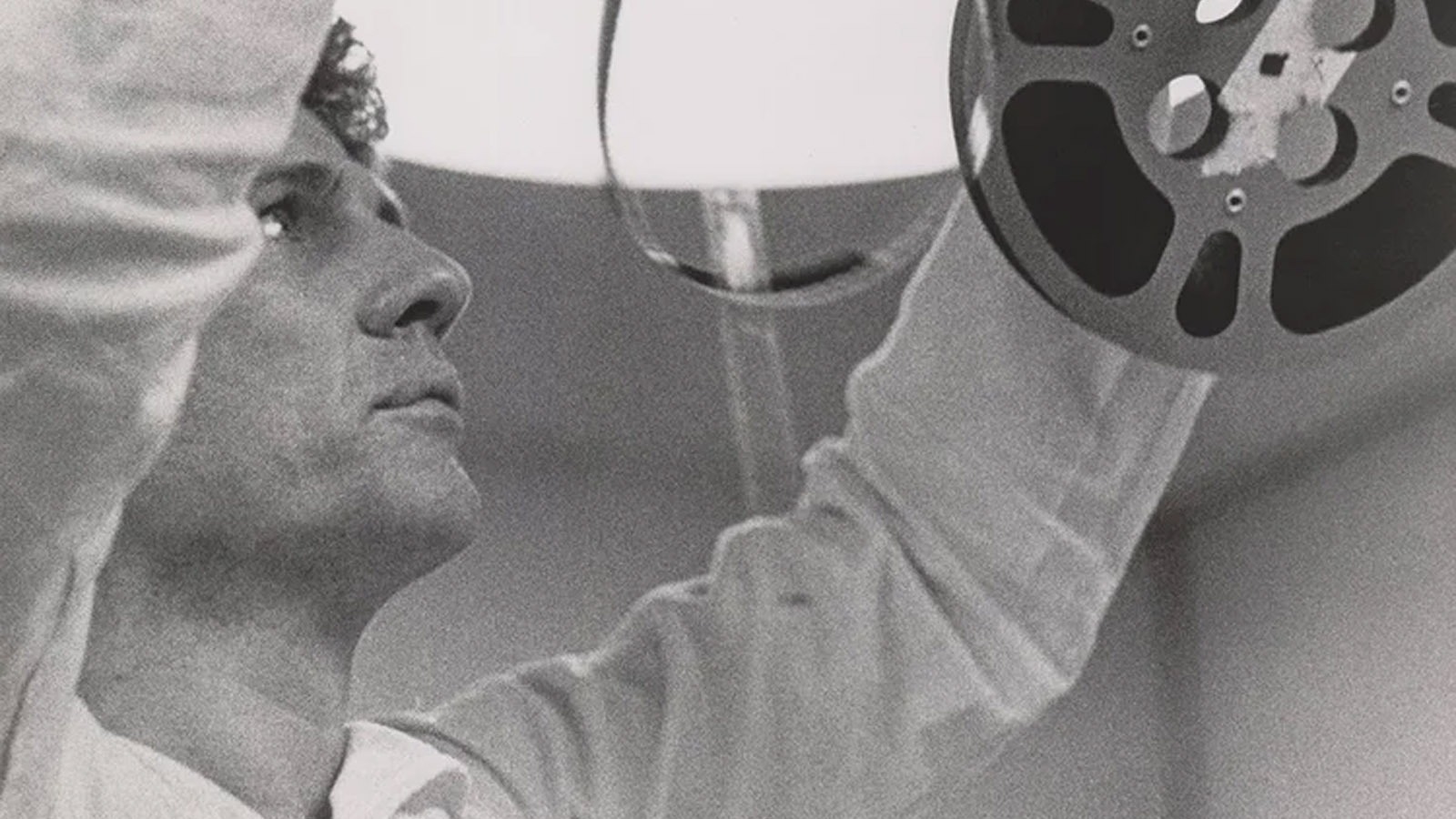
Herskowitz oversees the James Blue Project, and if you’re unfamiliar with Blue and his work, hit that link and watch the eleven-minute video embedded right up front. This will likely draw you deeper into the site, where you’ll learn much more, but briefly, this strikingly handsome man—little wonder that he started out as an actor—was born in Oklahoma at the height of the Great Depression. As James’s younger brother, Richard Blue, told Herskowitz, the family’s struggles “to avoid becoming ‘Poor White Trash,’” as their mother put it, made a deep impression on the two boys and undoubtedly helped shape their progressive politics.
In 1942, the family moved to Portland, and James Blue eventually studied at the University of Oregon, where he met James Ivory, who designed the sets for the production of a play performed in French and starring Blue. Encouraged by his professors to apply, Blue attended the renowned IDHEC, the film school in Paris later known as La Fémis. He then moved to Algiers, where he made The Olive Trees of Justice (1962), the story of an Algerian returning home from France at the tail end of the Algerian War.
Featuring a score by Maurice Jarre and a cast of young nonprofessional actors, The Olive Trees of Justice won an award from the the Society of Dramatic Authors and Composers when it screened as part of the inaugural edition of Critics’ Week in Cannes. Encouraged by George Stevens, Jr. to return to the States, he began working for the United States Information Agency, and overseeing seven filmmaking teams, he captured the 1963 March on Washington, where Martin Luther King Jr. delivered his historic “I Have a Dream” speech.
The March (1964) was added to the National Film Registry in 2008, and A Few Notes on Our Food Problem (1968) was nominated for an Oscar for Best Documentary Feature. By this point, Blue had become one of the first filmmakers to receive a grant from the Ford Foundation, and he used it to launch his globe-spanning interview project. The directors he interviewed “disagreed with each other as often as they agreed,” notes Herskowitz. “But a shared instinct runs underneath all of it: that a nonactor’s greatest asset is whatever the camera can’t manufacture.”
Don’t miss out on your Daily briefing! Subscribe to the RSS feed.