Cliff Booth, Eight Years On
Share
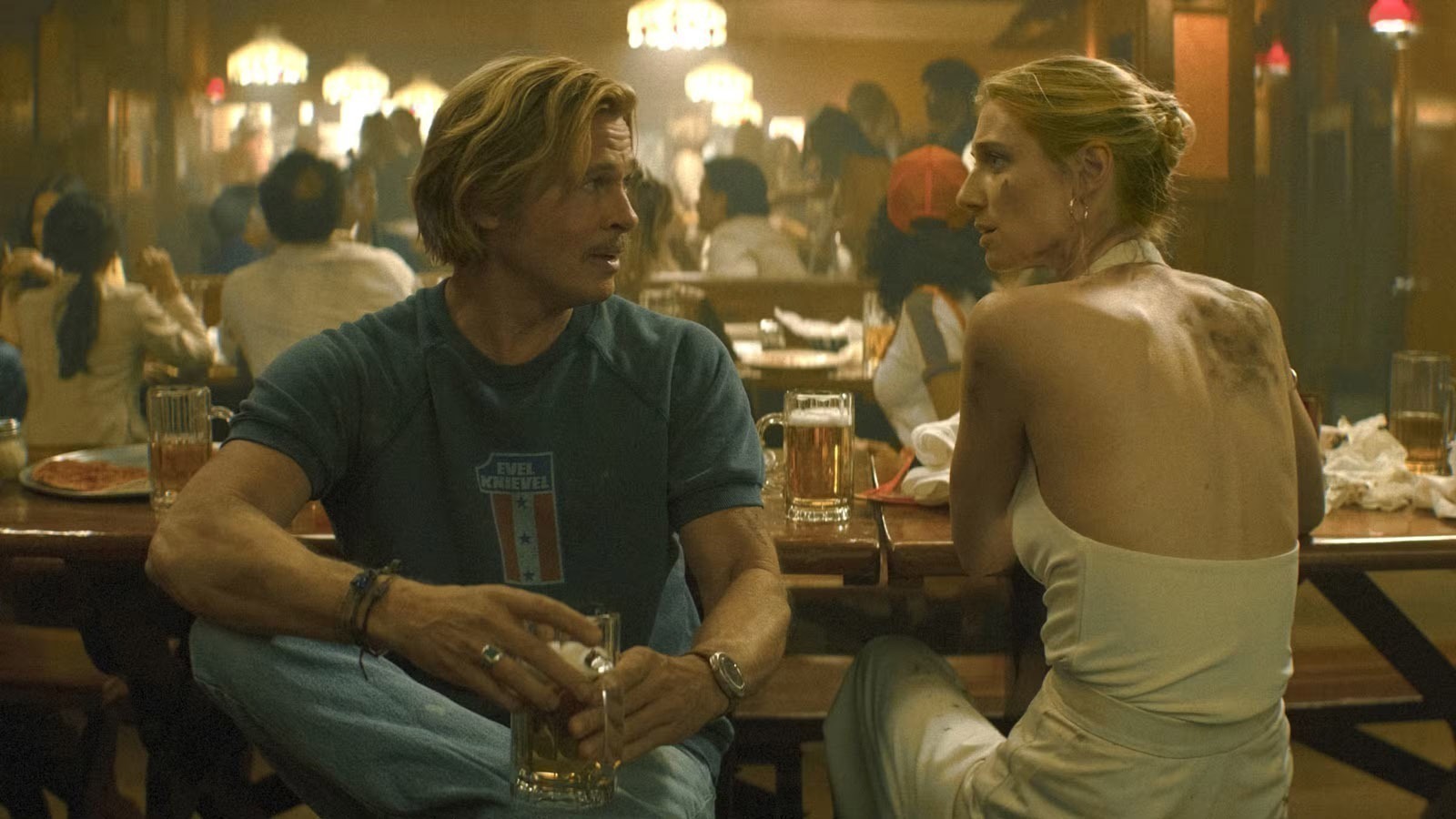
By the end of Quentin Tarantino’s Once Upon a Time in Hollywood (2019), Cliff Booth—the laidback stuntman Brad Pitt played with such a naturally winning ease that he won an Oscar—has inadvertently saved Sharon Tate and four other people from being murdered by the Manson Family. Cliff’s been stabbed by a Family kid, but as he’s loaded into an ambulance, he assures his friend Rick Dalton (Leonardo DiCaprio), the actor he doubles for, that he’ll be just fine.
Tate invites Dalton, whose career has hit another rocky stretch, into her home on Cielo Drive for a drink. A thin ray of hope beams down on Rick that warm August night in 1969. Maybe Tate will eventually introduce him to her husband, Roman Polanski. Eight years on, that has evidently not panned out. Rick Dalton is mentioned but never seen in The Further Mis-Adventures of Cliff Booth, a string of stories Tarantino has set in 1977. Dalton’s down in Australia, starring in a TV series called Dingo Dan.
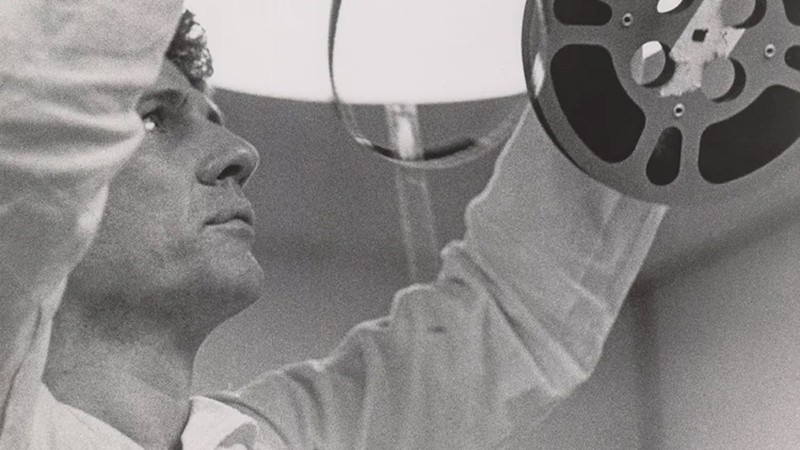
Cliff is working as a projectionist at the New Beverly Cinema, the Los Angeles theater Tarantino bought in 2007. Cliff also tends bar, hangs with his dad (Peter Weller), and fixes things. Charlie Peters (Scott Caan), a television star known for his diminutive stature and for doing his own stunts, has gotten himself into some hot water and put his wife (and Cliff’s former fling), Toni (Carla Gugino), in considerable danger.
Charlie has high-profile talent agent Karen Crosby (Elizabeth Debicki) recruit Cliff to keep the Verdusco brothers, Filipino gangsters played by Matt Grove and JB Tadena, from carrying out a hit. Cliff is clearly taken with Karen, but she’s not going to make anything easy for him. “For once using her native accent and taking full advantage of her imposing height,” writes the Hollywood Reporter’s David Rooney, “Debicki is in sublime command of her powers playing a savvy, languidly sensual Australian gal who is nobody’s idea of a delicate flower. Her chemistry with Pitt is off the charts.”
Tarantino wrote a 230-page screenplay but then decided that his tenth and final film would have to be something newer to him, not “the same ground I’ve already walked.” Pitt brought in David Fincher, who tells Joshua Rothkopf in the Los Angeles Times that he cut down the screenplay by around a quarter.
“It was mostly trying to understand and make room for Karen,” Fincher tells Rothkopf, who notes that Fincher calls Debicki’s character “one of the story’s many ‘Robert Towne women,’ a term he uses with the highest praise: broad-shouldered, loose-limbed, turned on by competency. ‘They’re not quite sure how it’s all going to work out,’ he says, ‘but they’re going to have some say in how it goes down.’” Fincher ultimately cut “three full versions” of The Further Mis-Adventures “until it felt right to him. ‘Went all the way through—“That’s not it”—tore it back to the studs, started over again, built it all again.’”
“What might’ve been Tarantino’s peculiar last movie is Fincher’s best in fifteen-something years,” finds Nick Newman at the Film Stage. “They couldn’t have found each other at a better moment.” For David Jenkins at Little White Lies, The Further Mis-Adventures “feels like Fincher is playing in the gaudy fun-time fairground of OUATIH, but he’s actually got Jackie Brown (easily QT’s most mature and cohesive film) on his mind. Cinephile fun seekers might even want to chalk this one up as, what if Paul Thomas Anderson made Licorice Pizza and One Battle After Another as one movie.”
“Tarantino’s script dangles a gaudy array of decorative events and tangy characters, florid dialogue and snappy gestures that are more than the movie’s raison d’être—they’re its main matter,” writes the New Yorker’s Richard Brody. “The Further Mis-Adventures has the typically Tarantinian explosive action and calibrated slow burns, the motormouth dialogue, the whimsical yet logical twists, the humor, and, above all, the light-footed, hearty energy and exuberant glee that Pitt brought to the original role.”
Time’s Stephanie Zacharek finds that the film “leap-frogs from one misadventure to another with entropic grace.” Fincher, “ever the perfectionist, and cinematographer Erik Messerschmidt (who won an Oscar for his work on Fincher’s now nearly forgotten Mank) give the movie just the right level of gritty polish, as if they’d been saving up some of the hazy, moody sunbeams of The Long Goodbye in a jar, waiting for just the right use.”
IndieWire’s David Ehrlich finds that the film “drifts from a casual hangout session to a brutal crime-thriller and a sweetly abrasive romance without ever becoming much of anything.” For Ehrlich, “after watching any number of Netflix TV shows that should have been shortened into movies, it’s a cruel irony to see two of our greatest filmmakers slush their talents together into a movie that should have been serialized into a long-running TV show, complete with a new guest star every week.”
Rolling Stone’s David Fear “can feel where Tarantino’s affections and indulgences chafe against Fincher’s cool, hyper-controlled chilliness, and vice versa. The latter has a way of utilizing high style and irony to enliven even his weakest projects—he has yet to make an uninteresting or dull movie—but there’s no sense that he has a connection to the material. This feels as much a work-for-hire as Fincher’s music videos, though even those are rife with signature moves and live-wire vitality. You wouldn’t know that one of the most important American directors of the twentieth century was calling the shots here. A major bummer, this.”
But Variety’s Owen Gleiberman “dug just about every ambling, low-down minute . . . As an artist, the hot-blooded, motormouth Tarantino is Dionysian; the rigorously controlled, ice-in-his-veins Fincher is Apollonian. Together, the two merge in a divertingly odd way. The Further Mis-Adventures is an enjoyable contradiction—a meticulous hangout movie. It hops from one thing to the next, but it’s disarmingly placid and even-keeled about what it’s doing. In spirit, it’s almost as if someone had slipped the movie half a Quaalude.”
The Telegraph’s Robbie Collin notes that when we first meet the Filipino gangsters, “they are riffing drolly in a parked car: all very Tarantino. Yet the execution for which they are psyching themselves up is staged with a startling sadism, pitiless exactitude, and tinder-dry wit that are all vintage Fincher: the first of many times the latter filmmaker uses the former’s tics to throw his audience off-guard.”
“At once among the mellowest and most distressing entries in both Fincher’s and Tarantino’s filmographies,” writes Eli Friedberg at Slant, The Further Mis-Adventures “finds in the aftermath of a midlife crisis a humbler, more sobering acceptance of life, aging, death, and the movies, without fully abandoning a puckish sense of fun.”
Don’t miss out on your Daily briefing! Subscribe to the RSS feed.