Stacy Keach Wouldn’t Wait
Share
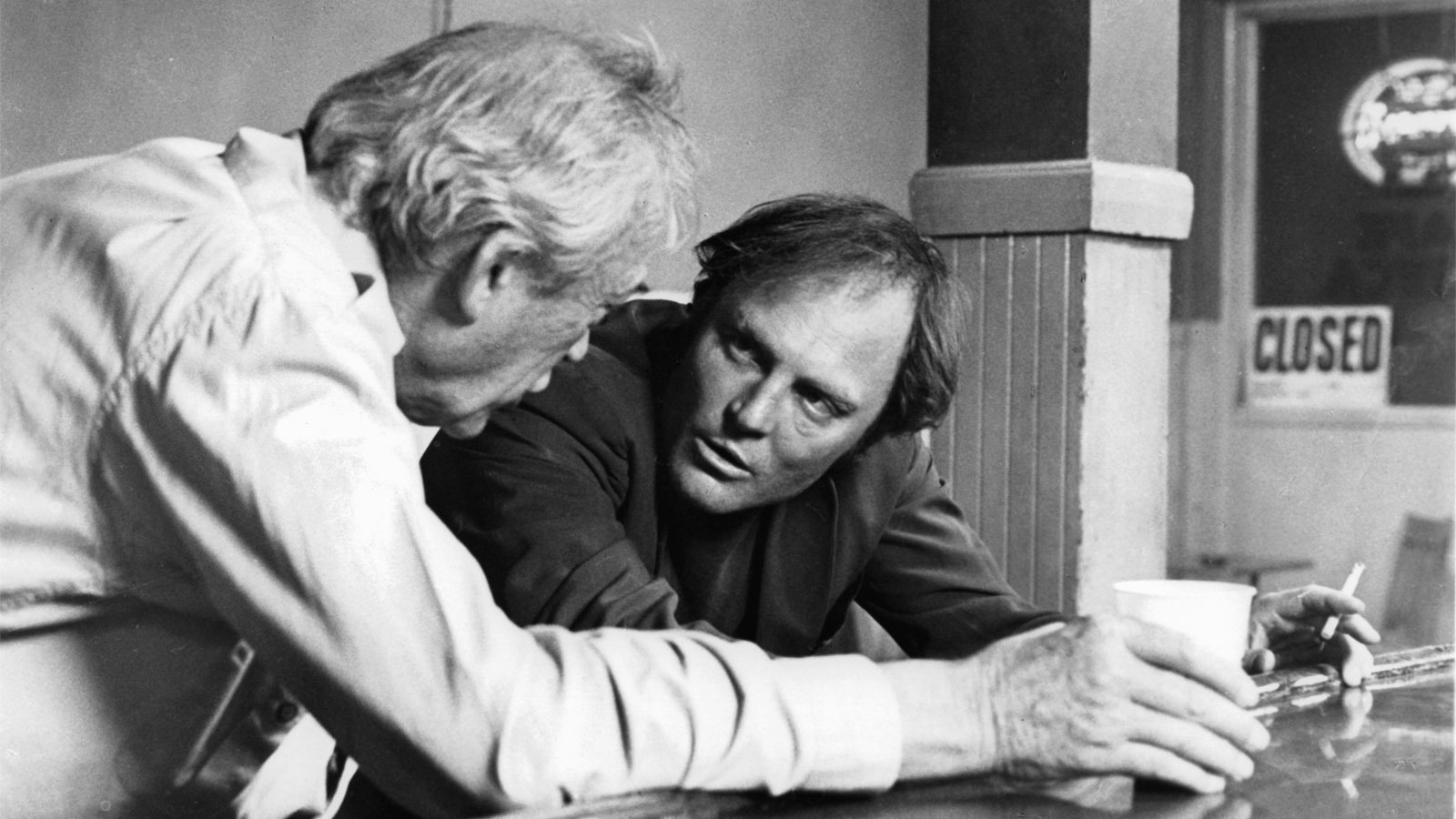
In 2019, more than half a century into his prolific acting career, Stacy Keach was finally given a star on the Hollywood Walk of Fame. Talking with him at the time for Variety, Amy Nicholson noted that Keach was “best known for playing heavyweights who tend to kill and be killed on film and TV, where the camera can closely observe his intimidating build, defining harelip, and what Elia Kazan called ‘a sense of violence behind the eyes that’s not housebroken.’” On Tuesday, Keach passed away at the age of eighty-five.
Walter Stacy Keach Jr. grew up in the San Fernando Valley, where his father directed plays, taught drama, did some talent scouting, and eventually appeared as minor characters in dozens of movies and television shows. His mother pursued a stage career, and both parents advised their boys to steer clear of the arts. But Stacy leapt into acting in high school, and his younger brother, James Keach, would go on to become an accomplished actor and filmmaker. In 1980, Stacy and James cowrote and coproduced The Long Riders, directed by Walter Hill and featuring the brothers as Frank and Jesse James.
Stacy Keach spent the mid-1960s studying at UC Berkeley and the Yale School of Drama, and during the summers, he acted with the Oregon Shakespeare Festival. He convinced Joseph Papp, the director of the New York Shakespeare Festival (as it was known before it became Shakespeare in the Park) to cast him as Marcellus in a 1964 production of Hamlet.
A Fulbright scholarship to study at the London Academy of Music and Dramatic Arts followed almost immediately, and when Keach returned to the Festival, the raves began rolling in. Keach’s Falstaff was “superb,” wrote Dan Sullivan in the New York Times in 1968, and in 1972, Clive Barnes declared that Keach had delivered “one of the great Hamlets of our time. Mr. Keach must surely be the finest American classic actor since John Barrymore, and this Hamlet is there to prove it.”
By this point, Keach was appearing in Shakespeare productions for television, and he had made his feature film debut playing a drifter in The Heart Is a Lonely Hunter (1968). In 1970, he worked with Robert Altman on Brewster McCloud but passed on an offer to play Hawkeye Pierce in M*A*S*H in order to take the role of Colonel Cathcart in Mike Nichols’s Catch-22—which proved to be an unfortunate move when Nichols decided to go with Martin Balsam instead.
“His unapologetically peripatetic acting life was launched, in a sense, by the parts he missed out on,” writes Barry Singer in the New York Times. Father Damien Karras in The Exorcist and Randle McMurphy in One Flew Over the Cuckoo’s Nest were among the roles that got away, and these “near-misses brought a realization,” writes Singer. “Rather than wait for the role that might make him a movie star, he would accept whatever roles came his way.”
That led to a lot of television work in a pre–Peak TV era when the medium was still for the most part deemed unworthy of actors as highly regarded as Keach was. But if there is a single role he was most immediately identified with, it was Mike Hammer, the womanizing and trigger-happy private investigator created by pulp novelist Mickey Spillane. Keach was a fan and played Hammer in a series that ran for three years in the mid-1980s, and he returned to the role in three made-for-TV movies.
The run was almost halted in 1984 when Keach was arrested at Heathrow Airport for trying to smuggle in just over an ounce of cocaine concealed in a can of shaving cream. “As my sentence was read—nine months in prison—I felt like someone had kicked me in the groin with lead cleats,” wrote Keach in his 2013 memoir, All in All: An Actor’s Life On and Off the Stage. “It was the lowest moment of my life.” Following his release six months later, Keach shook the addiction and spoke about his struggle before the House of Representatives, on college campuses, and at rehab centers.
Keach appeared in a good number of prestigious mini-series such as Franco Zeffirelli’s Jesus of Nazareth (1977), but his second big television hit was Titus (2000–2002), a sitcom created by comedian Christopher Titus. Storylines were drawn and skewed from Titus’s real-life family, and his “hard-drinking, always-smoking, philandering father” was “played with aplomb by Keach,” writes Andrew Sanford at Pajiba. “He was funny as hell, charismatic, and stole almost every scene that he was in.”
One of Keach’s early big-screen triumphs was his performance as Billy Tully, a former boxer looking to cut the boozing and get back in the game in John Huston’s Fat City (1972). “Keach looks like he smells terrible,” wrote Alan Scherstuhl in the Village Voice in 2015, “but he also exhibits at each moment this man’s soused optimism, his belief that he’ll get it together, get back in shape, get back to winning purses. He does, of course, in fits and starts, but he learns the same hard-knock lesson picked up by young-buck white-hope Ernie, played by a radiant Jeff Bridges: You can train and fight your heart out, but you’re still going to be asking, in a daze, at bout’s end, ‘Did I get knocked out?’ Even if you triumph, life socks you hard.”
Keach actually did get knocked out during the shoot. Staging a fight between Keach and real-life professional boxer Sixto Rodriguez, Huston had them really go at it, and “a right hand came flying out of nowhere,” Keach recalled in a 2013 conversation with Will Harris at the A.V. Club. And with a laugh, Keach added that “that’s the shot John Huston used in the movie.”
“He was one of those directors who was just magical,” said Keach. “He would let the actors direct scenes themselves, or at least stage them. The scene with Susan Tyrrell in the apartment, where we’re having dinner, he said, ‘All right, you guys work out where you’re gonna move and what you want to do in this scene, then come and call me, and I’ll come and take a look at it.’” And Huston “would tweak it here and there and make little changes. But it was wonderful, because everything was very organic in that respect. It came out of the actors themselves rather than something that our director told the actors to do. And it was really wonderful working that way.”
That same year, 1972, Keach played a rookie cop in Richard Fleischer’s The New Centurions and the notorious albino outlaw Bad Bob in Huston’s The Life and Times of Judge Roy Bean. He was a small-town deputy in Bert Kennedy’s The Killer Inside Me, the 1976 adaptation of Jim Thompson’s novel, and he narrated Ridley Scott’s debut feature, The Duellists (1977). In William Peter Blatty’s first feature, The Ninth Configuration (1980)—“something of a grand folly,” Anton Bitel calls it at Little White Lies—he played Colonel Hudson Kane, who takes over a military asylum in an isolated castle.
“Working with Jamie Lee Curtis was just delicious,” said Keach when Harris asked about Richard Franklin’s Road Games (1981), which was up to that point the most expensive movie made in Australia. It’s playing now in our Criterion Channel program Highway Horror, and curator Clyde Folley notes that it’s “a film that dares to ask the question: what if Rear Window took place in a truck driving through the outback and starred Stacy Keach and Jamie Lee Curtis? It’s simply a taut thriller that moves effortlessly and efficiently, a film made by a confident genre craftsman.”
Keach was Commander Mac Malloy in John Carpenter’s Escape from L.A. (1996) and Edward Norton’s neo-Nazi mentor in Tony Kaye’s American History X (1998). Kari Skogland’s Children of the Corn 666: Isaac's Return (1999) “had one of my better death scenes,” Keach told Stuart Miller in a 2012 Vulture interview. “I was electrocuted. In Other Desert Cities, my character used to be an actor and I could relate to his line, ‘Nobody at Warners died like me. It’s one thing I had a knack for.’ I have to put together all my death scenes on film . . . My best ever was in Class of 1999 when a robot comes up from behind me and puts his hand through me and takes out my heart.”
In Oliver Stone’s W. (2008), Keach played George W. Bush’s pastor and spiritual advisor, and he had another small role in Tony Gilroy’s The Bourne Legacy (2012) as the Director of Operation Outcome. More memorably, Keach played another bad guy of sorts, the former business partner of Bruce Dern’s Woody in Alexander Payne’s Nebraska (2013). Keach’s final film role was the disapproving father of a movie star (George Clooney) going through some things in Noah Baumbach’s Jay Kelly (2025).
“Perhaps it was his ubiquity and eclecticism that caused him to be so underrated,” wrote the late Ronald Bergan in an obituary that the Guardian published on Wednesday. Keach liked to work. “If a script interests me, or a character intrigues me, or the cast features someone I’ve always wanted to work with, or the location is somewhere exotic, then sign me up,” he wrote in his memoir. “I’m not going to wait for a call that may or may not come.”
Don’t miss out on your Daily briefing! Subscribe to the RSS feed.