The Artfully Balanced Life of Eva Marie Saint
Share
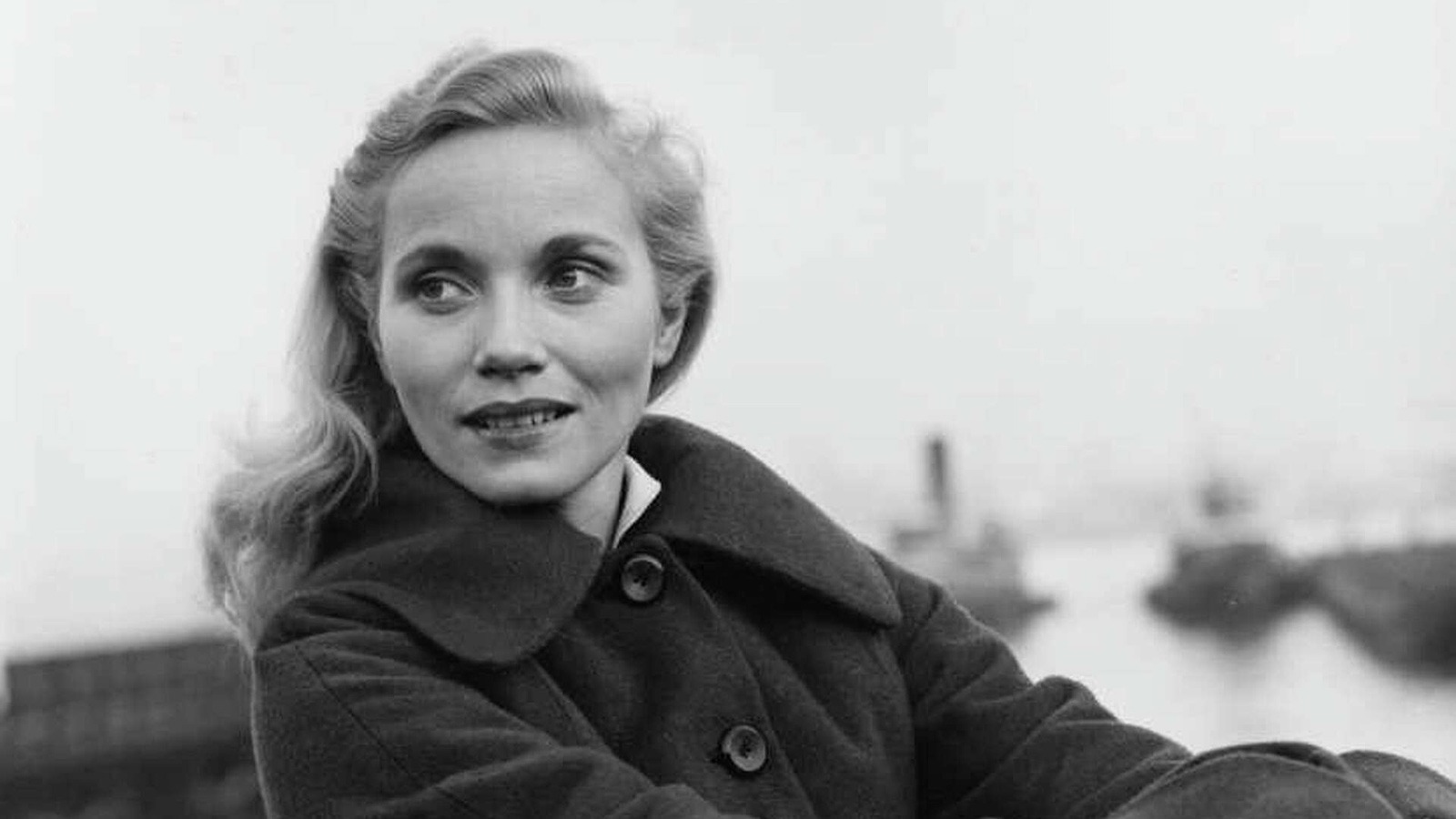
Eva Marie Saint, who passed away on Tuesday at the age of 102, was twenty-nine when Elia Kazan cast her as Edie, a young, blond Catholic woman, in On the Waterfront (1954). More than any other character in this crowded story of union corruption and violence on the docks of Hoboken, New Jersey, Edie would be sharing the screen with Terry, a former boxer working as a longshoreman. And Terry was to be played by Marlon Brando.
Three years earlier, Brando’s Stanley Kowalski in Kazan’s A Streetcar Named Desire set off a tectonic shift in American acting on film. In 1953, Brando scored his third Oscar nomination for his turn as Mark Antony in Joseph L. Mankiewicz’s Julius Caesar—and all but single-handedly created an immortal fashion template with his leather-clad biker Johnny Strabler in László Benedek’s The Wild One: “Hey Johnny, what are you rebelling against?” “Whaddaya got?”
Terry, an inadvertent accomplice to murder who eventually takes a life-threatening stand against a mob-connected union boss, may rank among Brando’s most challenging roles—and greatest performances—but no one, least of all Kazan, doubted that he was up to it. Edie, though, would be Saint’s feature-film debut.
“Saint holds her own with Brando, matching him moment for moment,” wrote filmmaker Michael Almereyda in 2013. “In their scenes together—Kazan’s favorite scenes in the film, he said—we see impossible distances closing between two people separated by barriers of temperament, breeding, guilt, grief, and fear. In the central, heartbreaking bar scene, the movie settles into a volley of ‘simple’ over-the-shoulder shots and close-ups, during which Brando and Saint register attraction and resistance, yearning and bitterness . . . The scene is simply one of the absolute glories of American filmmaking.”
Saint hadn’t come out of nowhere. Growing up near Albany as the younger of two daughters of a Quaker and a schoolteacher, she followed her sister to Bowling Green State University in Ohio, where, practically on a whim, she tried out for a play and was cast in the lead role. More lead roles followed, and her popularity soared. She was voted Sweater Queen, May Queen, and so on.
In her early twenties, she landed a job at NBC as a page and was soon appearing in live commercials, and then live television and radio broadcasts of theatrical productions, all while studying at the Actors Studio. “To a torrent of critical acclaim,” as Aljean Harmetz puts it in the New York Times, Saint starred with Lillian Gish in Horton Foote’s 1953 television play The Trip to Bountiful, and it was when the production moved to Broadway that Kazan and screenwriter Budd Schulberg saw her and decided to audition her for the role of Edie.
On the Waterfront was nominated for twelve Oscars and won eight, including Best Picture, Best Director, Best Actor, and Best Supporting Actress. By March 30, 1955, the night that the twenty-seventh Academy Awards were presented, Saint was nine months pregnant, and accepting her award, she famously exclaimed, “I may have the baby right here!” She’d married her husband, director and producer Jeffrey Hayden, in 1951, and they stayed together for sixty-five years until he passed away in 2016.
While Saint carried on working in television, she costarred with Bob Hope and George Sanders in That Certain Feeling (1956), directed by Norman Panama and Melvin Frank. “Saint is not known for comedy,” writes David Parkinson for the BFI, “but she anticipates Doris Day’s working chic, as small-towner Ethel Jankowski reinvents herself as city slicker Dunreath Henry in this sprightly farce.” Fred Zinnemann’s A Hatful of Rain, featuring Saint as the wife of a morphine addict (Don Murray), and Edward Dmytryk’s Civil War drama Raintree County, costarring Montgomery Clift and Elizabeth Taylor, both followed in 1957.
When Alfred Hitchcock went looking for a femme fatale to play Eve Kendall opposite Cary Grant as Roger Thornhill, an advertising executive mistaken for a government agent in North by Northwest (1959), he surprised more than a few by selecting “a star whose three names each hinted in their ways at purity and piety, [giving] this stylish, assured performer a hint of something respectable, even prim that the passion could work against,” as Peter Bradshaw writes in the Guardian.
“It was a combination that Hitchcock found irresistible,” Bradshaw continues, “and Saint found immortality in her most famous role—as the demurest and coolest of cool customers, an arctically radiant blonde goddess of mystery who outrageously comes on to Cary Grant with some of the airily sexy entitlement that Grace Kelly had in To Catch a Thief, a little of the secret sadness of Kim Novak from Vertigo, or the damage of Tippi Hedren in Marnie. Hitchcock’s instructions to Saint were to lower her voice, not use her hands, and look into Grant’s eyes at all times. The resulting stylization made Eve an intensely realized persona, almost a hypnotic trance subject, but very charismatic.”
By this point in her career, Saint was telling her agents that she had no desire to become a superstar. Her children and her own private life were to take priority. The pace slowed to the occasional television appearance and around one feature per year. In 1960, she went with Exodus.
“An unfeasibly fresh-faced Saint plays a naive American nurse who, in 1946, becomes embroiled in Paul Newman’s fight to establish the state of Israel,” writes Anne Billson in the Guardian. “Fact-based fiction or Zionist propaganda? Either way, Otto Preminger’s epic, adapted by the formerly blacklisted writer Dalton Trumbo from Leon Uris’s bestseller, is simplistic, exposition-heavy, and lumbers on forever. As the comedian Mort Sahl once said, ‘Otto, let my people go!’”
“In the first (and lesser) of the two films she made with John Frankenheimer, Saint plays Echo, one of many casualties to Warren Beatty’s charisma,” writes Scott Tobias in the New York Times. All Fall Down (1962) is “an overheated Southern melodrama in the Tennessee Williams mold, but it has a tragic bent that gets the most out of actors like Saint and Beatty.” The second Frankenheimer movie Saint appeared in was Grand Prix (1966), which for Tobias, “may be the best gearhead movie ever made.”
In Vincente Minnelli’s The Sandpiper (1965), Saint joined a coterie of actors playing women who lose their men to Elizabeth Taylor. In this case, she might have seen it coming, as the man, a headmaster at an Episcopalian boarding school, is played by Richard Burton. Saint was a pleasantly supportive player in Norman Jewison’s chaotic comedy The Russians Are Coming the Russians Are Coming (1966), and she played the exhausted wife of a philandering artist (George Segal) in Irvin Kershner’s Loving (1970).
Throughout the 1970s and ’80s, Saint spent most of her working life appearing in television movies, though she did play Tom Hanks’s emotionally fragile mother in Garry Marshall’s Nothing in Common (1986). In 1990, she won an Emmy for playing a regal matriarch in People Like Us, a miniseries adapted from Dominik Dunne’s novel. In Wim Wenders’s Don’t Come Knocking, Saint plays the mother of an aging actor (cowriter Sam Shepard), “and a year later,” notes Andrew Pulver in the Guardian, “she was cast in Superman Returns—where she was ‘reunited’ with On the Waterfront star Brando, whose estate gave permission for 1978 footage to be used in the film after his death in 2004.”
In 2010, Tyler Hayden landed an extensive interview with his famous grandmother that ran in the Santa Barbara Independent. Saint recalled irritating her husband by having them arrive at airports hours before their flights. “I loved to watch people,” she said. “I could sit there and watch people forever. I would remember the walks. I would remember listening to them, their facial expressions. It’s constant learning. [Actors Studio director Lee] Strasberg once said, ‘The time between jobs is as important as the jobs themselves.’ That’s the time when you’re living.”
Don’t miss out on your Daily briefing! Subscribe to the RSS feed.