Isabelle Stever’s I Rarely Wake Up Dreaming
Share
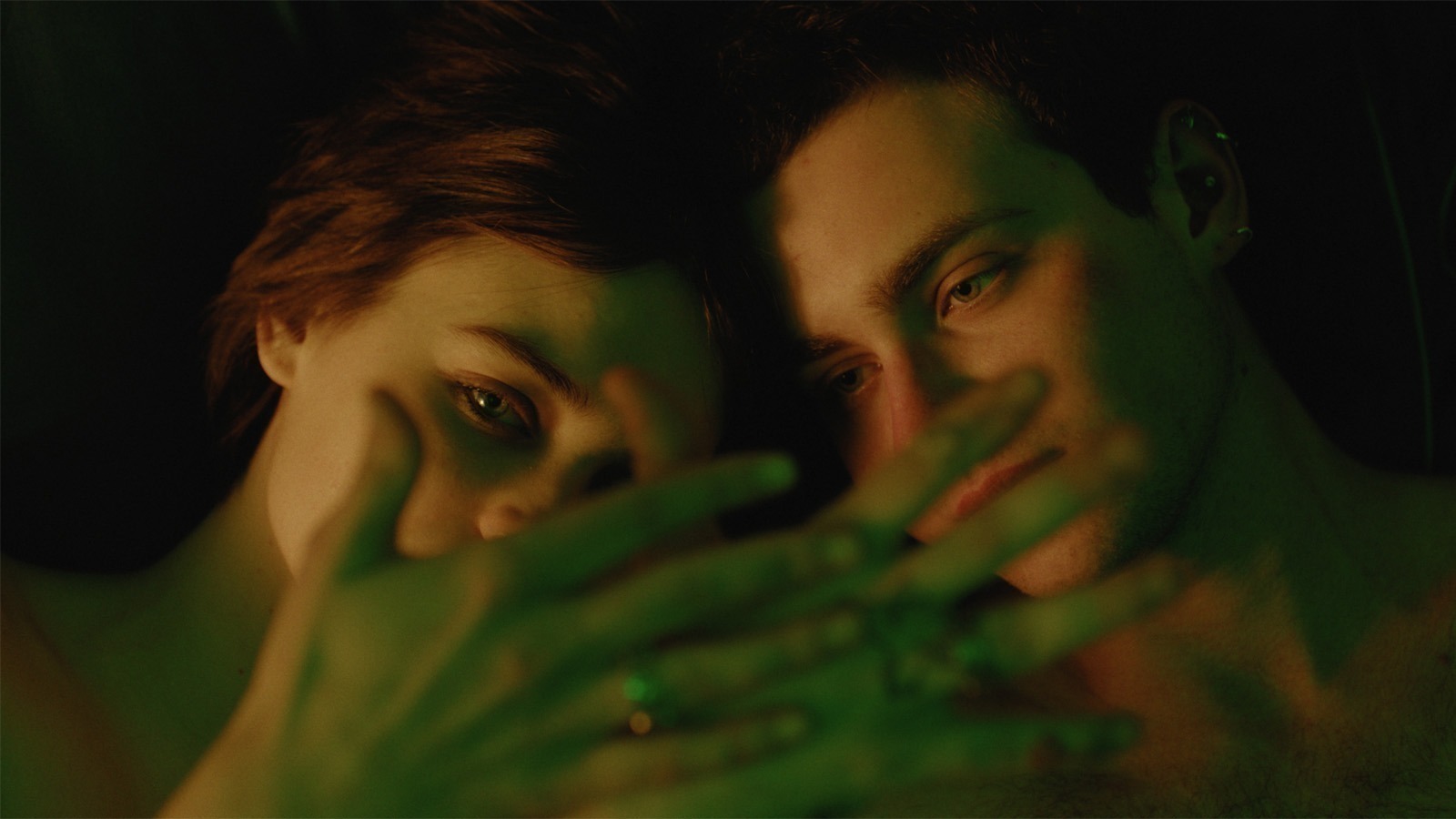
When the awards were presented in Locarno earlier this month, both Variety’s Guy Lodge and RogerEbert.com’s Robert Daniels noted that they were surprised that Fabrice Du Welz’s jury had overlooked a clear critical favorite, I Rarely Wake Up Dreaming. Written by Anna Melikova and directed by Isabelle Stever—the married couple who previously collaborated on the daring incest story Grand Jeté (2022)—I Rarely Wake Up Dreaming heads next to the New York Film Festival.
Olya (Tania Myronyshena) and Oleh (Markus Bright) are a queer couple in Kyiv already working through a personal crisis when, in February 2022, Russia launches its invasion of Ukraine. “I entered a heterosexual relationship against my will,” Olya tells Oleh, who has come out as a trans man. “You promised me you’d stay the same person.”
As missiles pummel Kyiv, the couple first flees west to Olya’s parents, and from there, they intend to head to Berlin. But at the border, guards insist that Oleh—despite his officially documented gender dysphoria—declare himself either a woman or a man. As a woman, he would be free to move on to the EU. As a man, he would have to stay and fight. This confrontation presents “the kind of set piece that has every opportunity to become sensationalistic but never takes the bait,” writes C. J. Prince.
For Leslie Felperin in the Hollywood Reporter, I Rarely Wake Up Dreaming “succeeds not only as an examination of the extraordinary quandary facing the couple but also simply as a compelling wartime drama featuring excellent performances from the two leads, who are, like most of the cast, nonprofessional actors.” Myronyshena is a journalist working with the Kyiv Independent, and Bright is a cofounder of The Third Place, an NGO for autistic adults.
“A Crimea-born curator and novelist, Melikova is also known as a gifted ex–film critic, the kind who published long, knotty interviews with such deep-cut German directors as Stever,” writes Sonya Vseliubska for IndieWire. “From Melikova’s intimate prose and local industry connections arises an essential sensory texture of national belonging, alongside a moral register sharp enough to carry a critical charge and light enough to keep it wry.”
At DMovies, Nataliia Serebriakova finds that Melikova’s screenplay “captures not only the dramatic events of the beginning of the invasion but also the everyday reality of Ukrainians who continued to live, love, argue, celebrate, and make plans despite the catastrophe surrounding them.” And Stever’s direction is “based on observation, physical details, and emotional authenticity rather than explanation. The result is a film that feels deeply rooted in Ukrainian life.”
At the Film Stage, Leonardo Goi senses that the film “wants to trace a correlation between Oleh’s identity crisis and his own country’s, between an individual and a nation that are both trying to find themselves and resist forces that would rather wipe them out altogether. That’s an apt analogy, if one that Dreaming seems frustratingly engineered to draw. Its dramatic logic is almost transparent in its forceful connection of the micro and macro; and Oleh, for all the intricacies of his existential struggle, sometimes registers as a chess piece moving along a monotonously literal trajectory.”
“A third-act development that again redefines the couple’s place in heteronormative society is somewhat rushed, leaning too heavily into melodrama to be wholly convincing,” writes Guy Lodge. “But it’s moving just the same, underlining the filmmakers’ interest in unorthodox found-family structures, and their foregrounding of minorities whose rights are often the first to be disregarded in times of national crisis. As the conflict in Ukraine trudges on, Stever’s stark, surprising film is a reminder that we’ve barely skimmed the surface of the country’s war stories.”
Don’t miss out on your Daily briefing! Subscribe to the RSS feed.