Graham Greene at the Harvard Film Archive
Share
The Harvard Film Archive returns from its summer break with a selective yet robust retrospective, The Cold Heart Is More Precious Than Diamonds: The Cinema of Graham Greene. Running through September 19, the series opens on Friday with The Fallen Idol (1948), the first of three collaborations between director Carol Reed and the prolific novelist, book and film critic, and screenwriter.
As Howard A. Rodman has noted, Greene once described Reed as “the only director I know with that particular warmth of human sympathy, the extraordinary feeling of the right face for the right part, the exactitude of cutting, and not least important the power of sympathizing with an author’s worries.” In The Fallen Idol, based on Greene’s 1936 short story “The Basement Room,” an ambassador’s young son (Bobby Henrey) befriends the family butler (Ralph Richardson), who quarrels with his wife (Sonia Dresdel) and has been seeing another woman (Michèle Morgan) on the side. Death, suspicions, and misunderstandings ensue.
“The shifting of viewpoints, from shot to shot or within the same shot, is what The Fallen Idol is made of,” writes Geoffrey O’Brien, adding that “Greene’s vision of betrayal as central to human experience found its perfect corollary in Reed’s characteristic tilted angles, which here serve as constant, sometimes brutal, reminders that someone else is watching or overhearing. A sense of dread permeates ordinary life; the slightest gesture or most innocuous object can trigger disastrous consequences.”
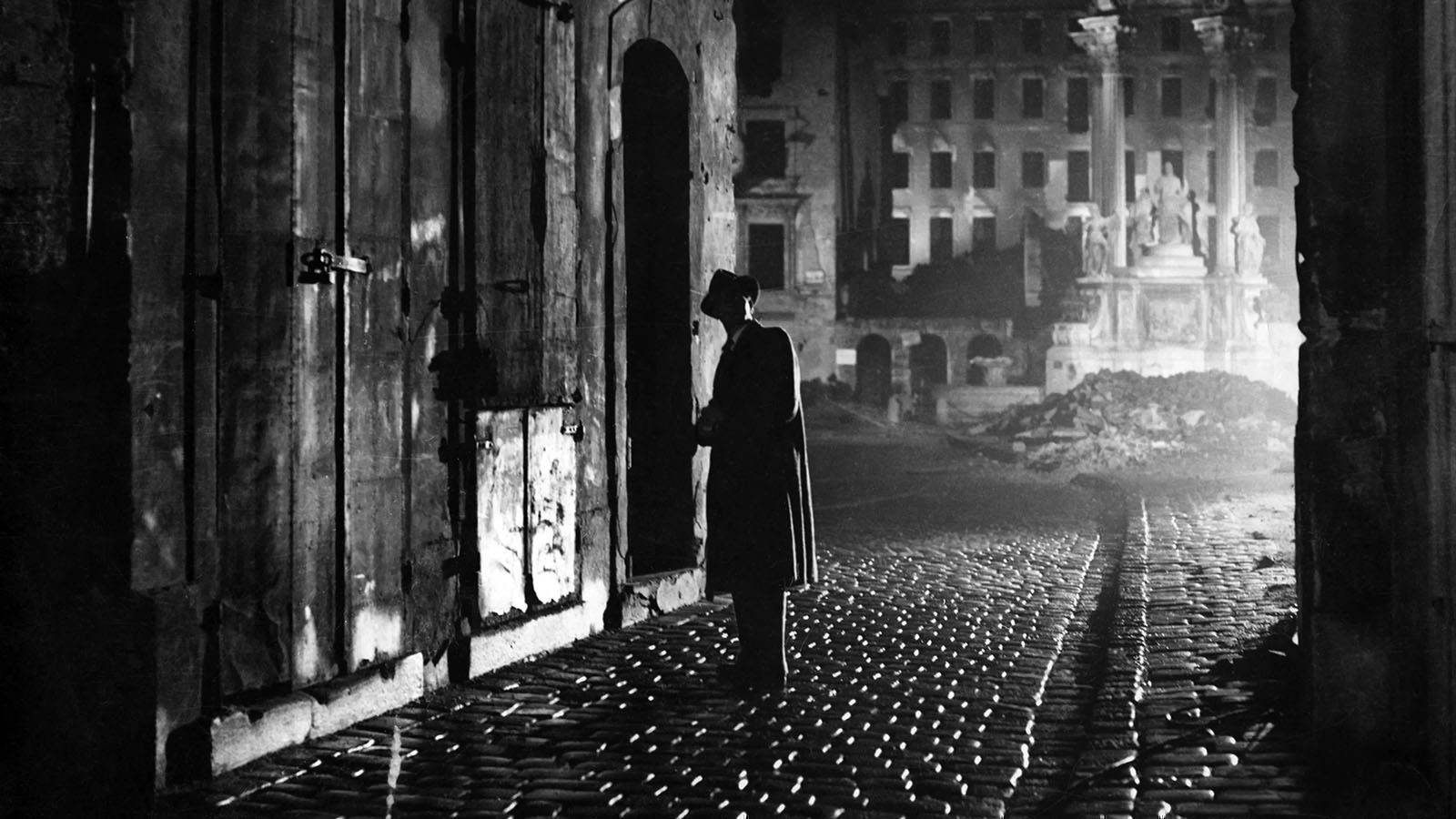
Directed by Reed from Greene’s original screenplay, The Third Man (1949) stars Joseph Cotten as a pulp-fiction writer who arrives in Vienna to take up a job offer from his friend Harry Lime (Orson Welles), only to discover that Harry is dead. Lucy Sante has called the film “one of that handful of motion pictures (Rashomon, Casablanca, The Searchers) that have become archetypes—not merely a movie that would go on to influence myriad other movies but a construct that would lodge itself deep in the unconscious of an enormous number of people, including people who’ve never even seen the picture.”
“No director ever served a screenwriter as well,” declared novelist Philip Kerr in a 2008 essay on The Third Man. “But it’s still Greene’s picture. You may not see him in the film, but Greene is always there, lurking in every shadowy, bullet-scarred doorway, watching the action with a raised eyebrow and a cynical smile.”
Reed and Greene reteamed ten years later on an adaptation of the latter’s 1958 novel Our Man in Havana—shot on location just two months after the overthrow of the Batista regime. Writing for TCM, Frank Miller suggests that the film’s “high-octane cast—including Alec Guinness, Ralph Richardson, Noël Coward, Ernie Kovacs, and Maureen O’Hara—and witty Graham Greene script make it a standout, well worth rediscovery and reevaluation.” Miller also has stories to tell about Fidel Castro’s set visit and O’Hara’s long chats with Che Guevara about Irish rebellions against the British.
The earliest adaptation in the series is Frank Tuttle’s classic noir This Gun for Hire (1942), based on Greene’s 1936 novel A Gun for Sale. “Alan Ladd’s transformation from stubbly fleapit dweller to angel of death (trench coat, fedora, faint smile) is a severe trick, and a rare chance to see an icon being whipped up right before your eyes,” writes Fernando F. Croce. “Veronica Lake’s musical numbers are similarly svelte sleights of hand.”
Released seven months later, Alberto Cavalcanti’s Went the Day Well? (1942) is based on Greene’s 1940 story “The Lieutenant Died Last,” in which a small English town thwarts a German troop’s efforts to lay the groundwork for a Nazi invasion. In 2008, Tom Huddleston, writing for Time Out, found that the film “remains a jaw-droppingly subversive and efficient piece of work, as former documentarian Alberto Cavalcanti establishes, with loving care and the occasional wry wink, the ultimate bucolic English scene, then takes an almost sadistic delight in tearing it to bloody shreds in an orgy of shockingly blunt, matter-of-fact violence.”
Greene’s “dismissal” of Fritz Lang’s 1944 adaptation of the 1943 novel Ministry of Fear “can be seen to derive, depending on your perspective, from either critical detachment or enlightened self-interest,” wrote Glenn Kenny in 2013. “As for Lang’s own misgivings concerning this actually quite excellent picture, they could have had something to do with the kind of filmmaker he aspired to be at the time.”
The story of an Englishman “drawn into a Nazi espionage machination in Blitz-battered Britain must have appeared to Lang to present opportune material with which to continue his own war effort,” added Kenny, but “the absence of standard-issue Menacing Nazis is one of the distinguishing characteristics of Ministry of Fear . . . Just as this is not a propaganda film, it isn’t a puzzle film either. It’s a nightmare film, pure and simple.”
On the poster for Broadway producer turned director Herman Shumlin’s Confidential Agent (1945), based on Greene’s 1939 novel, Charles Boyer and Lauren Bacall—who play a spy and the bored rich woman who teams up with him—kiss, and Warner Bros. promises that “You’ll see the screen Cook when ‘The Lover’ meets ‘The Look’!!!” Writing for Cineaste, Leonard Quart finds the film “static and somewhat stolid, but there is nevertheless enough of Greene here to make it of interest.”
Quart has similar reservations about John Ford’s The Fugitive (1947), starring Henry Fonda as an outlaw priest and filmed in Mexico by the great Gabriel Figueroa with assistance from Emilio Fernández, the renowned director working here as an associate producer. Based on The Power and the Glory (1939), “arguably the best novel Graham Greene wrote,” as Quart puts it, The Fugitive is “an exquisitely shot film, whose indelible beauty cannot save it from being one of Ford’s lesser works.”
Richard Attenborough was twenty-four when he played Pinkie, a low-level gangster, “with frighteningly volatile perversion” in John Boulting’s Brighton Rock (1948), writes Jeremy Carr in a 2018 deep dive for Notebook. Brighton Rock “had its roots in real-life Depression-era gangland activity, but arguably more than that, it had its thematic foundation in Greene’s deep-seeded Catholicism, manifest here by pervasive guilt and the predominance of a tortured soul.”
The Heart of the Matter (1953), directed by George More O’Ferrall, is adapted from Greene’s 1948 novel about Harry Scobie, an unhappily married deputy police commissioner in Sierra Leone who falls for a survivor from a torpedoed ocean liner (Maria Schell). “Despite its betrayal of Graham Greene’s concluding chapters, this is still an atmospheric adaptation,” found Time Out’s reviewer in 2012, “and as the tormented Scobie, Trevor Howard gives what is possibly his finest screen performance.”
In her program notes for the series, Sidney Dritz points out that the screenplay for The Stranger’s Hand (1954) “was born from a few chapters [Greene] had submitted under a pseudonym to a writing competition in the manner of Graham Greene (he came in second). In it, Greene distilled his own style thus: a little boy with a wide-eyed, innocent view of the world must search for his missing father, which leads him into a seamy underworld of international espionage and interpersonal double-crossing. Mario Soldati’s subsequent film, extrapolated from these chapters, was an attempt to out-Graham Greene all other Graham Greene adaptations by shooting on location in the twisting streets of a European city—lending a distinct character of place to the narrative—and by casting Trevor Howard and Alida Valli, stars of other successful Greene adaptations, in key roles.”
The series wraps with an oddity starring Maggie Smith, George Cukor’s Travels with My Aunt (1972), “a whimsical romantic fantasy that works,” as Roger Ebert described it—“which is to say, if you are not a fan of whimsical romantic fantasy, it’s going to be too much for you. It was nearly too much for me—I found myself wincing from time to time when one of the movie’s ornate props seemed about to bean me—but in the end I was won over, I guess.” Andrew Sarris, on the other hand, admired “the bursts of color amid assured pacing and grading that mark Cukor’s mastery of the medium.” Writing in the Village Voice in 1973, Sarris called Travels with My Aunt “a resonant enchantment.”
Don’t miss out on your Daily briefing! Subscribe to the RSS feed.