Kyoko Kagawa Rarities
Share
In a career spanning seventy-five years, Kyoko Kagawa has made lasting impressions as the youngest daughter of aging parents in Yasujiro Ozu’s Tokyo Story (1953), the sister of an escaped slave in Kenji Mizoguchi’s Sansho the Bailiff (1954), the wife of a wealthy industrialist in Akira Kurosawa’s High and Low (1963), and the love of two men’s lives in Hirokazu Kore-eda’s After Life (1998). These are all vital supporting performances, but with Kyoko Kagawa Rarities, programmers Joseph Eusebio and Akinaru Rokkaku are putting Kagawa front and center.
The series opens in New York on Thursday evening at Anthology Film Archives with Mikio Naruse’s Little Peach (1958), and four more films starring Kagawa will screen from Friday through Sunday at Asia Society. Writing about Little Peach for Slant in 2005, Keith Uhlich suggested that Naruse was working through some of his own issues when he created the character of the struggling writer Ryokichi Urshiyama (Isao Kimura).
But Little Peach is “less Ryokichi’s story than it is his long-suffering wife Kyoko’s (Kyoko Kagawa),” wrote Uhlich. “Naruse details the couple’s courtship in the film’s romantic and intoxicating first half-hour,” and the film’s second half “plays as a sort of prequel to Naruse’s marital-strife drama Sudden Rain, with the director similarly illustrating the divide between houses via his superb compositional grasp of interior space and through his keen use of music as psychological demarcator.” Ultimately, Little Peach becomes “a loving portrait of a woman tragically caught between her wants and her responsibilities, fated to tread a potentially never-ending path between the trials of her marriage and the refuge of her past.”
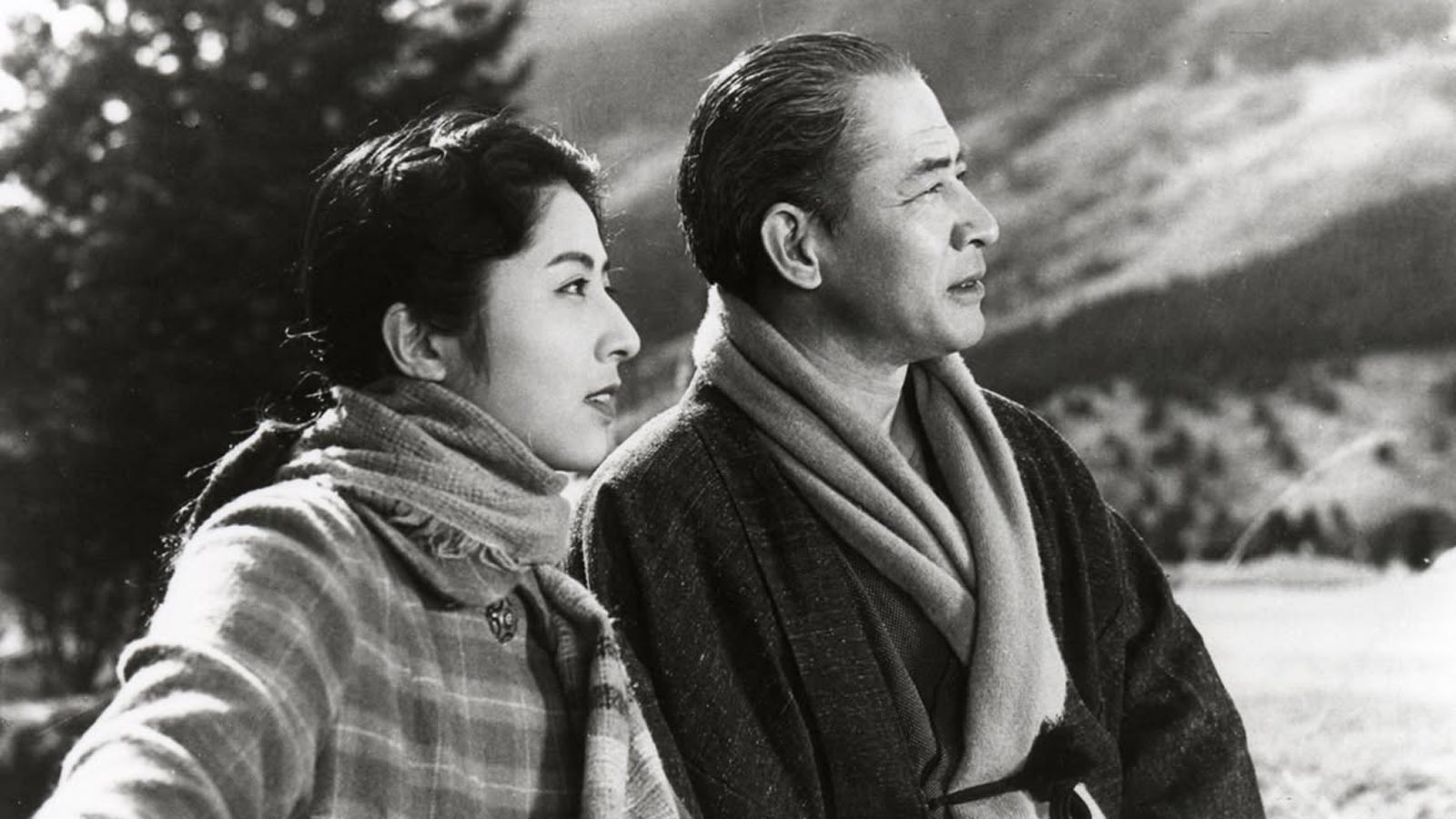
Nobuo Nakagawa’s Farewell to the Highland Station (1951) will be seeing its U.S. premiere on Friday. A botanist (Michitaro Mizushima) heads to a sanatorium in the highlands, where he falls for Yuki (Kagawa), a nurse in white.
“Kagawa’s performance is extraordinarily subtle and richly nuanced,” writes Marcella Leonardi. “In Yuki we find the innocence of the protagonist of Five Sisters (1954),” the drama directed by Seiji Hisamatsu screening on Saturday; “the joyful vitality of the mischievous young woman in Shozo, a Cat and Two Women (1956),” Shiro Toyoda’s comedic adaptation of a text by Jun’ichiro Tanizaki, screening Sunday; “but also the despair of the tragic Osan in [Mizoguchi’s] A Story from Chikamatsu (1954). Farewell to the Highland Station reveals an increasingly mature and self-aware actress, capable of modulating an emotion through a gesture, a smile, or a fleeting expression.”
On Saturday afternoon, Asia Society will present Tokyo Rendezvous (2008), the first feature directed by Chihiro Ikeda, who would go on to cowrite Kiyoshi Kurosawa’s Creepy (2016). In Tokyo Rendezvous, a salaryman (Hidetoshi Nishijima) aims to sell his grandfather’s land but instead finds himself living there. He seeks advice from local elders played by Kagawa and Sansei Shiomi. “Amidst glowing 16 mm frames shot by the great Masaki Tamura (Lady Snowblood, Eureka),” writes Joseph Eusebio in his program notes, “we feel the living charge of humble stardom across generations.”
Don’t miss out on your Daily briefing! Subscribe to the RSS feed.