Arthur Harari’s The Unknown
Share
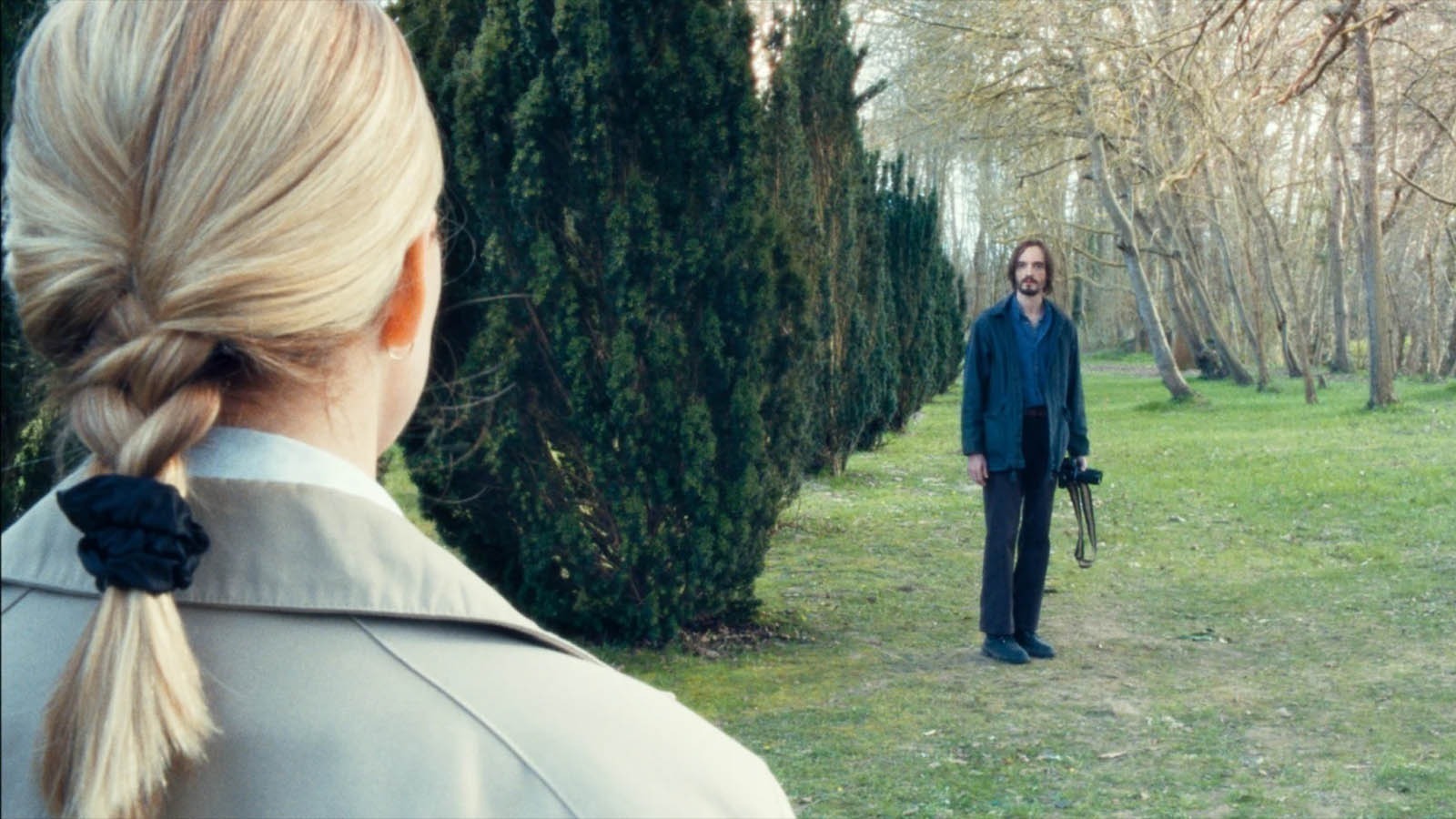
Arthur Harari’s The Unknown, screening on Friday, October 2, and Monday, October 12, at the New York Film Festival, was met with both glowing and damning reviews when it premiered in competition at Cannes. On the Film Comment Podcast,Jordan Cronk, Adam Piron, and Ruun Nuur tried to explain to host Devika Girish what it was about the film that they just couldn’t shake. Bertrand Bonello’s The Beast (2023)—which, like The Unknown, stars Léa Seydoux—came up, making what appears to be one of the year’s great stumpers all the more intriguing.
Niels Schneider, perhaps best known for his work with Xavier Dolan, costars as David, a photographer who has been documenting the changing cityscape of Paris. Eva (Seydoux) has caught his attention before she shows up at a club with a hungry yet passionless stare at David. After a furious hookup, David wakes up to discover that he’s inhabiting Eva’s body. Freaked out, David heads out to track down his previous body, and when he finds it, he realizes that there is a teenage girl in there, Malia (Lilith Grasmug).
David—appearing to the viewer, remember, as the spitting image of Léa Seydoux—and Malia (Schneider) go looking to unravel the mystery, and their path leads them at one point to Malia’s father, played by Radu Jude. “Not to make too much of what is a relatively small (though not insignificant) role,” writes Jessica Kiang in Variety, “but Jude’s anomalous casting as Malia’s Marcus Aurelius–quoting, crane operator dad does carry with it a current of eccentric vivacity that the rest of the film sorely lacks.”
For Kiang, it’s “an interesting instinct, to drain the body-swap premise of its comic, Steve-Martin-channelling-Lily-Tomlin potential so that it hews closer in feel to something like Kafka’s ‘Metamorphosis’—a clear inspiration here, albeit shorn of the novella’s absurdist gallows humor. But along with the comedy, a lot of the life has drained out of the concept too.” And for Hannah Strong at Little White Lies, The Unknown’s “intriguing premise is completely underserved by its oblique script.”
The Hollywood Reporter’s David Rooney suggests that “calling this sui generis freakout horror or sci-fi or even fantasy seems simplistic. There’s a surface kinship here with films like It Follows and especially Under the Skin, in which post-coital afterglow sours fast. But the director declines to get too specific about his allegorical intent, which could be sexual trauma or gender identity or just a mysterious body-snatcher nightmare. Either way, this is a spellbinding psychological puzzler led by a typically fearless performance from Léa Seydoux.”
“One of the best aspects of The Unknown is its lack of causes,” writes the New Yorker’s Richard Brody, adding that “the crisis is inexplicable, traceable to nothing like environmental catastrophe, biological mutation, or supernatural curse. Something has happened to these characters, it may have afflicted a few others, and they all must simply deal with it . . . The transformations are achieved with a rare virtuosity—the actors’ precision fuses with the meticulous screenwriting (by Harari, his brother Lucas, and Vincent Poymiro, based on a graphic novel by the brothers)—and the direction anchors the characters in their respective milieux in ways that, through the disturbance of normalcy, turns familiar places and habits strange and uncanny.”
Harari—best known for his 2021 feature Onoda: 10,000 Nights in the Jungle and for cowriting Anatomy of a Fall (2023) with his partner, director Justine Triet—“reaches new heights, adopting a late-modernist approach that I’d have no problem filing alongside works from the likes of Kieślowski, Antonioni, and Lynch,” writes Blake Williams for Notebook. “Harari flirts with the ridiculous while maintaining a firm grasp on sincerity, and The Unknown is as mesmerizing as it is because it allows the viewer to effectively (and affectively) embody an intersubjective perspective on the world, whereby the increasing disassociation we feel towards our own bodies is treated as a serious and defining development of modern life.”
Williams adds that The Unknown is “an allegory for cinema-going, too, yes, and it takes that task seriously as well. But the allure of this film’s confidence to keep expanding, to unremittingly fall deeper into itself with each new scene, nearly every shot, is one that easily transcends its function as cinema. It goes so far as to encompass the sense that only ever being able to exist as ourselves, bound into a single body and consciousness for life, feels further from an absolute than ever.”
At Reverse Shot, Julien Allen argues that “nothing, however challenging or opaque, is gratuitous in The Unknown—especially given that identity and visual familiarity are active components of the narrative. Body-swap, previously the cinematic preserve of comedy (Freaky Friday, All of Me) or genre (Face-Off, Possessor), here provides the starting point for an absorbing existential drama, which at times thrillingly exploits its marriage of narrative thriller techniques and Freudian fantasy.”
Further, Allen suggests that The Unknown “operates as an electroshock-fueled invitation to outflank our standard operating procedures when identifying with screen characters visually, and to begin to dig into, comprehend, and relate to ‘others’ (in all senses of that word) on a much deeper level. The souls (Eva, David, Malia) to whom we have been introduced are still intact and worthy of investment, but their afflictions mean that they no longer fit the world around them. That is a challenge for them, but more valuably, it is a challenge for us.”
Don’t miss out on your Daily briefing! Subscribe to the RSS feed.