Werner Herzog’s Bucking Fastard
Share
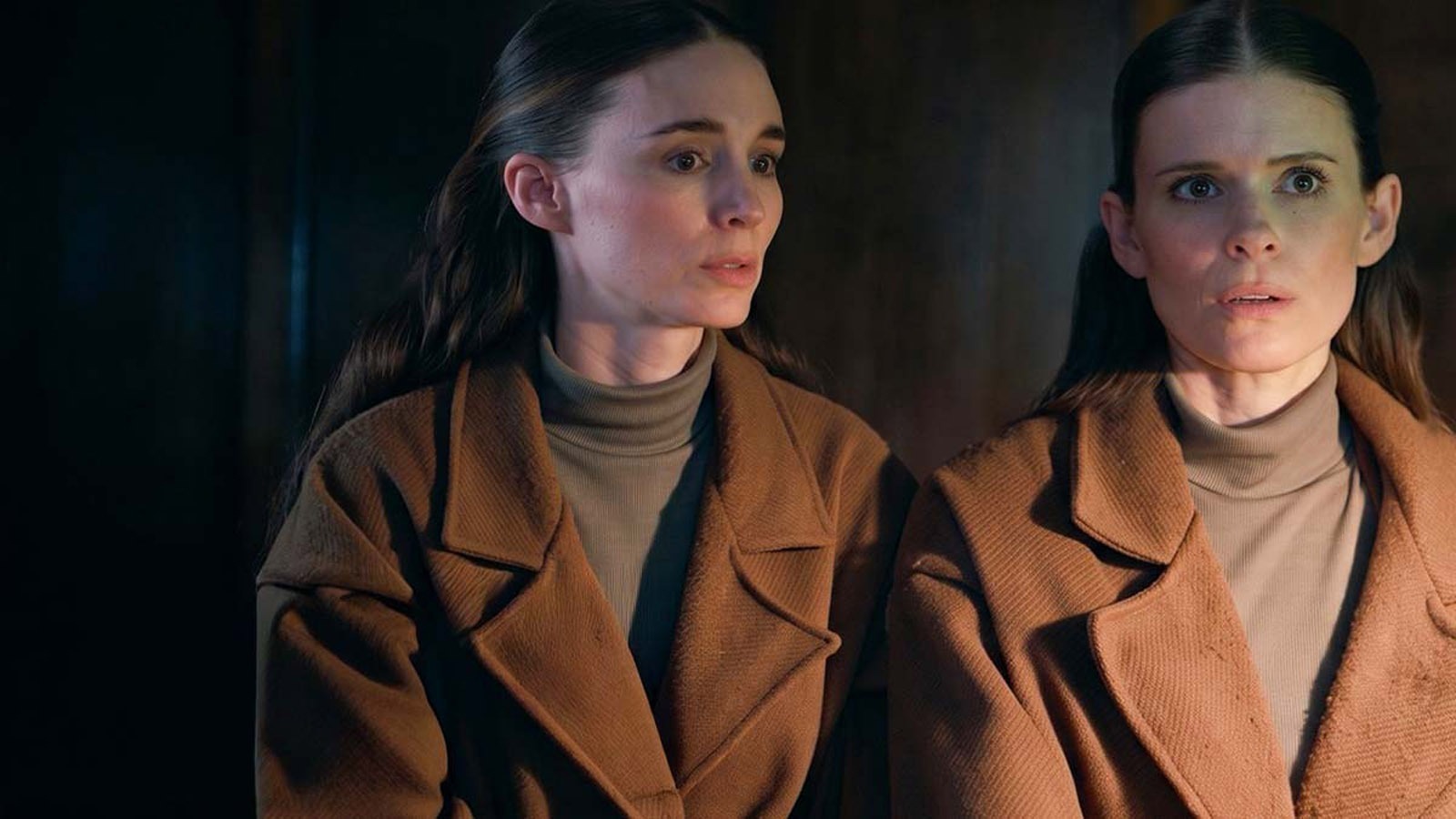
In the early 1980s, the case of Freda and Greta Chaplin, twin sisters from Yorkshire, kicked up a flurry of media attention in the British press. The Chaplins had been obsessing over a local truck driver and were briefly locked up for harassing the man. The story lit a spark in Werner Herzog’s imagination, one that smoldered for decades until he hit upon the brilliant idea of casting Rooney and Kate Mara as Jean and Joan Holbrooke, two sisters in contemporary Ireland—not twins, they insist—who go on trial for taking sneaky revenge on the beau (Orlando Bloom) who has spurned them for another woman.
“In its tale of two sisters bonded so closely that they do everything in eerie, exact unison, and the rejection they subsequently face in the world, we can see a variation on the twisted innocents and holy fools that populate so much of the director’s work,” writes Vulture’s Bilge Ebiri. “Bucking Fastard is dedicated to David Lynch, but perhaps Herzog should have dedicated it to his younger self, to the Werner Herzog who made The Enigma of Kaspar Hauser, Even Dwarves Started Small, and Woyzeck—sigh, the things that guy could have done with this deliciously weird tale. Bucking Fastard is nuts, yes, but it could have been, should have been nuttier—transcendentally, galactically nuttier.”
Leonardo Goi, writing for the Film Stage, has his reservations as well, but “if I cannot bring myself to dismiss Bucking Fastard entirely, it is not out of auteurist reverence, but because the wide-eyed romanticism that permeates it feels genuine, heartfelt, and occasionally infectious.” For one thing, “there’s an irreducible tension between the two women—and the actresses who embody them—that makes their union a highly volatile, staticky relationship, and Herzog mines their joint activities (vacuuming, making tea, or opening a can of sardines before a friendly counselor played with saint-like patience by Domhnall Gleeson) for some surreal choreographies.”
“Where many twin narratives concern the desire to be seen as individuals,” writes Hannah Strong at Little White Lies, “this film explores the concept of two sisters who yearn to be a single entity and the complications such a desire creates in a world obsessed with individualism.”
The Maras’ sister act—“think the eerie supernatural twins in The Shining (1980) but much more cheeky fun, and dressed by Wes Anderson’s production team,” suggests Stephen Dalton at the Film Verdict—is “an impressive feat of disciplined acting that exerts its own peculiar fascination,” writes the Hollywood Reporter’s David Rooney. “At least for a while. Part of it is the identical outfits, a look that mixes Olsen twins with sister wives and a dash of Franciscan monk. Love the brocade granny handbags. But radical anti-fashion aside, this bizarro fable about unfulfilled love, oversized knitwear, and abandoned story threads frays beyond repair, well before it reaches an abrupt and perplexing halt.”
To escape the media frenzy, Jean and Joan Holbrooke move into an apartment in Dublin before taking up an aunt’s invitation to live with her out in the countryside, where the sisters discover a cave and decide to burrow their way through a mountain to some mystical land where they will find true love. “From there, Bucking Fastard becomes a set of wriggly vignettes more than a linear story,” writes Time’s Stephanie Zacharek, and “the meandering storyline is pure, sweet, gaga Herzog.”
In Sight and Sound, Nicolas Rapold finds that “Herzog’s latest eccentric yarn is probably his best fiction feature since he had his second coming in the 2000s as a kind of superhero Teutonic auteur,” and at the Daily Beast, Nick Schager suggests that Herzog has crafted “perhaps the most beguiling—and downright bizarre—film of his career.” It “may play at times like a greatest-hits compilation,” writes Mark Hanson at Slant, “but the sincerity with which Herzog regards the sisters’ stubborn hopefulness in the face of a selfish and uncaring world gives the film a lasting emotional power.”
Bucking Fastard screens on October 8, 10, and 12 at the New York Film Festival; on October 14 through 18 at Film Fest Gent; and on October 21 and 23 at AFI Fest in Los Angeles.
Don’t miss out on your Daily briefing! Subscribe to the RSS feed.