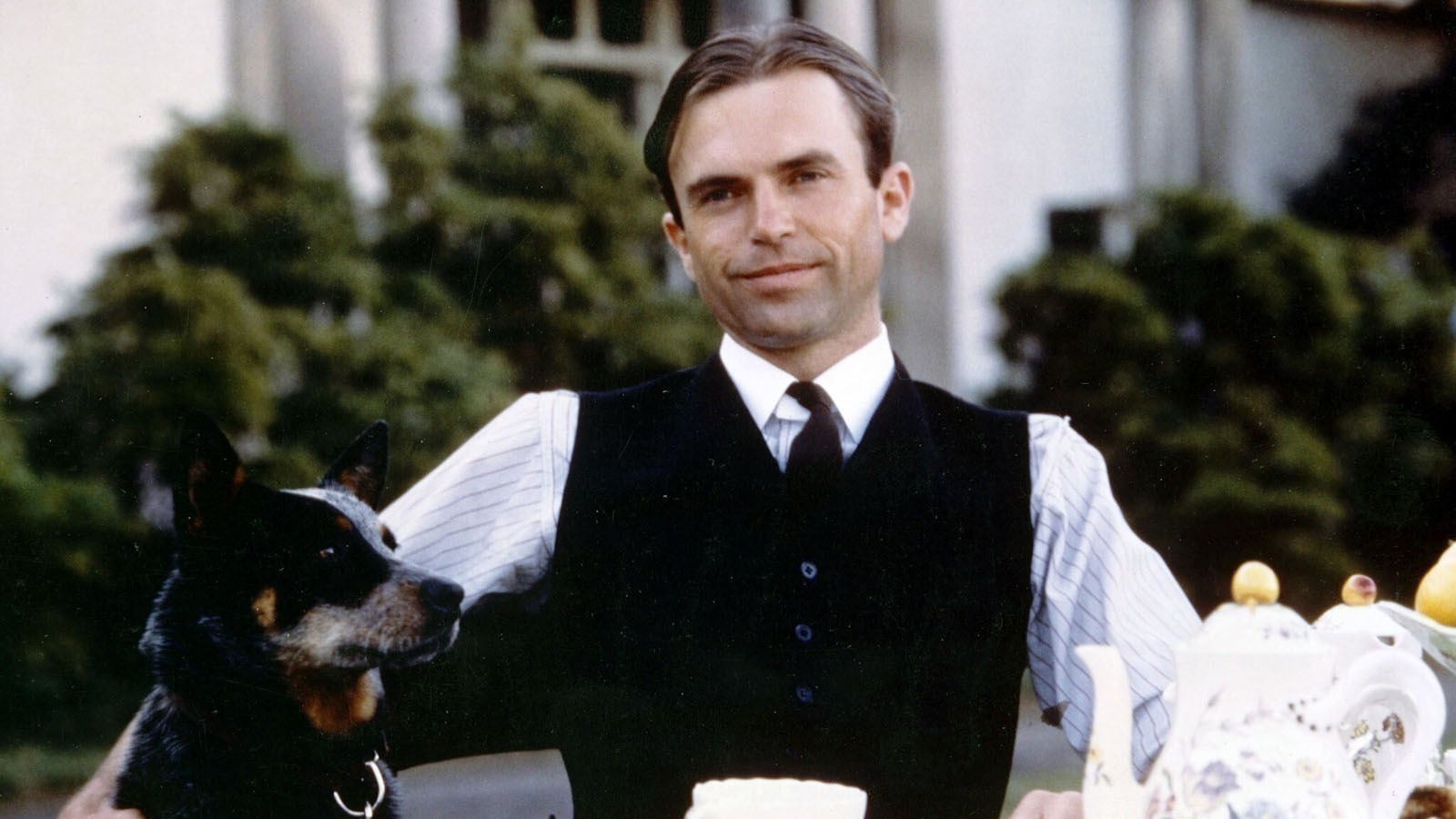
Sam Neill in Gillian Armstrong’s My Brilliant Career (1979)
One of the themes running through the vast outpouring of genuine affection for Sam Neill since his passing was announced on Monday is an appreciation for his eagerness to cede the spotlight to his costars. And more often than not, those costars were women: Judy Davis in My Brilliant Career (1979), Isabelle Adjani in Possession (1981), Nicole Kidman in Dead Calm (1989), or Holly Hunter in The Piano (1993). In scene after scene, his modest yet firm grip on his own character would not only allow but encourage his partner to take flight.
A few years ago, Neill sat down in his home in New Zealand, where he ran a respected winery, Two Paddocks, and started jotting down a few stories. In short order, those pages were steering toward a memoir: “The thing is, I’m crook. Possibly dying. I may have to speed this up.”
Neill had been diagnosed with a type of blood cancer that would require chemotherapy for the rest of his life. By the time Did I Ever Tell You This? was published in 2023, he could happily announce on his endearing Instagram account—where he often posed with the farm animals he’d named after friends such as Helena Bonham Carter (a cow) or Meryl Streep (a chicken)—that doctors had declared his body cancer-free.
“I’m not afraid to die,” Neill told Lucy Clark in a 2023 Guardian interview, “but it would annoy me. Because I’d really like another decade or two, you know? We’ve built all these lovely terraces, we’ve got these olive trees and cypresses, and I want to be around to see it all mature. And I’ve got my lovely little grandchildren. I want to see them get big. But as for the dying? I couldn’t care less.” His death at the age of seventy-eight was, as his family put it, “sudden and unexpected.”
The son of an Englishwoman and a New Zealander, Nigel John Dermot Neill was born in Northern Ireland, and when he was seven, the family moved to New Zealand. By the time he was eleven, he’d ditched his name and posh accent. “To land in a pretty rough playground in a New Zealand primary school with a plum in the voice and Nigel for a name was asking for trouble,” he wrote in his memoir. He decided to go by Sam because he liked westerns, and besides, it “sounds friendly.”
A projected career in law went nowhere, but while studying at universities in Christchurch and Wellington, where he was cast in drama school productions, he discovered that acting thrilled him. Working with the New Zealand National Film Unit, he directed short documentaries for television and appeared in Paul Maunder’s Landfall (1975) as a member of an unraveling rural commune.
Roger Donaldson cast Neill as a loner in Sleeping Dogs (1977), one of the first features produced entirely in New Zealand. The action-spiked political thriller “has a litany of reasons for why it is one of the most important Kiwi films ever made,” writes Abid Rahman in the Hollywood Reporter, “but Neill’s performance as the rebellious Smith, who fights back against fascist forces looking to take over his country, earned rave notices from critics, including Janet Maslin in the New York Times.”
The springboard to international recognition and eventually more than 150 on-screen credits was My Brilliant Career, the 1979 adaptation of Miles Franklin’s 1901 novel directed by Gillian Armstrong. Judy Davis stars as Sybylla, a headstrong woman determined to become a writer once she overcomes poverty and her unwanted feelings for her well-to-do childhood friend.
“The man in question is the fetching (and did I say rich?) Harry Beecham (Neill), he of the James Mason voice and hungry eyes that ravish Sybylla and not a few moviegoers,” wrote Carrie Rickey in 2019. “In 1980, I found Neill particularly attractive, and he is lovingly and lingeringly shot in this film. In other words, like the girl in most movies. In retrospect, I realize this was an early experience for me of seeing a male lust object through the eyes of a female director. In any event, never again was Neill quite so delicious.”
Whatever the opposite of delicious is, Neill imbued it in Mark, the Cold War–era spy he played in Andrzej Żuławski’s Possession. Mark returns to his home in Berlin to discover that his wife, Anna (Isabelle Adjani), seems utterly preoccupied by someone—or something—else.
“Adjani’s volcanic performance may be the film’s most famous element,” writes the Playlist’s Rodrigo Perez, “but Neill matches her hysteria with a different, equally terrifying form of psychic collapse: Mark begins as a devastated husband clinging to rational explanations and gradually becomes sweaty, bug-eyed, abusive, and barely recognizable. Neill makes the character frightening because his need to possess Anna remains emotionally legible even as the movie descends into grotesque, apocalyptic lunacy.”
In Phillip Noyce’s Dead Calm, Neill is a navy captain vacationing on his yacht with his young wife (Nicole Kidman) when they take on board a distressed survivor of a schooner disaster who turns out to be a murderous psychopath (Billy Zane). “Part Cary Grant, part MacGyver,” writes Glenn Whipp in the Los Angeles Times, “Neill gives a great physical performance, which he parlayed into well-paying Hollywood action roles for the rest of his career. None came close, though, to his flare-gun theatrics here.”
Playing a Russian officer, Neill joined the all-star cast of John McTiernan’s The Hunt for Red October (1990) before becoming part of another sprawling ensemble in Wim Wenders’ Until the End of the World (1991). Narrating the globe-spanning sci-fi drama, Neill plays Eugene, whose lover, Claire (Solveig Dommartin), is drifting away.
“His melancholy voice provides the film with a steady emotional current, grounding its vast geographical and philosophical ambitions in the sadness of a man watching someone he loves slip beyond his reach,” writes Nicholas Laskin at the Playlist. “Neill’s hauntingly subdued performance demonstrates how much he could contribute to a film through stillness, observation, and quiet emotional ache.”
In the summer of 1993, Jane Campion’s The Piano premiered in Cannes just one month before Steven Spielberg’s Jurassic Park became the highest-grossing film released worldwide, beating Spielberg’s own record set with E.T. (1982) and holding it until Batman Forever came along in 1995. The stars of Jurassic Park were, of course, the dinosaurs, but as the Telegraph’s Tim Robey points out, if Neill’s Dr. Alan Grant “couldn’t persuade an audience the dinosaurs were real, the entire film would have failed: it rested on his shoulders more than is often recognized.”
Talking with Brian Davids about the blockbuster in the Hollywood Reporter in 2022, Neill recalled that he’d “suggested something, which is an illustration of how I was never an action hero. [Laughs.] I said to Steven, ‘Look, after a lifetime of imagining dinosaurs, to actually see a dinosaur, Alan Grant just might flat out faint.’ [Laughs.] And Steven said, ‘Yeah, okay.’ So that’s why you see me stagger around and I have to sit down and put my head between my legs. [Laughs.] I thought, ‘That’s actually a human reaction,’ so I’m glad he was open to that.”
Campion became the first female director to win the Palme d’Or, and The Piano would go on to win three Oscars, including one for Holly Hunter, who plays Ana, a willfully mute Scottish woman who expresses herself through her piano. Neill’s Alisdair Stewart is a nineteenth-century settler in New Zealand, and because he’s arranged to have Ana, her young daughter (Anna Paquin, who was eleven when she won her Oscar), and the piano transported to him, he’s furious when Ana refuses to give him what he sees by the rights of their arranged marriage to be his to take.
“Sam was kind, committed, and supportive,” says Campion. “He looked after me and actually everyone on the set. He stomped through mud, organized dinners, bossed me around at rushes, and told me off if he thought I was letting the lighting get too dark. I loved him as Stewart. I can remember gasping as he pulled Holly out of his hut, into the streaming rain and mud, with a force I had not expected but at once realized the story needed. He already knew, Stewart’s jealousy was terrifying.”
“We hate him,” writes Glenn Whipp. “Which was fine by Neill, as he wrote in his 2023 memoir: ‘There is honor to be found in the second fiddle. Or fourth. No one notices you much, you don’t get nominated for things. But you served. I was there in an important feminist film. It’s a work of art. And look, that tiny little figure in the fabric—see down there on the right—that’s me. It’s a film that will always have a place in cinema history. And I served in it.”
“His voice was magical (it’s unsurprising that he played Merlin for a 1998 miniseries) and his exterior so composed that it became a thrill any time we saw him get ruffled,” writes Tim Robey. With his quietly dry humor and somewhat reserved comportment, Neill could throw us off when he let it rip as he did when playing the driven Dr. William Weir in Paul Anderson’s sci-fi horror movie Event Horizon (1997).
Ranking twenty of his favorite Neill performances in the Guardian,Luke Buckmaster places Neill’s leading turn in John Carpenter’s “sensationally loud and Lovecraftian” In the Mouth of Madness (1994) at the top. Neill plays John Trent, “an insurance investigator convinced that a mass hysteria event surrounding the release of a new horror novel is a PR trick. The hardened cynic who becomes a true believer is a classic trajectory, and our man runs with it to hell and back, the protagonist’s sanity erupting like a burst blood vessel.”
Taika Waititi’s Hunt for the Wilderpeople (2016) “takes a troika of familiar story types—the plucky kid, the crusty geezer, the nurturing bosom—and strips them of cliché,” wrote Manohla Dargis in the New York Times. “Charming and funny, it is a drama masquerading as a comedy about an unloved boy whom nobody wants until someone says, Yes, I’ll love him.” Neill plays that someone—who also happens to be the geezer. Earlier this year, Neill got “a bit teary” at a tenth-anniversary screening of one of the films he’d made during a career that spanned half a century that turned out to mean the most to him.
“It’s worth pondering why Sam Neill wasn’t a bigger star,” writes Ty Burr. “He worked for major directors, in major projects, and he clearly was in demand throughout his career . . . He was handsome enough, but in a slightly generic and slightly slippery way—a handsomeness that with an invisible twist of some inner dial could become threatening or weak or bitter. Above all, he never really had what every true movie star needs, which is a persona, some connective sense of who he was offscreen, whether that was true or not. Offscreen, I think he was more interested in just being a person, while onscreen he could be anybody but himself. We call such people actors, and we don’t really appreciate them until they’re gone.”
Don’t miss out on your Daily briefing! Subscribe to the RSS feed.