Karlovy Vary 60/80 Awards
Share
In 1959, Soviet authorities decided that the Karlovy Vary International Film Festival, founded in 1946, would be held every other year. This would allow Moscow’s fledgling festival to take the spotlight in the alternate years—until, of course, the dissolution of the USSR in the early 1990s. That’s why KVIFF’s sixtieth edition, which wrapped over the weekend, was also a celebration of eighty years as one of the main annual cultural events in Central Europe.
Among the many highlights of KVIFF 60/80 were the world premiere of a new restoration of Věra Chytilová’s Tainted Horseplay (1988); conversations with awardees, including Dustin Hoffman, Juliette Binoche, Jesse Eisenberg, Maggie Gyllenhaal, Jeffrey Wright, and Harvey Keitel; and Saturday evening’s presentation of the awards.
Crystal Globe Competition
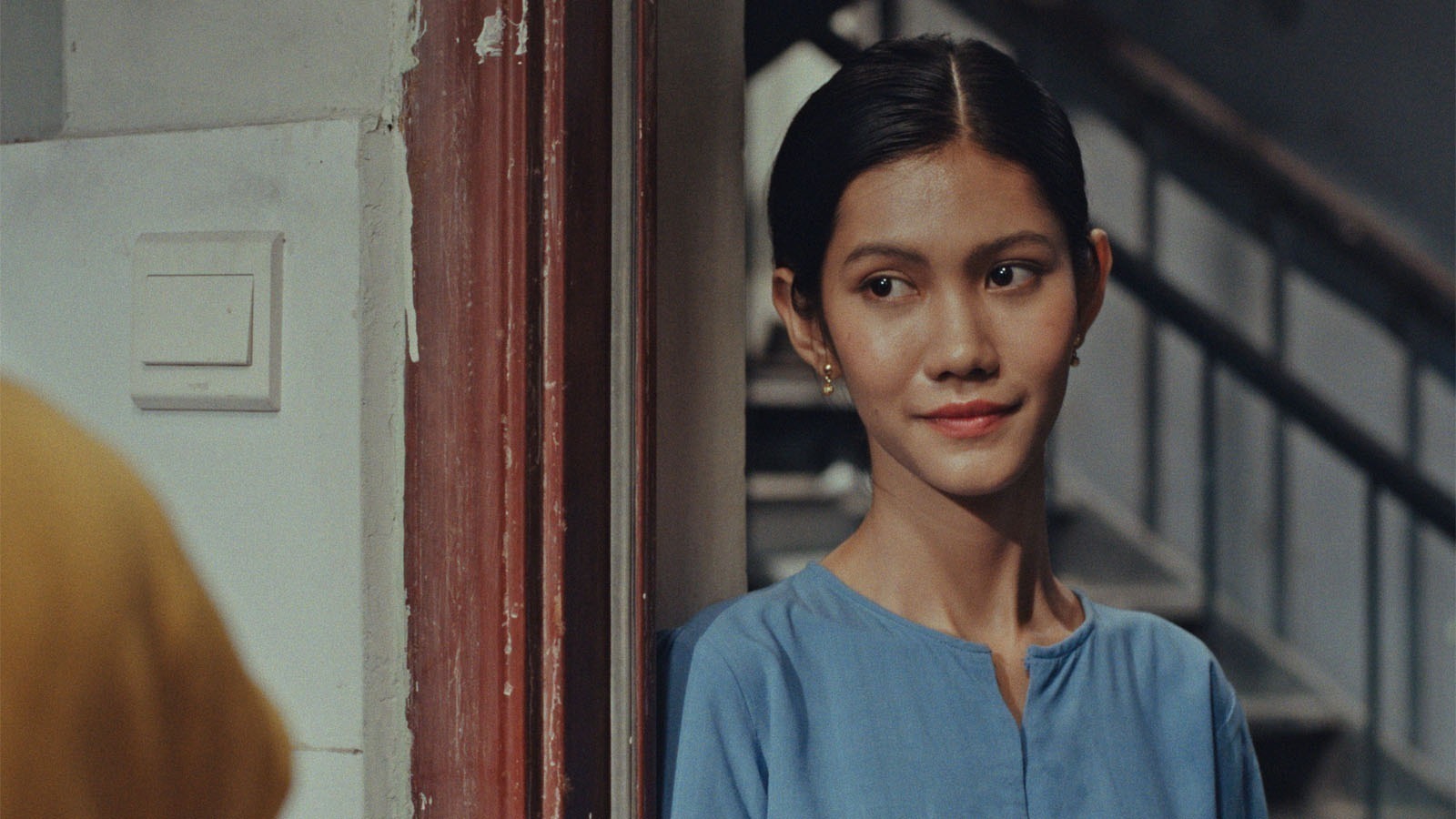
The festival’s top prize, the Crystal Globe, went to Fruit Gathering, the first feature from Aung Phyoe, whose shorts have screened at festivals in Locarno and Singapore. San Kyi (Nandar Myat Aung) is toiling away in a textile factory in Myanmar and keeping pretty much to herself when an outgoing new coworker, Theint Theint Oo (Nandar Myint Lwin), catches her eye.
“Fruit Gathering is most artful,” writes Variety’s Guy Lodge, “and most moving, when it interrogates the terms of this relationship through silent, pregnant gazes and gestures, shot with dreamy stillness in summery light by DP Thaiddhi, unaccompanied by any score: an image of one woman looking quizzically into the mirror where the other is brushing her hair; the subtly increasing pastel matchiness of Akari Diraki’s beautifully tailored costumes; the outwardly platonic but internally loaded significance of holding hands in a public place. Any greater eroticism is largely kept off screen, but such scenes crackle with sensual possibility.”
Another first feature, Mads Mengel’s The Guest, won both the Special Jury Prize and the Best Director Award. New parents Karl (Simon Bennebjerg) and Emilie (Mette Klakstein Wiberg) have invited just a few close family members to a seaside hotel in Denmark, where they will celebrate the naming of their newborn son. Definitely not invited is Karl’s mother, Vibeke (Trine Dyrholm). Karl hasn’t spoken to her in years, but his sister, Rikke (Josephine Park), clearly has. She’s the one responsible for Vibeke making a surprise appearance at the party.
“Clean-lined and sharp-edged,” writes Jessica Kiang for Variety, “with David Bauer’s cinematography washed in cool-toned summer light and line-dried under pale Scandinavian skies, the film has many hallmarks of the current Nordic drama wave: parental estrangement, familial resentments, the pained politeness of the middle-class in response to social discomfort, blondeness. But in a virtuosic yet restrained performance of volatility from actress Trine Dyrholm, it also shows a steely tensile strength that distinguishes it from its softer contemporaries.”
“The most audacious move here,” suggests Leslie Felperin in the Hollywood Reporter, “may be Mengel and cowriter Christian Bengtson’s choice to write something that will inevitably invite comparisons with Festen (The Celebration), arguably the most notorious Danish-language film of the last thirty years, which similarly revolved around a bougie gathering disrupted by angry revelations. But there’s a savvy 2026 vibe about the way the film refuses to create florid melodrama out of quotidian crisis, and instead observes with generosity as the characters grope awkwardly toward emotional détente and mutual forgiveness.”
In Jan-Eric Mack’s A Happy Family, Anna Schinz, the winner of the Best Actress Award, “impresses from the get-go as Nicole ‘Niki’ Hofer, a single mother of two already struggling to satisfy child protection services in the film’s opening scene,” writes Elena Lazic for Variety. “Anna was actually the head writer,” Mack tells the Hollywood Reporter’s Georg Szalai. “She started this project and, since we are a couple, the film was living with us for about five years. During the process, we added two cowriters to the project. The four of us wrote it, which is very unusual, but we are very close. Later, Anna needed to change perspective from an analytical view as a writer to an emotional approach as an actress to become the main character.”
Jurors Justin Chang, Amanda Nell Eu, Pavel Rejholec, Nadia Turincev, and Eskil Vogt presented the Best Actor Award to Ghassan Saad “for fully inhabiting the role of a longtime village plumber who greets every setback with surprising warmth and gruff good humor” in Pipes, the fifth feature Karim Kassem has directed in the past five years.
Proxima Competition
With its Proxima Competition, KVIFF aims to give “space to the world’s new voices from across the vast cinematic spectrum.” Lover, Not a Fighter, the first feature from Slovakian director Martina Buchelová, won the Grand Prix. Adam Kubala stars as twenty-year-old Andrej, who is trying to dry out—with only a limited degree of success—while summering with his grandmother. As he clicks with and eventually falls for Miša (Michaela Kostková), Buchelová widens her scope to draw in a winningly eclectic array of supporting players.
“Structured as a patchwork of loosely connected, inconsistently chronological episodes,” writes Guy Lodge, Buchelová’s “hugely appealing” film “feels rhythmically shaggy in a way that reflects the insecurities, anxieties and liberties of GenZ living, without patronizing its drifting characters.”
A Special Jury Prize went to Shuntaro Uchida’s Incinerator,which jurors Estrella Araiza, Dirk Decker, Jakub Felcman, Devika Girish, and Marija Kavtaradze call “a film of deceptive simplicity—its subtlety and lightness bely layers of poetry and profundity. The director beautifully adopts the perspective of an unusual young girl who says little, but senses everything; like a Richter scale her face records the unspoken tensions and tremulations of everyone around her.”
Efthimis Kosemund-Sanidis won the Proxima Best Director Award for A Whole Person Almost, the story of a young man’s trip to a remote island to claim his late father’s inheritance. “Even after almost twenty years, the so-called Greek Weird Wave still appears to be going strong,” writes Marko Stojiljković for Cineuropa. “Here, the setting of an unnamed island—one that lives by its own rules, at once rigid and ever-changing—serves that purpose perfectly, as the filmmaker and his cowriter, Elizampetta Ilia Georgiadou, explore not just the setting itself, but also the characters’ inner lives and psychology.”
A Proxima Special Mention went to Anna and Šimon Domček’s 33 Steps, a blend of fiction and nonfiction that focuses on Milan Daniel, a Roma man who was attacked near the Czech-Slovak border. “In a deep, raw voice-over, he tells us how he saw both the devil and God while he was in a coma, and that the latter warned him not to seek revenge,” notes Vladan Petkovic at Cineuropa. The jury calls 33 Steps “an audacious film—one that, though inspired by an incident of brutal bigotry, goes beyond the simple narratives of victimizer and victims.”
Further Awards
The Ecumenical Jury singled out Tonia Mishiali’s The Lion at My Back. Stella (Elena Kallinikou), a Cypriot woman in her forties with a dark past, takes in Mariama (Sokhna Diallo), a Senegalese immigrant who has just turned eighteen. For David Jenkins at Little White Lies, this is “a story which seems jerry-rigged for either depressive disaster or overwrought sentimentality, and props to Mishiali for locating a satisfying third route which leaves things at a point of authentic continuity.” The Lion at My Back is “a powerful work about the necessity of female solidarity and mutual care in an environment that is rife with repellent male operators.”
The Europa Cinemas Label Award went to Miroslav Terzić’s 3 Weeks After. Two dozen Serbian high schoolers board a bus set to take them on a field trip. One of these students is the best friend of another who has killed himself, and he’s now the target of his classmates’ merciless bullying. “Little wonder, given Terzić’s long background in commercial work, that the craft work delivers such pleasurable polish,” writes Sonya Vseliubska at In Review Online. Terzić “retains the tact not to turn an already painful finale into a spectacle of violence under the microscope. That less obvious gesture, rarer for the subgenre and its subject, refuses easy answers by retreating to an extreme long shot, while paradoxically drawing emotionally closer. Here the film wins most: in a dramaturgical evolution generous enough to offset how little 3 Weeks After adds to the savage cruelty of adolescence, cinema’s inexhaustible resource.”
The International Federation of Film Critics awarded two FIPRESCI Prizes. The jury found that Ivan Ostrochovský’s Only Beautiful Things to Look At, a Crystal Globe contender, “blows the lid off a very touchy topic for bygone Czechoslovakia—the ethical implications of the state-sponsored sterilization campaign of Roma women.” And through “rich atmosphere, lingering observation, and a seductive sense of mystery,” Mate Ugrin, the director of Proxima entry Petty Thieves, “crafts a quietly universal portrait of a generation caught between economic hardship, fractured human connections, and the search for belonging and dignity.”
Don’t miss out on your Daily briefing! Subscribe to the RSS feed.