It’s All a BIG Conspiracy
Share
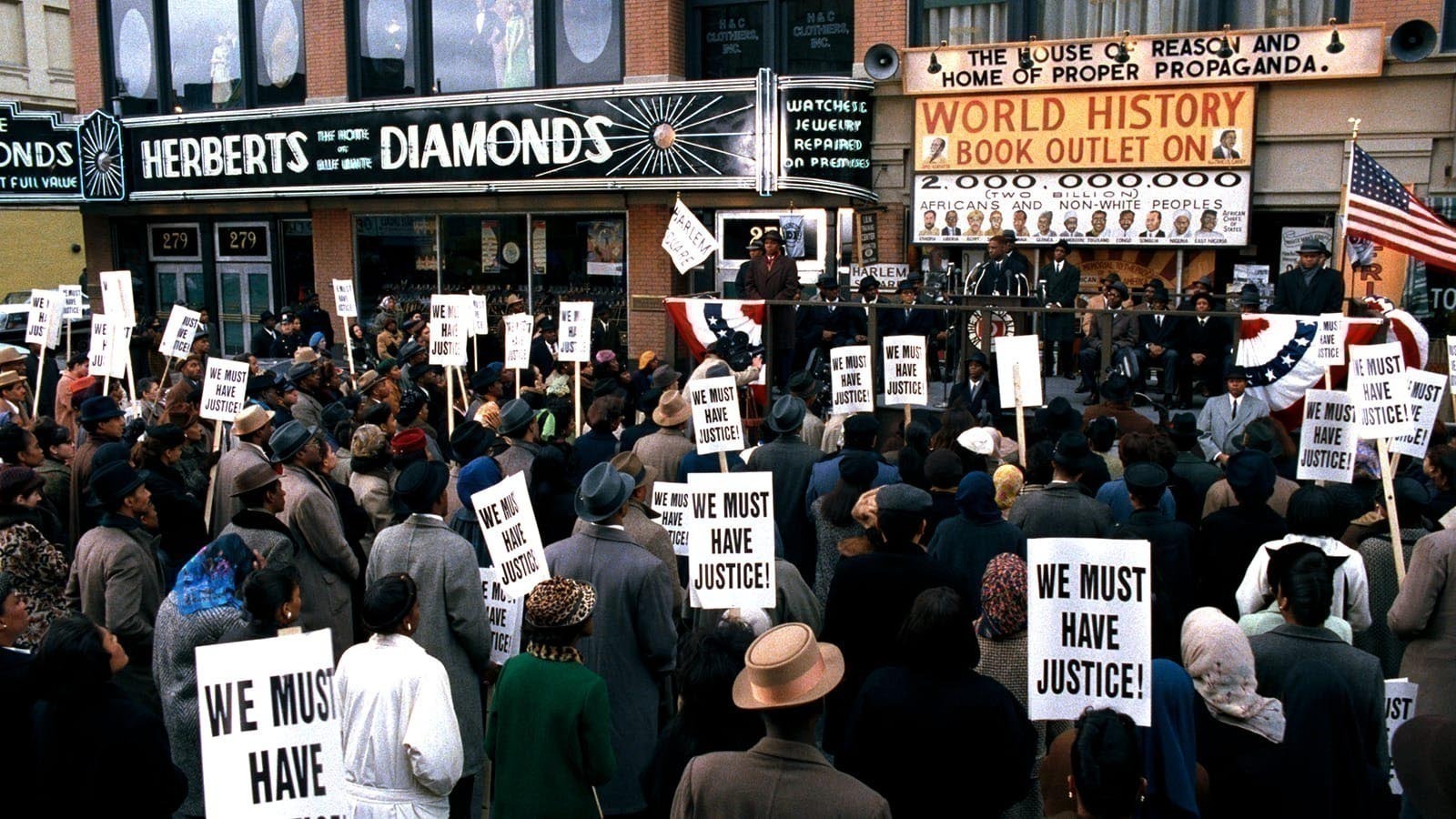
It’s telling that a good number of the film series and lists that aim to take a hard and honest look at 250 years of American history include work by Spike Lee. Do the Right Thing (1989), set on a hot summer day in Brooklyn that will end with the death of a Black man at the hands of a white cop, tops Anthony Breznican’s ranked list of the twenty-five “Most American Movies of All Time” at Esquire. And while the Los Angeles Times critics’ list of ten “must-watch movies that capture America in times of profound change” is not ranked, Do the Right Thing is in there.
“For a moment,” writes the LAT’s Glenn Whipp, “the Black Lives Matter movement signaled a willingness to grapple with the past. But the pendulum swung and we’re back to days of Driving Miss Daisy denial. But Do the Right Thing remains with us, its urgency and relevance undiminished, waiting for an America open to listen and live up to its idealized aspirations.”
Lee’s Malcolm X (1992) is one of ten films set to screen on 70 mm as part of the Film at Lincoln Center series It’s All a BIG Conspiracy, which opens today and runs through July 9. Drawing from The Autobiography of Malcolm X, the screenplay passed through several hands—James Baldwin, Arnold Perl, David Mamet—for two decades before Lee took over the project from Norman Jewison (In the Heat of the Night). Lee rewrote the screenplay and cast Denzel Washington as Malcolm Little, a hard-partying low-level criminal who gets arrested, meets a member of the Nation of Islam in prison, and eventually becomes Malcolm X.
“Malcolm’s dismissal of the John F. Kennedy assassination as ‘the chickens coming home to roost,’ his subsequent suspension from the Nation of Islam, his life-changing pilgrimage to Mecca (where he became El-Hajj Malik El-Shabazz), his electrifyingly moving salat at a mosque in Cairo, the CIA’s dogged surveillance of him during his time in Mecca and Africa, are signposts of a life in flux,” wrote the late Barry Michael Cooper in 2022.
“However,” Cooper continued, “it was the earnest determination of Lee and his collaborators that turned Malcolm X into not just a film but also a chance to actually inhabit an iconic life. From the firebombing of Malcolm’s family home in Queens (a cinematic bookend with the incineration of his childhood home) to his tragic assassination inside the Audubon Ballroom in the Washington Heights neighborhood of Manhattan, Malcolm X is in and of itself a pilgrimage of the human spirit, and a study of what happens when that spirit is denied full access to freedom.”
The FLC series will open this evening with Batman (1989), which even director Tim Burton called “more of a cultural phenomenon than a great movie.” The marketing drumroll leading up to the film’s release on June 23—one week before Do the Right Thing—was all-pervading. “You couldn’t turn around without seeing the Bat-Signal somewhere,” filmmaker Kevin Smith later recalled.
Michael Keaton would later work through his identification in the public eye with the Caped Crusader in Alejandro G. Iñárritu’s Birdman (2014), and as the Joker—who terrorizes Gotham with toxic products that cause consumers to die laughing—Jack Nicholson wrings every drop of seductive evil from a line like “You ever dance with the devil in the pale moonlight?” Nicholson’s reading became one of more than two dozen samples from the movie that Prince worked into “Batdance,” a number-one hit from the soundtrack album that became a double-platinum bestseller.
Capping the night is Brian De Palma’s The Untouchables (1987), which will screen again on 70 mm in August as part of the Museum of the Moving Image’s ongoing series De Palma: Summer of Suspense. Aiming to bring down Al Capone (Robert De Niro), Eliot Ness (Kevin Costner) teams up with Jimmy Malone (Sean Connery), an Irish cop and “a weary, steady man, very clearly seen by an actor whose every gesture is wryly informed by the humorous, and uncynical knowledge of a lifetime,” as Richard Schickel described him in Time. “What is true of Connery’s work applies to the whole movie.”
Tomorrow brings Jordan Peele’s Nope (2022), starring Daniel Kaluuya and Keke Palmer as OJ and Em, siblings and descendants of the Black jockey seen in The Horse in Motion, Eadweard Muybridge’s 1878 series of photos often hailed as “the world’s first bit of cinema.” OJ and Em are struggling horse-wranglers for Hollywood productions when a UFO makes its presence known, and they set out to save their ranch by selling footage of their discovery.
Nope is “a strange amalgam of various genres yoked together under the framework of an alien abduction movie,” wrote Blair McClendon for Notebook. “Peele’s project in Nope, and throughout his career, has pushed the question of representation further than mere presence. His form of revisionism tries to discern whether it is possible for Black cinema to be integrated into the idioms of American cinema.”
Starring John David Washington as a CIA agent recruited into a secret organization to track down objects traveling backward through time, Christopher Nolan’s Tenet (2020), screening first on Friday, is essentially an “espionage adventure,” wrote Jonathan Romney for the Los Angeles Times, “but with a science fiction backbone: Nolan ups the ante on Mission: Impossible by making the impossibility not just physical but quantum physical. And he goes about it expertly, bullishly, and with giddily perverse intent to bewilder.”
In James Cameron’s Aliens (1986), we learn that not only has Sigourney Weaver’s Ripley survived Ridley Scott’s original Alien (1979) but also that Paul Reiser’s soulless corporate rep Burke is still around, too. Aliens is “a tale of the struggle between macho bluster and the maternal instinct, between teamwork and corporatism,” wrote Vulture’s Bilge Ebiri when he placed the film at the top of his ranked list of Cameron’s features: “And it’s still one of the most exciting films ever made.”
FLC’s long Friday wraps with David Lynch’s Dune (1984), which arrived “like the anti-Star Wars, undoing everything [George] Lucas's trilogy did to make sci-fi a friendly place,” as Daniel D. Snyder put it in the Atlantic in 2014. “If the movie's goal was to create, like the book, a world that felt utterly alien, then Lynch and his surreal style were the right choice. With its bizarre dream sequences, rife with images of unborn fetuses and shimmering energies, and unsettling scenery like the industrial hell of the Harkonnen homeworld, the film’s actually closer to Kubrick (2001: A Space Odyssey) than Lucas. It seeks to put the viewer somewhere unfamiliar while hinting at a greater, hidden story.”
Saturday, July 4, offers Paul Thomas Anderson’s The Master (2012), featuring Philip Seymour Hoffmann as the founding leader of a cultish movement with an immediately recognizable similarity to Scientology and Joaquin Phoenix as a WWII vet returning home damaged and ready and willing to be molded—up to a point. “Beautifully textured, richly nuanced,” wrote the Guardian’s Xan Brooks, “The Master probes at the shadows cast by the spotlight of American supremacy. It identifies a strain of self-doubt in an otherwise triumphant 1950s and paints a compelling picture of a postwar prosperity built on the backs of a confused and traumatized people.”
Afternoons on Sunday and Monday are given over to Kenneth Branagh’s Hamlet (1996), the first film version to stage the complete and unabridged text. Taking the lead himself, Branagh cast Derek Jacobi as King Claudius, Julie Christie as Gertrude, and Kate Winslet as Ophelia, and he called on an almost absurdly comedic hodgepodge of celebrities to pop up as supporting characters: Robin Williams, Jack Lemmon, Gérard Depardieu, Charlton Heston, Billy Crystal, John Gielgud, and Judi Dench.
“The full Hamlet has a different specific gravity, a density which makes it seem like the first great English novel,” wrote Geoffrey O’Brien in an outstanding 1997 piece for the New York Review of Books on what was then an unexpectedly rich crop of Shakespeare adaptations. “With all the rests restored, it becomes possible to look beyond the intrusive shocks of the plot and get a feeling for the life they have interrupted.” Hamlet is “a much more interesting and surprising work—and, with its roundabout strategies and gradual buildups and contradictions of tone, a more realistic one—when all of it is allowed to be heard, and it is bold of Branagh to have gambled on this more ambitious dramatic arc.”
The tenth film in the series is Alfred Hitchcock’s North by Northwest (1959), and looking back on it in 2009, Time Out’s Dave Calhoun wrote that this “sleek, wry, paranoid thriller caught the zeitgeist perfectly: Cold War shadiness, secret agents of power, urbane modernism, the ant-like bustle of city life, and a hint of dread behind the sharp suits of affluence. Cary Grant’s Roger Thornhill, the film’s sharply dressed ad exec who is sucked into a vortex of mistaken identity, certainly wouldn’t be out of place in Mad Men. But there’s nothing dated about this perfect storm of talent, from Hitchcock and Grant to writer Ernest Lehman (Sweet Smell of Success), costars James Mason and Eva Marie Saint, composer Bernard Herrmann, and even designer Saul Bass, whose opening-credits sequence still manages to send a shiver down the spine.”
Don’t miss out on your Daily briefing! Subscribe to the RSS feed.