Masahiro Shinoda: From Pop to Kabuki
Share
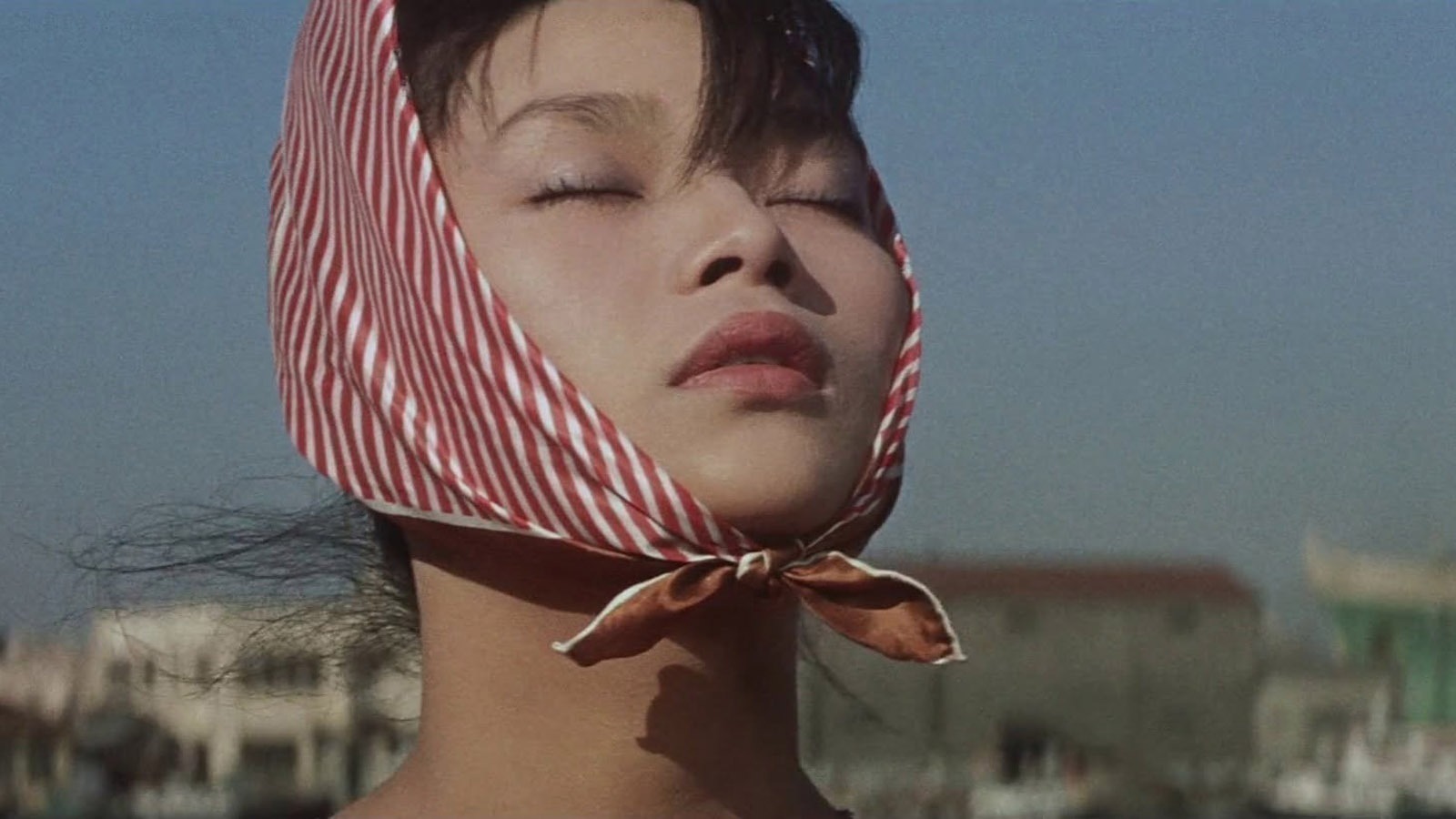
Back in March, we took a look at Sixties Shinoda, a Harvard Film Archive series of films that the late Masahiro Shinoda, a key figure in the Japanese New Wave, directed during the first decade of his long and prolific career. The program included Dry Lake (1960), Pale Flower (1964), Assassination (1964), Samurai Spy (1965), and Double Suicide (1969), and starting Friday, all five films—plus seven more—will screen in New York as part of a Brooklyn Academy of Music retrospective copresented with the Japan Foundation.
BAM programmer Jesse Trussell has selected two films from the 1960s that the HFA passed over, The Burning Sunset (a.k.a. Killers on Parade, 1961) and A Flame at the Pier (a.k.a. Tears on the Lion’s Mane, 1962). Writing for Film Comment in 2017, Marc Walkow called The Burning Sunset “a madcap, candy-colored, pop-art nonsense comedy following a group of assassins, members of the ‘Killer’s Association,’ who devolve to infighting when a nonaccredited hit man turns out to be a better marksman than any of them. It’s Frank Tashlin meets Mr. Freedom, filtered through the eye of Seijun Suzuki, and it’s one of the most brilliant satires Japan ever produced. A Flame at the Pier takes a more serious tone as it riffs on On the Waterfront in its monochrome tale of a rebellious rock-and-roller put to work as muscle for the yakuza strikebreakers who control the Yokohama docks in cahoots with corrupt corporate bosses.”
Silence (1971) is the first of three adaptations of Shusaku Endo’s 1966 novel about two Portuguese Jesuit priests sent to seventeenth-century Japan, where Christianity is forbidden and its practitioners are persecuted. The second version, Os Olhos da Ásia (1996), was directed by Portuguese filmmaker and writer João Mário Grilo, and the third, of course, was Martin Scorsese’s Silence (2016). “While Scorsese’s version is more internal and less preoccupied with violence, it speaks to much of the visual language that was established [in 1971], even going so far as to share a number of virtually identical shots,” wrote IndieWire’s David Ehrlich in 2016. Shinoda’s version is “a lurid, tortured examination of faith as a physical crisis,” and as such, it’s “an invaluable religious epic.”
On Sunday, BAM will present a 35 mm print of Himiko (1974) imported from Japan. Shima Iwashita, Shinoda’s wife and frequent collaborator who also appeared in films by Yasujiro Ozu, Keisuke Kinoshita, and Masaki Kobayashi, stars as the shaman queen and prophet of the Sun God in ancient Japan. Made in collaboration with the avant-garde production company Art Theater Guild, Himiko is “the kind of experimental cinema that no studio would have financed, complete with a discordant [Toru] Takemitsu score, extreme violence, and butoh dancers gamboling in wild costumes and various states of undress,” wrote Walkow. “Himiko is, surprisingly, a perfect flip-side to Silence, with both equally about political power and religious faith, and a pair of cultures colliding violently over the two.”
Kimberly Lindbergs has called Under the Blossoming Cherry Trees (1975) “a strange amalgam of traditional Japanese theater, folktales, ghost stories, social commentary, antiwar sentiment, dark humor, and existential philosophy.” Based on Ango Sakaguchi’s story about a grisly affair between a bandit (Tomisaburo Wakayama of the Lone Wolf and Cub series) and the wife of the man he’s killed, “Shinoda’s film avoids typical horror movie tropes in favor of psychological dread and startling imagery that unnerves and arouses the senses.”
Drawing from a play by Izumi Kyoka and featuring Tamasaburo Bando, renowned for his portrayal of women, Demon Pond (1979) is “still a shock to any Western viewer’s system—a jolt of delicious weirdness that may have seemed as throwback-wacky when it was released in its home country as it has felt outrageous everywhere else,” writes Michael Atkinson. “Maybe more than any other film, Shinoda’s mythopoeic bugout builds a bridge between what the West perceives as ‘realism’ and hellzapoppin’ Kabuki dream-time, the way a rainbow might connect a mundane nursery life to a neverland oasis.”
A new restoration of Gonza the Spearman (1986), based on the 1717 play by Chikamatsu Monzaemon, opens the series and screens through next Thursday. It’s a film “filled with historical imagination, social comment, and restrained passion, along with scene after elegantly composed scene of a culture that seems to have been paralyzed in a spare beauty,” wrote Walter Goodman in the New York Times when Gonza arrived in the States in 1988. “Kazuo Miyagawa’s camera finds the beauty in stone walls, sliding panels, simple gardens, rich gowns, women’s faces. When the action resumes, the strangely powerful music of Toru Takemitsu keeps us on edge.”
Don’t miss out on your Daily briefing! Subscribe to the RSS feed.