One Rave After Another
Share
“The hype is real,” announces Adam Nayman in his review of One Battle After Another at the Ringer. Currently the highest-ranked film of the year at Letterboxd, Paul Thomas Anderson’s tenth feature is also riding high at Metacritic with a score of ninety-five. “There are sequences here,” writes Nayman, “so fluid and lucid—so controlled in terms of composition, cutting, and the hurtling, all-in sensation theorized by film scholar David Bordwell as ‘intensified continuity’—that remaining skeptics may feel obliged to bend the knee.”
In the New York Times, Manohla Dargis agrees that One Battle After Another is “brilliantly directed, but what makes it exhilarating is that it engages with its moment as few American fiction films do. It feels shockingly urgent. It’s also snort-out funny, even when its laughs tremble with rage.”
Taking only what he needs from Thomas Pynchon’s 1990 novel Vineland, Anderson has shifted the timeframe. In an opening sequence set sometime around the second year of the Obama administration, the French 75, a band of revolutionaries led by Perfidia Beverly Hills (Teyana Taylor) and explosives wiz “Ghetto” Pat (Leonardo DiCaprio), raids a detention center with the goal of freeing caged immigrants.
“Surely in the century-plus history of cinema,” writes Amy Nicholson in the Los Angeles Times, “other actors have created characters as sexy, powerful, and hot-headed as Taylor’s Perfidia, nine months pregnant and blasting away with an automatic rifle, but I’m not sure anyone else has ever packaged all three with such potency. You believe she could give what Pynchon teasingly refers to as a ‘Kunoichi death kiss.’”
Col. Steven J. Lockjaw (Sean Penn) leads a team that aims to put a stop to the raid. “Penn plays this obsessive man as a walking, talking balled fist, with ramrod posture and a permanent expression of distaste,” writes Rolling Stone’s David Fear. “It’s an expert portrait of self-loathing and redirected rage,” and Penn “knows exactly how to walk the line between caricature and the truthful cracking open of someone determined to stay locked on target. This is best-in-show work.”
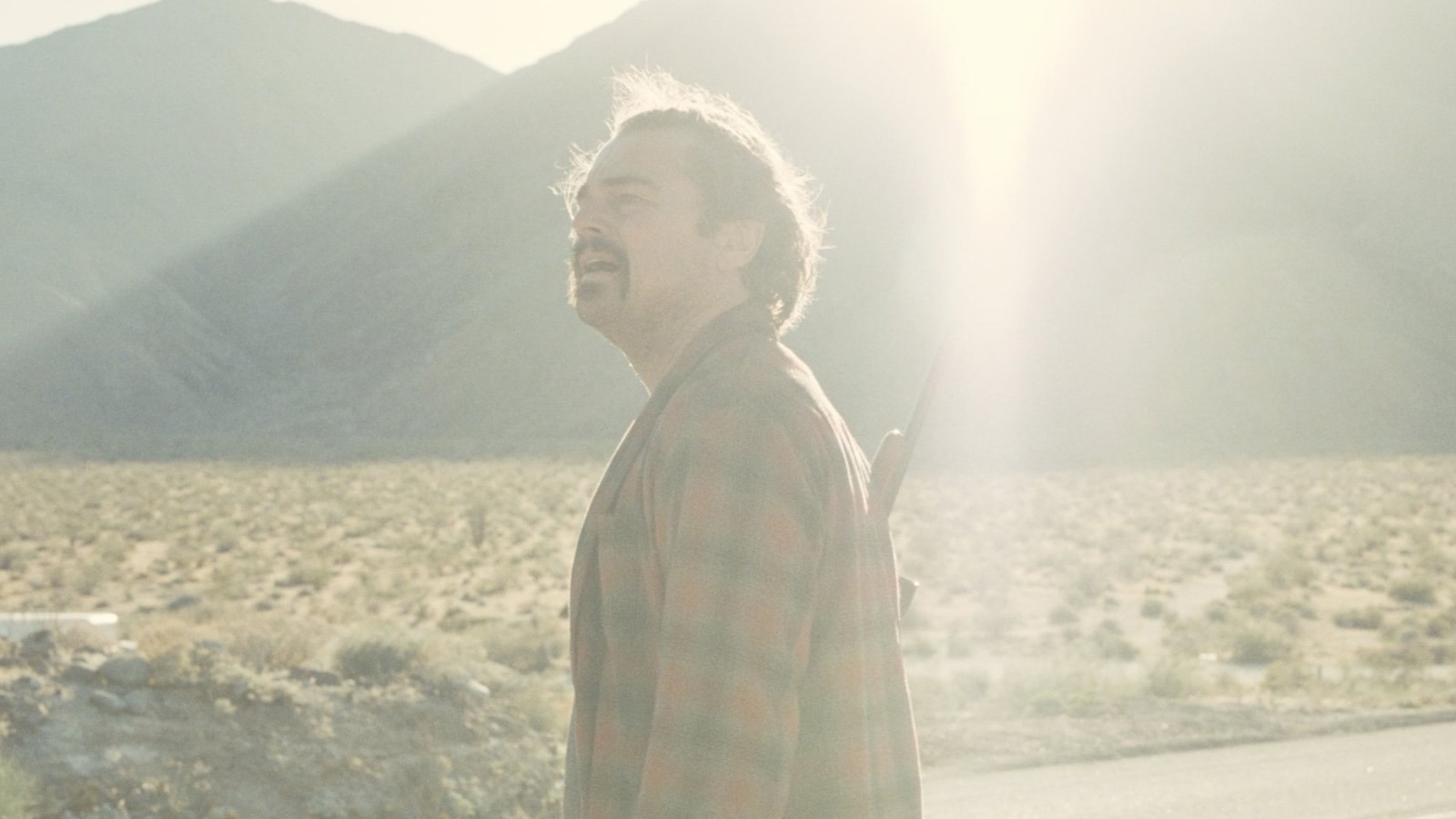
Sixteen years later—which brings us to right about now—the first generation of the French 75 has been scattered and driven underground. “Ghetto” Pat is now Bob Ferguson, a stoner in a bathrobe watching The Battle of Algiers on a loop in his remote northern California home. Brittle and paranoid, he’s also a dad raising the daughter Perfidia gave birth to before disappearing, Willa (Chase Infiniti).
“Nearly every aspect of the cruel and senseless culture of fear and repression in which these characters are struggling to survive becomes at some point a target for satire,” writes Slate’s Dana Stevens, “with the exception of the unassailably good and true thing at the film’s heart: the love between a father and his daughter, and by association the inherent value of all human relationships based on love and mutual care.”
When Lockjaw reenters the scene, Bob springs to action. “DiCaprio revives his Wolf of Wall Street slapstick talents as he scrambles through the frame, taking some cartoonishly dangerous falls while rocking a pair of stolen shades and a skull cap,” writes Jesse Hassenger at the A.V. Club. “Stepping into a funhouse-mirror reflection of The Searchers results in one of his best performances.”
For help, Bob turns to Willa’s martial arts instructor, Sensei Sergio St. Carlos (Benicio del Toro), “an instant addition to the pantheon of iconic PTA characters in his own right,” writes IndieWire’s David Ehrlich, “and his zen approach to the threat posed by Lockjaw’s forces gradually emerges as the movie’s defiant ethos. ‘We’ve been laid siege for hundreds of years,’ he says with a steady breath. ‘Ocean waves.’”
“There are times when One Battle After Another owes as much to Terminator 2: Judgment Day as it does to Pynchon in its depiction of a teen being raised by a seemingly fanatical parent who is convinced dark forces are out to get them,” notes Vulture’s Alison Willmore. “For all that the film revels in satire—a powerful white-nationalist secret society is Christmas-themed, and its members greet one another with ‘Hail, St. Nick!’—it’s electric when it veers into action, and a chase sequence on a series of cresting hills manages to both reference and stand up to the one in which the T-1000 pursues John Connor into the LA River.”
“There’s something deeply 1970s Hollywood, too, about the level of confidence Anderson has in his audience,” finds the Telegraph’s Robbie Collin. Anderson “seems incensed and horrified by the current American moment,” writes Richard Lawson in the Hollywood Reporter, and Time’s Stephanie Zacharek observes that One Battle After Another is “of the moment without hammering away at us with its ideas; its seriousness is the unserious kind, which makes it even more potent, in a Dr. Strangelove sort of way.”
“The film clocks in at nearly three hours but feels half as long,” writes the Atlantic’s David Sims. “And though all of Anderson’s artistry and jittery comedic sensibility is present, the director hasn’t created a pretentious version of an action flick; One Battle After Another is the real thing.”
Don’t miss out on your Daily briefing! Subscribe to the RSS feed.