Chloé Zhao’s Hamnet
Share
A quote from Shakespearean scholar Stephen Greenblatt opens both Maggie O’Farrell’s 2020 novel Hamnet and Chloé Zhao’s adaptation: “Hamnet and Hamlet are in fact the same name, entirely interchangeable in Stratford records in the late sixteenth and early seventeenth centuries.” In Zhao’s film, cowritten with O’Farrell, young Will Shakespeare writes his immortal play about a Danish prince hurled into an existential crisis by the loss of his father and a smoldering desire for revenge as a way to mourn the loss of his eleven-year-old son.
He was also reaching out to his wife with an urge to have her understand that he shares her fathomless grief. For Vulture’s Bilge Ebiri, Hamnet is “devastating, maybe the most emotionally shattering movie I’ve seen in years,” and most early reviews find critics on the same page. There are, however, a few detractors.
Will (Paul Mescal) first spots Anne Hathaway, known around Stratford-upon-Avon as Agnes (Jessie Buckley), through a window while tutoring three students in Latin. An herbalist, beekeeper, and falconer, Agnes has emerged from the woods—there are whispers that she is a “forest witch”—and Will drops his lessons to find her, kiss her, and learn her name. In that order. Their love is immediate and fierce, and Agnes is soon pregnant with their first daughter, Susanna (Bodhi Rae Breathnach).
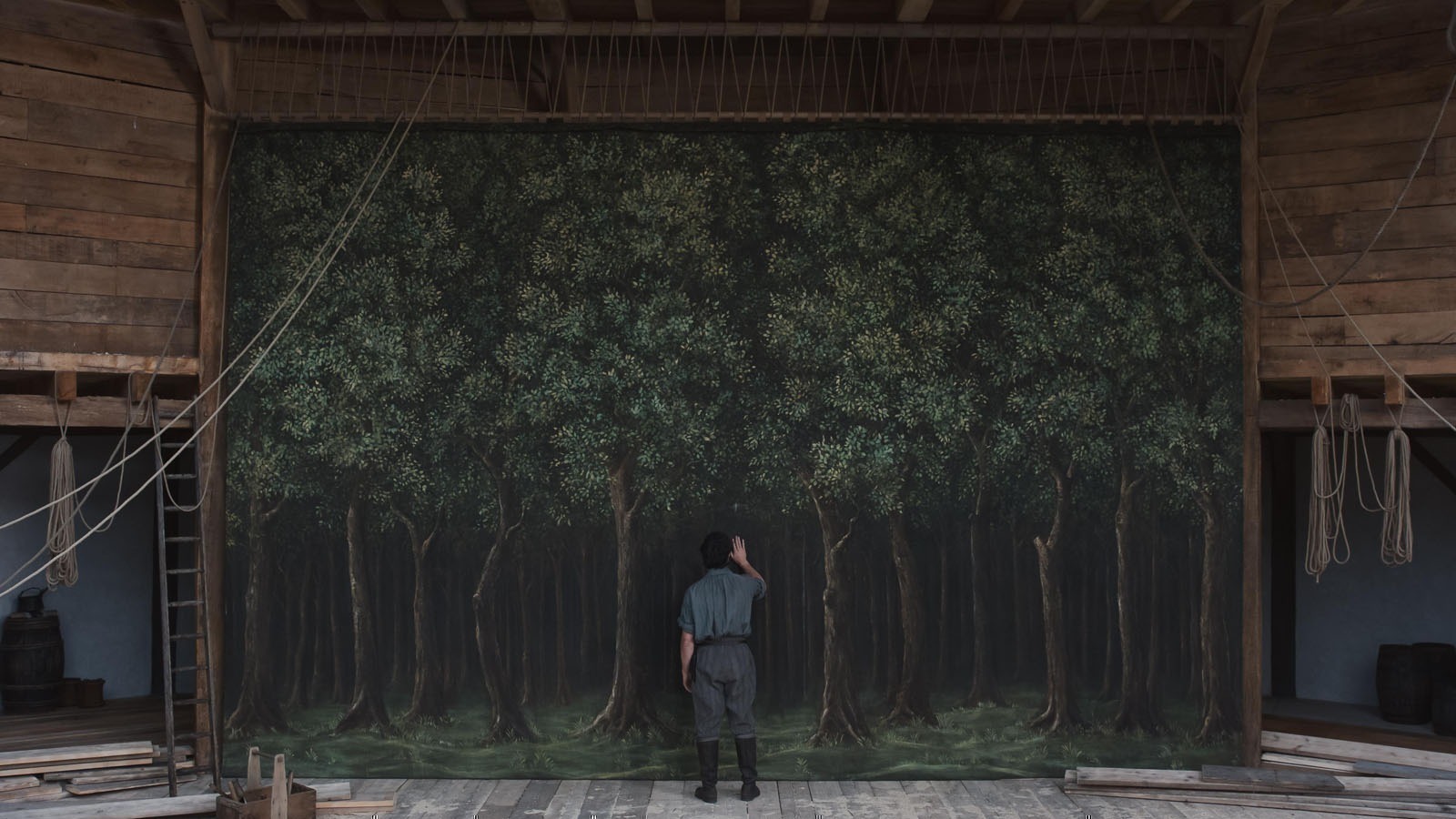
“Cinematographer Łukasz Żal captures the vast lushness of the forest where Agnes and Will first fall in love in generous wide shots that occasionally make the couple look like forest creatures,” writes the Hollywood Reporter’s Angie Han, “and sound designer Johnnie Burn evokes the quiet rhythms of everyday life with an occasional musical assist from Max Richter’s ethereal score.”
Over the objections of their families, Will and Agnes marry, and soon enough, Agnes is giving birth to twins, Hamnet (Jacobi Jupe) and Judith (Olivia Lynes). The twins delight in exchanging clothes and passing themselves off as each other, and when the plague comes for Judith, Hamnet swears that he will fool death and take her place.
Profiling Buckley for the New York Times, Alice Newell-Hanson writes that “when Agnes realizes that, despite all her efforts, her son is no longer breathing, she releases a wrenching, full-bodied scream, filmed from the side so that we can see the sound erupting from her mouth, then dissolving into silence, her lips still straining, as if her grief is ultimately unutterable. Buckley’s performance of loss, here and in the rest of the film, seems to draw from some dark place where every parent’s worst nightmare has pooled.”
Buckley “has crafted dozens of broken, batty, bold, and even bizarre characters over the past ten years,” writes Rolling Stone’s David Fear, “yet what she’s doing here feels unprecedented. It rewires your expectations of how to play someone rediscovering their soul.” In the Guardian, Richard Lawson writes that it is “on her shoulders that the film’s knockout climax rests. As she rises to the task, it is as if she is no longer acting but instead channeling a whole history of human lamentation.”
As for Mescal, “his response at the first sight of his dead son represents some of the best acting I’ve ever seen,” writes Bilge Ebiri, and “it’s matched later when he interrupts a rehearsal of Hamlet’s ‘Get thee to a nunnery’ speech and delivers it himself with such snarling self-loathing (‘I could accuse me of such things that it were better my mother had not born me!’) that he instantly and convincingly reinterprets the world’s most famous play before our very eyes. Agnes accuses Will of not grieving enough, but Mescal makes sure we see that oceans of pain lie beneath his hesitancy: He is Hamlet.”
IndieWire’s David Ehrlich suggests that the “pliability of English drama’s most famous speech allows the suicidal dilemma of ‘To be, or not to be’ to double as an invitation to reject its binary proposition, as the movie doesn’t invoke it until it’s clear that—so far as his increasingly estranged parents are concerned—poor Hamnet is being and not being all at once. He isn’t there, but he isn’t not there either.”
In her first dispatch from Toronto, the Los Angeles Times’ Amy Nicholson writes that she found that Hamnet “started strong but got soggy with its repetitive weeping and gnashing. As Hamlet would say, ‘it touches us not.’” For the Daily Beast’s Nick Schager, what was so “artless and poetic” in Zhao’s The Rider (2017) and Nomadland (2020)—“the romantic evocation of the natural world and its connection to its inhabitants; the authentic performances, often from non-professionals; the striking ‘stolen moments’ that lent the drama its lyricism—has turned severely affected in Hamnet,” a “work of tremendous look-at-me energy,” or worse, “grief porn.”
Most, though, would agree with Dan Mecca when he writes at the Film Stage that Hamnet is “the best film Chloé Zhao has made by quite a wide margin.” She’s “patient with her pace. The fluidity of movement allows for every emotion to sneak up on you. It’s like a magic trick, hinted at in The Rider and Nomadland but perfected here.”
“All my films start with characters who’ve lost what defined them: dreams, home, purpose, faith,” Zhao tells Josh Rottenberg in the Los Angeles Times. “They grieve who they thought they were in order to become who they truly are.”
Don’t miss out on your Daily briefing! Subscribe to the RSS feed.