Terence Stamp: “I Can Do That!”
Share
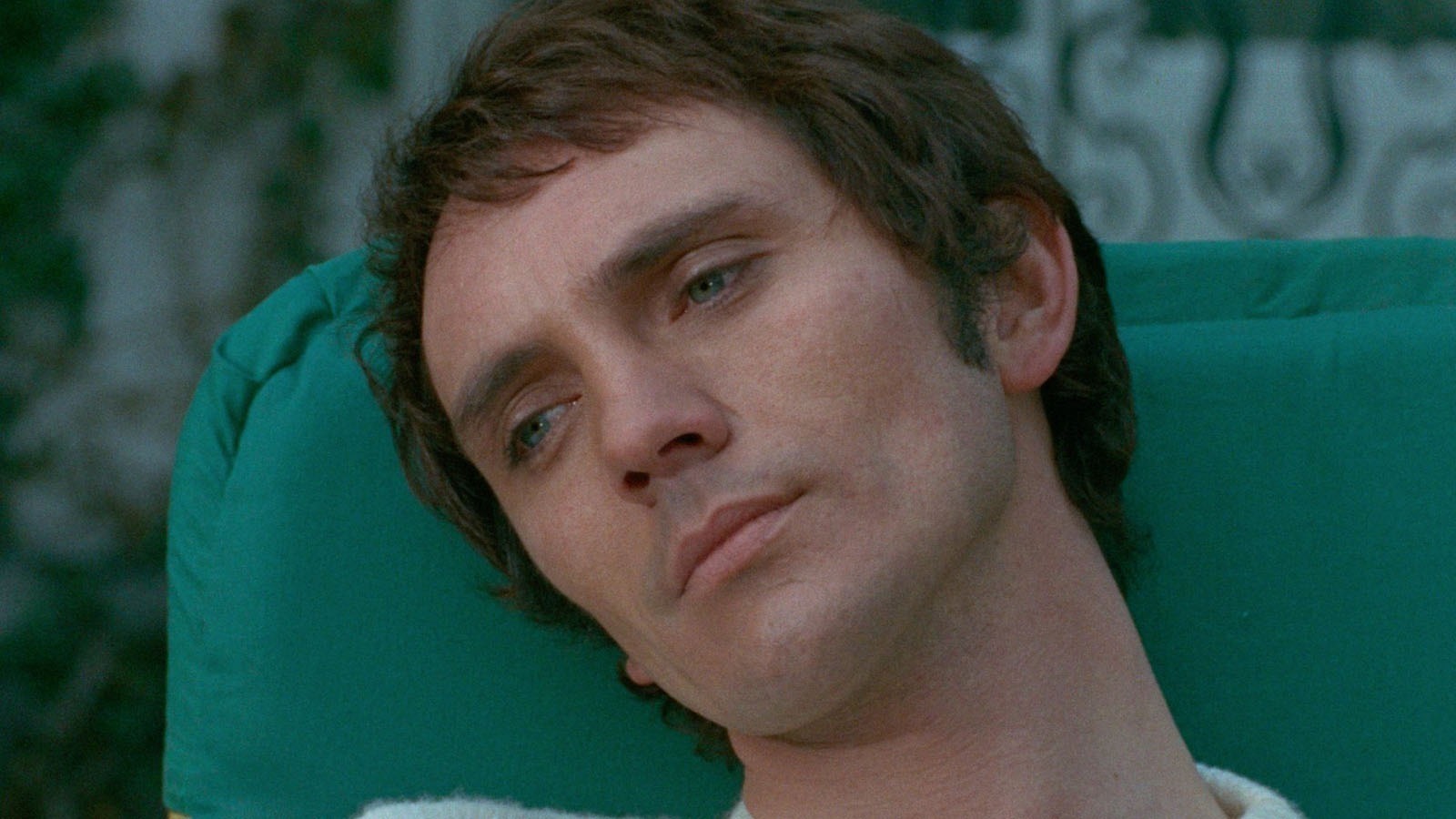
When Terence Stamp passed away last Sunday at the age of eighty-seven, the Telegraph remarked that he had emerged “as a one-man caricature of the sixties,” working with directors as varied as Ken Loach and Pier Paolo Pasolini and posing with Julie Christie and Jean Shrimpton for photographer David Bailey, the great chronicler of Swinging London. Stamp then disappeared for a few years, returned with a bang in two Superman blockbusters, and kept swerving, playing gangsters and financiers, princes and generals, and Bernadette Bassenger in The Adventures of Priscilla, Queen of the Desert (1994).
“From his first appearance as the eerily beautiful sailor in 1962’s Billy Budd through to his last manifestation as ‘the silver-haired gentleman’ in Edgar Wright’s Last Night in Soho,” writes the Guardian’s Xan Brooks, “Stamp remained a brilliantly, mesmerizingly unknowable presence. He was the seductive dark prince of British cinema, an actor who carried an air of elegant mystery.”
The son of an often absent tugboat stoker, Stamp was raised in East London for the most part by his mother, aunts, and grandmother. They went to the movies when they could afford it, and young Terence became enthralled by Gary Cooper in Beau Geste (1939), and eventually James Dean. He won a scholarship to study at the Webber Douglas Academy of Dramatic Art, and it was while touring with a production of Willis Hall’s Second World War drama The Long and the Short and the Tall that he fell in with Michael Caine.
They became roommates, and when an opportunity to audition for Peter Ustinov came Stamp’s way, Caine, several years older, told him directors didn’t like talky actors. So when he wasn’t speaking his lines, Stamp kept his mouth shut, and something about his enigmatic silent beauty convinced Ustinov that he’d found his Billy Budd.
Stamp “looked into the camera with what one journalist later called his ‘heartbreak blue eyes’ and let his tousled blond hair fall over his forehead whenever his character was provoked—which was often, since he was being accused of murder,” writes Anita Gates in the New York Times. Stamp’s performance scored him an Oscar nomination and a Golden Globe for Most Promising Male Newcomer.
In William Wyler’s The Collector (1965), Stamp plays an amateur entomologist who abducts a young woman he’s had an eye on for years. “As he carried a bottle of chloroform toward a beautiful art student (Samantha Eggar), those startlingly blue eyes now seemed terrifying,” writes Gates. “In the New York Herald Tribune, the critic Judith Crist called his performance ‘brilliant in its gauge’ of madness.” Both Stamp and Eggar won top acting awards in Cannes.
Stamp was at this point as hot as he’d ever be, teaming up with Monica Vitti in Joseph Losey’s spy spoof Modesty Blaise (1966); with Ken Loach on the television director’s first theatrical feature, Poor Cow (1967); and with cinematographer (and future director) Nicolas Roeg on a grassy hillside sequence in John Schlesinger’s 1967 Thomas Hardy adaptation Far from the Madding Crowd, in which Stamp’s dashing sergeant brandishes his sword, whipping it this way and that to impress Julie Christie’s Bathsheba Everdene.
In Italy, Stamp played a Shakespearean actor losing his mind to alcohol in Toby Dammit, Federico Fellini’s segment in the 1968 horror anthology, Spirits of the Dead. Fellini “was just everything and more,” Stamp told Sam Wigley in Sight and Sound in 2013. “I think he was one of the most wonderful human beings I’ve ever met. There was never a moment wasted with Federico.”
Talking to the Guardian’s Andrew Pulver in 2015, Stamp recalled Pasolini’s pitch for Teorema (1968). “Pasolini told me: ‘A stranger arrives, makes love to everybody, and leaves. This is your part.’ I said: ‘I can do that!’”
Writing about Teorema in 2020, James Quandt notes that “azure-eyed Terence Stamp, with the dark, tousled looks of one of Caravaggio’s more refined ragazzi . . . simply appears, like a force of nature” at the home of a well-to-do Italian family. Pasolini once wrote that Teorema “deals with the arrival of a divine visitor in a bourgeois family,” and Quandt points out that “others have cited the visitor’s ability to seduce and destroy each member of the industrialist’s household in defining the Stamp character as, if not the devil himself, verifiably diabolical.”
After Stamp played Arthur Rimbaud opposite Jean-Claude Brialy’s Paul Verlaine in Nelo Risi’s A Season in Hell (1971), his phone stopped ringing. “It’s a mystery to me,” he told Andrew Pulver. “I was in my prime. When the 1960s ended, I just ended with it. I remember my agent telling me: ‘They are all looking for a young Terence Stamp’ . . . I thought: this can’t be happening now, it’s only just started. The day-to-day thing was awful, and I couldn’t live with it. So I bought a round-the-world ticket and left.”
He traveled through Egypt and then stayed for a few years in India. He simply checked out until a telegram arrived addressed to “Clarence Stamp” with an offer to play the evil General Zod in Richard Donner’s Superman (1978), and he eagerly embraced the opportunity to work with Marlon Brando, who had been cast as the caped hero’s father. The screenplay swelled to more than four hundred pages, so two films went into production in 1977. It’s in Superman II (1980) that Stamp gets to milk his command “Kneel before Zod!” for all that’s in it.
In Stephen Frears’s The Hit (1984), Stamp’s Willie Parker is an erudite thief hiding out in Spain after squealing on his partners ten years before. When the inevitable arrives in the form of killers played by John Hurt and Tim Roth, Willie waxes philosophical and quotes John Donne, and it would all “seem like blatant sophistry, calculated to disarm his listeners, if it weren’t for Stamp’s brilliant, ambiguous performance,” writes Graham Fuller.
Stephan Elliott’s The Adventures of Priscilla, Queen of the Desert (1994) sent two drag queens (Hugo Weaving and Guy Pearce) and Stamp’s character, a transgender woman named Bernadette, on a road trip across the Australian outback, and it became a surprise international hit. Elliott’s screenplay gives Stamp delicious lines like, “I’ll join this conversation on the proviso that we stop bitching about people, talking about wigs, dresses, bust sizes, penises, drugs, night clubs, and bloody Abba!”
Stamp was initially reluctant to take the role. “I thought it was a joke,” he told Sam Wigley, but a friend assured him that “my fear was out of all proportion to the possible consequences.” And “it was only when I got there, and got through the fear, that it became one of the great experiences of my whole career. It was probably the most fun thing I’ve ever done in my life.”
For Xan Brooks, “arguably the ultimate Stamp performance” can be found in Steven Soderbergh’s The Limey (1999). “Soderbergh cast him as Wilson, an aging career criminal who haunts LA like a ghost. It’s a film that is implicitly about Stamp’s youth and age, beautifully folding the present-day drama in with scenes in Ken Loach’s Poor Cow to show what happened to the golden generation of swinging ’60s London—and by implication, what happens to all of us. Somewhere along the way, wending his way up the coast to Big Sur, Stamp’s knackered criminal stops being a ghost and becomes a kind of living sculpture, a priceless piece of cinema history, returned for one last gig to seduce the world and set it spinning before heading off towards the sunset.”
But not to stay there. Dozens of performances followed, with one of the most memorable being his last. Edgar Wright’s Last Night in Soho (2021) is “a great film, made by a director who admired him, a cast that felt lucky to work with him, for an audience that cherished getting to see him again,” writes C. Robert Cargill. “Few actors get that kind of swan song.”
“Terence was kind, funny, and endlessly fascinating,” recalls Wright. “I loved discussing music with him (his brother managed the Who, and he’s name-checked in the Kinks’ ‘Waterloo Sunset’) or reminiscing about his films, going back to his debut in Billy Budd. He spoke of his last shot in that film, describing a transcendental moment with the camera—a sense of becoming one with the lens . . . I witnessed something similar. The closer the camera moved, the more hypnotic his presence became. In close-up, his unblinking gaze locked in so powerfully that the effect was extraordinary. Terence was a true movie star: the camera loved him, and he loved it right back.”
Don’t miss out on your Daily briefing! Subscribe to the RSS feed.