John Sayles in Toronto
Share
John Sayles is heading to Toronto to take an active part in all ten screenings of the TIFF Cinematheque series Declarations of Independence: The Cinema of John Sayles, which opens on Thursday and runs through June 18. Whether introducing a film or taking questions, he’ll occasionally be joined by his partner, Maggie Renzi, and always by critic, author, and guest curator Adam Nayman.
“Sayles is very much a critical American filmmaker,” writes Nayman in his program notes, “a vital and influential avatar of the DIY ethos whose movies registered as acts of conscientious objection during Hollywood’s early ’80s imperial phase. Not only did Sayles help set the terms for filmmakers operating outside the system, but he’s continued to work on them, alongside his wife and producer Maggie Renzi, for more than forty years. ‘There is such a thing as the right money and the wrong money,’ Sayles wrote in his 1987 how-to book Thinking in Pictures: The Making of the Movie Matewan. The political and artistic principles he’s refused to compromise behind the scenes over the course of his extraordinary career are the same ones on the screen.”
Sayles was a novelist before he became a director. Having earned a degree in psychology, he was knocking around between odd jobs and writing short stories when he decided to turn one of them into his first novel, Pride of the Bimbos, which was published in 1975 and later deemed “by turns hilarious and poignant” by Randall Kenan in the Nation. His follow-up, Union Dues (1977), was nominated for a National Book Award. And he’s still at it. Crucible was published earlier this year, and at the top of his interview with the author for the Chicago Review of Books, Steve Nathans-Kelly notes that Sayles’s eighth novel “chronicles fifteen tumultuous years in mostly Depression-era Detroit in a multi-threaded, character-rich narrative.”
The segue into filmmaking began in the late 1970s when Frances Doel, the head of the script department at Roger Corman’s New World Pictures, hired Sayles to rewrite a screenplay that had been aimed at cashing in on the phenomenal success Steven Spielberg’s Jaws (1975). Joe Dante directed Piranha in 1978, and Sayles stuck around to splash in the genre pool a little longer. “Sayles clearly enjoyed his apprenticeship, pumping fresh blood into these narratives of werewolves, mutant reptiles, and tommy-gun shootouts with his trademark literate dialogue, bemused humor, and attention to social bearings,” wrote Robert Keser in Bright Lights Film Journal in 2003.
TIFF will screen two films from this period. Battle Beyond the Stars (1980) rides the coattails of George Lucas’s Star Wars (1977) just as shamelessly as Piranha did Jaws’. But Battle “has a charm that belies its low budget and opportunistic origins,” wrote Noel Murray at the A.V. Club in 2002. “Sayles ‘borrowed’ the plot of The Seven Samurai, set it in space, and—with the help of special-effects wunderkind James Cameron, baby-faced composer James Horner, and where-is-he-now director Jimmy Murakami—made it a visually inventive and intermittently involving intergalactic shoot-em-up.”
When Gabe Klinger interviewed Joe Dante for Metrograph’s Journal, he noted that The Howling (1981) “appears as the work of an upstart whose ambitions hadn’t yet met a ceiling (or studio writer’s room, as it were), working through genre film problems with the savvy of a true film connoisseur, and elevating a would-be grindhouse item by virtue of curating worthy collaborators—among these, John Sayles, who rewrote the film’s mediocre script.” Sayles was “always topical in his scripts,” notes Dante. “He used everything that was in the zeitgeist.”
Return of the Secaucus 7 (1979), Sayles’s directorial debut, was the “most modest and beguiling film to come out of the independent feature movement,” wrote Dave Kehr in the Chicago Reader. A decade after their heyday as campus radicals in the 1960s, seven friends come together to hang out in a house in the country. “Such coziness and affection may not be the stuff of high art, but it feels good,” wrote Kehr. “Made on a tiny budget of $60,000, the film is full of technical flaws, but the casting, which is where most low-budget films fall down, is extraordinarily strong.”
Sayles signed on to direct a movie for a major studio just once. Paramount was looking for a teen sex comedy, and what Sayles delivered with Baby, It’s You (1983) was not that. Rosanna Arquette stars as a nice girl sailing through high school in suburban New Jersey in the mid-1960s when she falls for the new kid, a roustabout played by Vincent Spano. “Sayles knows this is well-trod ground,” writes Jason Bailey, “but he finds the complexity in these characters and situations; he captures the urgency and eroticism of first love, as well as the importance of getting that love out of your system.”
The Brother from Another Planet (1984), the biggest box-office success of Sayles’s career, stars Joe Morton as an alien who—except for his three-toed feet, his mute innocence, and his unobtrusive yet occasionally useful extraterrestrial powers—could pass for a male Black human. “Arriving first at Ellis Island and overwhelmed by his new surroundings, the whippet-lean and dreadlocked Morton is very much a symbol of the immigrant experience, right down to his (literal) voicelessness and vulnerability to his well-armed pursuers,” wrote Adam Nayman for Downtime a few years ago.
“But if the script’s organizing metaphor is broad and obvious,” Nayman went on, “the dramaturgy is subtle and sharp, privileging granular, street-level encounters that allow Sayles to show off his novelist’s gift for characterization and dialogue over any grand statements about the nation’s psyche . . . With apologies to the flawless neo-noir Lone Star (1996), Brother is Sayles’s masterpiece: American Babylon as a kind of Twilight Zone, a picaresque portrait drenched in neon and nightshade.”
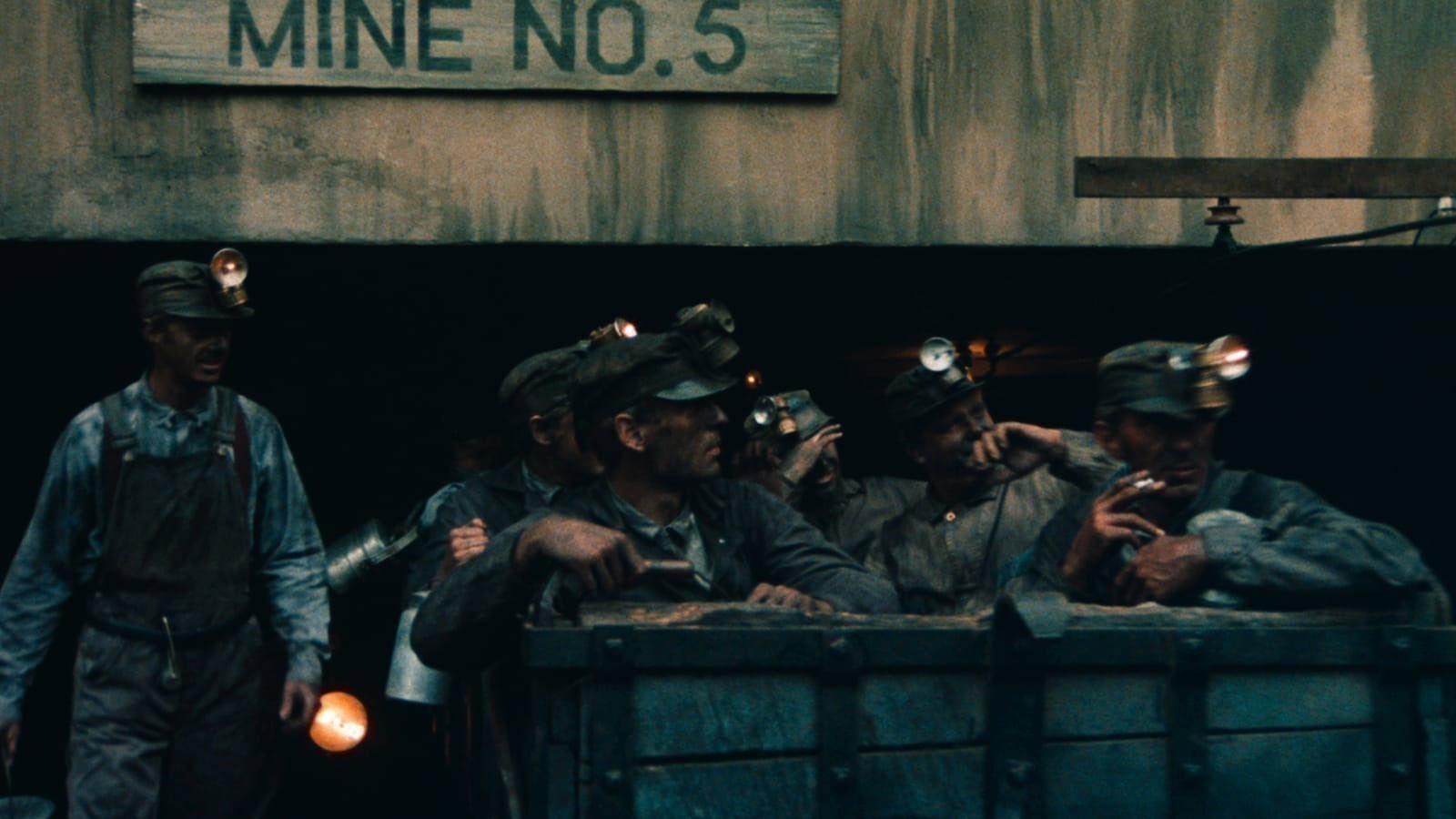
Starring Chris Cooper, James Earl Jones, Mary McDonnell, Will Oldham, and David Strathairn, Matewan (1987) dramatizes the violent 1920 confrontation between miners and union busters hired by the Stone Mountain Coal Company in West Virginia. “The opportunity to inflict unlimited pain and damage on workers and on the land, it goes without saying, requires the absence of unions,” writes A. S. Hamrah. “Matewan is one of the few movies produced in the U.S. to make the need for them its subject. The gun-toting, nonminer hillbillies who stealthily materialize out of the woods in the film know that the coal companies stole their land. We, however, have to be shown.”
Sunday sees a thirty-fifth-anniversary screening of a new restoration of City of Hope. Set in a fictional city in New Jersey, the film tracks connections between three dozen or so characters “and follows them through their days and nights, as they run into one another, make deals, tell lies, seek happiness, and find mostly compromise and disappointment,” as Roger Ebert wrote in 1991. “City of Hope is a powerful film, and an angry one . . . It asks a hard question: Is it possible for a good person to prevail in a corrupt system, just simply because right is on his side? The answer, in the short run, is that power is stronger than right. The notion of a long run, of course, is all that keeps hope alive.”
Lone Star shifts between two timelines in the same town—the 1950s and the then-present ’90s in Frontera, Texas—to unravel the mystery of the death of a violently racist sheriff chillingly played by Kris Kristofferson. Domino Renee Perez has been “thinking, teaching, and writing about Lone Star for almost two decades,” and in 2024, she looked back on the first time she saw it: “Awestruck not only by the movie’s powerful cultural critique but also by its mixing of genres—western, noir, murder mystery, and romance—I left the theater believing it was one of the most beautifully scripted, acted, shot, paced, edited, and scored films I had ever seen. I still believe it.”
In Men with Guns (1997), an aging doctor (Federico Luppi) in an unnamed Latin American city ventures into the jungle to reconnect with his former students. After he’s told that one of them has been murdered, he begins to suspect that all of them have met the same fate. “From Matewan to City of Hope to the brilliant Lone Star, Sayles has proven himself time and again a master of story, structure, character, and conflict,” wrote Marc Savlov in the Austin Chronicle. Men with Guns stands out for “its use of magical realism, repeated flashbacks, and the fact that it’s almost entirely in Spanish, but it’s still very much a John Sayles film, from its frequent use of deeply layered symbolism to its lush photography and deep, abiding emotional core.”
“As a candidate named Dickie Pilager, Chris Cooper is both George W. Bush and not George W. Bush in John Sayles's exciting political muckraking film Silver City,” wrote Caryn James in the New York Times in 2004. And “the film goes beyond election-year satire to reach broader themes of corporate power, campaign double talk, and journalistic responsibility.” Wrapping his program notes, Adam Nayman points out that “Cooper’s Dubya impersonation is superb, and Sayles fills out the ensemble with a murderer’s row of veteran character actors, including choice parts for Danny Huston, Daryl Hannah, Richard Dreyfuss, and a killer Kris Kristofferson.”
Don’t miss out on your Daily briefing! Subscribe to the RSS feed.