Noir in Vancouver
Share
Over the next five weeks, eight shadowy films noir will screen in Vancouver, and the Cinematheque suggests that those who just can’t get enough might want to supplement the series with its screenings of Denys Arcand’s “nasty” 1970s crime trilogy—Dirty Money (1972), Réjeanne Padovani (1973), and Gina (1975)—and two “white-knuckle procedurals” from Akira Kurosawa, Stray Dog (1949) and High and Low (1963).
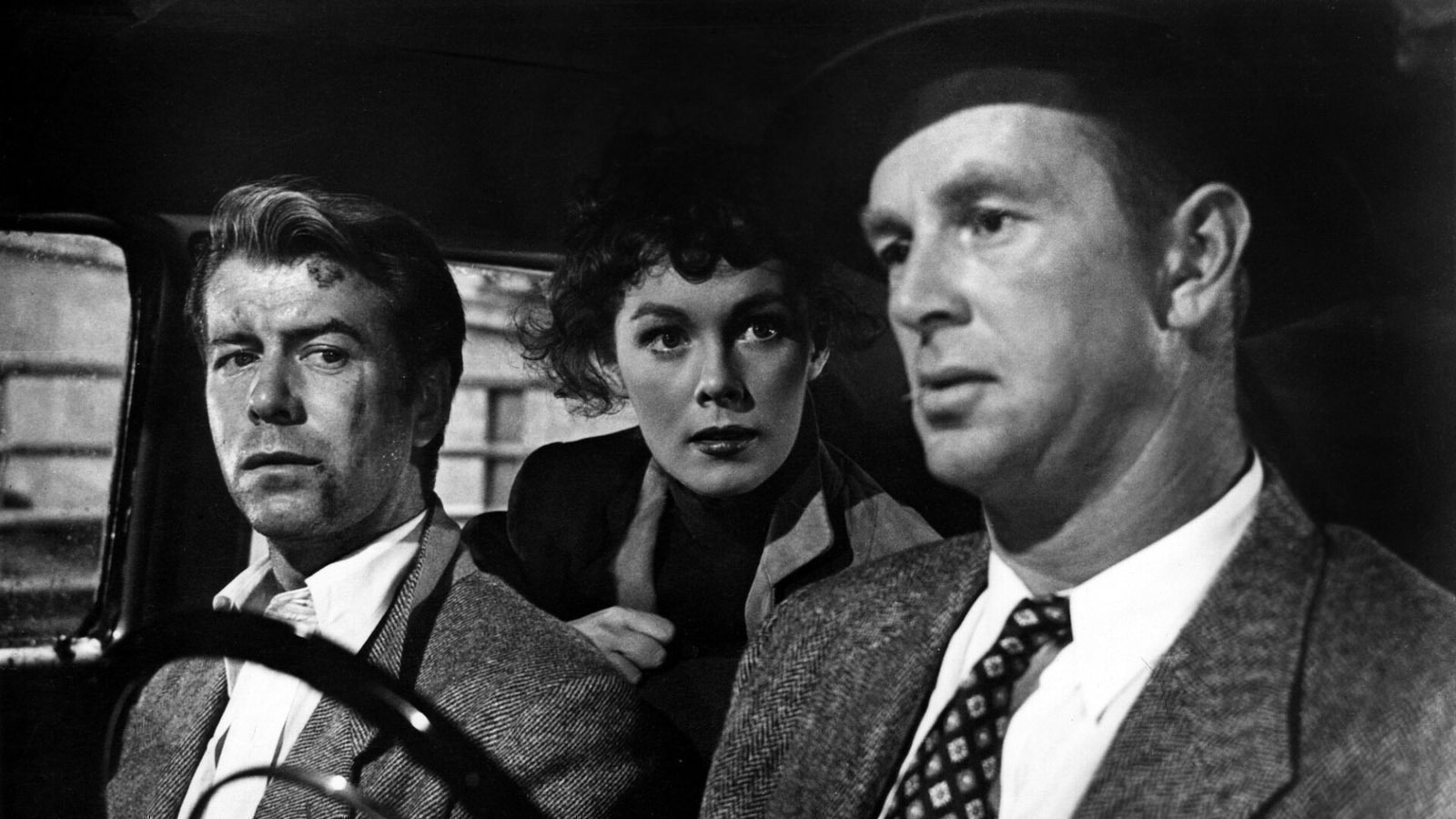
The main event, Film Noir 2025, opens on Thursday with André de Toth’s Crime Wave (1953), “a relentlessly unforced potboiler that gazes at noir through the looking glass,” as Eric Henderson wrote when Slant included the Los Angeles–set, one-last-heist movie on its 2019 list of the hundred best noirs of all time. The studio wanted Humphrey Bogart to play the “ink-eyed and unflappable” Detective Lieutenant Sims, but de Toth insisted on Sterling Hayden because he had “a certain rumpled dignity.”
Another film from 1953, I, the Jury, is the first adaptation of a novel by Mickey Spillane. Directed by Harry Essex (It Came from Outer Space), I, the Jury gives us Biff Elliot as Mike Hammer—in 3D. Consensus holds that the star of the show is the cinematography by John Alton, who had worked with Ernst Lubitsch, Anthony Mann, Allan Dwan, and Vincente Minnelli.
Billy Wilder’s Double Indemnity (1944), starring Fred MacMurray as an insurance salesman who teams up with a married woman (Barbara Stanwyck) to off her husband, is “the Platonic ideal of the classic film noir,” writes Angelica Jade Bastién. “Perceptive editing by Doane Harrison; Miklós Rózsa’s swelling score; the piercingly rhythmic, hard-edged dialogue by novelist Raymond Chandler, who cowrote the screenplay; the perfectly cast actors playing off one another in ways that reveal both their artistry and the power of noir archetypes; the precision of Edith Head’s costuming; John F. Seitz’s cinematography that plunges the leads deeper and deeper into a darkness from which they can’t escape—all work together to create an endlessly entertaining picture, and one that would shape the genre not just in terms of style and story but with its sharp vision of the seen and unseen forces of American life.”
Bullied by the other men in his small town, Danny (Dane Clark) lashes out in self-defense and kills his meanest tormentor in Moonrise (1948), directed by Frank Borzage, who was better known for such classic love stories as Seventh Heaven (1927), Street Angel (1928), and History Is Made at Night (1937). “When a director’s basic instincts and the style in which he or she is working are at daggers drawn, the results can be disastrous—or paradoxically fruitful,” writes Philip Kemp. “Few films display this creative tension more effectively than Moonrise, the last—and some would say the best—major film directed by Borzage.”
Produced by Joan Harrison, who had cowritten screenplays for such Alfred Hitchcock films as Foreign Correspondent (1940) and Rebecca (1940), Robert Siodmak’s Phantom Lady (1944) stars Ella Raines as Carol “Kansas” Richman, a New York secretary who sets out to prove that her boss, Scott Henderson (Alan Curtis), did not murder his wife. Writing for Metrograph Journal, Phuong Le argues that Phantom Lady is, “in effect, a gender-swapped noir: Kansas operates as the hero of the story while Scott, in turn, is the ‘damsel in distress.’” Raines’s “fierce, independent presence accentuates the emasculation of the male characters, contributing to the heady brew of disorienting sexual politics inherent to Siodmak’s noirs.”
For the sake of his kids, a thief (Victor Mature) considers ratting out his cohorts, and one of them (Richard Widmark, making his unforgettable screen debut) is determined to shut him up in Kiss of Death (1947). Written by Ben Hecht and Charles Lederer and directed by Henry Hathaway, Kiss of Death is “lean, direct, and rife with urban poetry, reveling in noir’s propensity for docudramatic haiku,” writes Chuck Bowen for Slant. “Hecht and Lederer were once newspaper men, and their screenwriting often exudes a charge of no-nonsense efficiency so pregnant and pronounced that it resembles a kind of working-man’s existentialism.”
Long championed by Patton Oswalt, Allen Baron’s Blast of Silence (1961) is “among the last of the true film noirs,” noted Terrence Rafferty in 2008, and “one of the first of the low-budget independent movies that suggested the existence of a uniquely New York style of filmmaking, documentary-like and expressively unpolished. It’s among the very few works in the history of cinema to boast a voice-over narration in the second person. And it is, hands down, the best movie ever made about a common, important, and unjustly neglected American experience: the really bad business trip.”
Burt Lancaster is a Machiavellian gossip columnist and Tony Curtis is a toadying press agent in Alexander Mackendrick’s intoxicatingly swift and mean Sweet Smell of Success (1957), written by Ernest Lehman and Clifford Odets, shot by James Wong Howe, and scored by Elmer Bernstein. “We do not mind the absence of a few genre conventions, like a hero or hope or justice, when we can get, in spades, scintillating dialogue, ingenious photography, keyed-up performances, and coolly thumping music, all paced at a carousing canter,” wrote Gary Giddins in 2011. “Sweet Smell of Success is a delirious, almost nostalgic wallow in old-school corruption. Hell is other eras.”
Don’t miss out on your Daily briefing! Subscribe to the RSS feed.