San Francisco Silent Film Festival 2023
Share
On Wednesday, film historian Jeffrey Vance, whose audio commentaries you can hear on a good number of our releases of films by Charlie Chaplin, will introduce the film that opens this year’s San Francisco Silent Film Festival, Allan Dwan’s The Iron Mask (1929). Vance has written books on Chaplin, Buster Keaton, Harold Lloyd, and Douglas Fairbanks, who stars in The Iron Mask as D’Artagnan, reprising the role he first played in Dwan’s A Modern Musketeer (1917) and then again in Fred Niblo’s The Three Musketeers (1921).
“As a valedictory to the silent screen, The Iron Mask is unsurpassed,” writes Vance in his 2008 book, Douglas Fairbanks. “In one of his few departures from playing a young man—and with fewer characteristic stunts—Fairbanks conjures up his most multi-dimensional and moving screen portrayal in a film that is perhaps the supreme achievement of its genre.” Wednesday’s screening will be accompanied by the Guenter Buchwald Ensemble, and for that matter, every presentation at the Castro Theatre through Sunday—twenty-three programs in all—will feature live music.
It’s the women who’ll dazzle on Thursday. Janet Gaynor—“a newcomer and a corker,” alerted Variety—is jilted by George O’Brien in Irving Cummings’s disaster movie The Johnstown Flood (1926). Marie Prevost delights in E. Mason Hopper’s Up in Mabel’s Room (1926), an adaptation of the bedroom farce that became a Broadway hit in 1919, and a young Norma Shearer stars in John L. McCutcheon’s Man and Wife (1923) as a woman believed to have lost her life in a hotel fire; turns out, all she lost was her mind.
In his SFSFF 2023 overview at 48 Hills, Dennis Harvey notes that Man and Wife is paired with “what may well be the revelation of the entire festival.” Alfred Zeisler and Viktor Abel’s The Great Love of a Little Dancer (1924) is “a twenty-one-minute German marionette novelty that’s like a George Grosz drawing come to life, or a Lon Chaney movie in wooden miniature. Its bizarre carnival-set adult nightmare is very twisted and surreal, to a degree where one wonders just who the intended audience was. But it’s hard to imagine this obscurity did not somehow get seen by Jan Svankmajer, or even Tim Burton—the bug-eyed villain is rather a ringer for figures in the latter’s animated films.”
Friday offers Three Ages (1923), in which Buster Keaton sends up D. W. Griffith’s Intolerance (1916); Paul Leni’s horror classic The Cat and the Canary (1927); William Worthington’s The Dragon Painter (1919), with Sessue Hayakawa heading up a mostly Asian cast, a rarity for Hollywood in the silent era; and Dwan’s family drama Padlocked (1926), which features cinematography by James Wong Howe.
Saturday begins with a late-morning program of early shorts pairing Stan Laurel and Oliver Hardy before attendees hunker down with a 1925 German adaptation of Shakespeare’s A Midsummer Night’s Dream directed by Jans Neumann. TCM host and Film Noir Foundation president Eddie Muller will introduce Martin Frič’s The Organist at St. Vitus Cathedral (1929), a tale of suicide and blackmail set in Prague and starring Karel Hašler. Glenn Erickson calls Crainquebille (1922), Jacques Feyder’s adaptation of Anatole France’s novella starring Maurice de Féraudy, “a bittersweet, satirical dissection of injustice among the poor of Paris.”
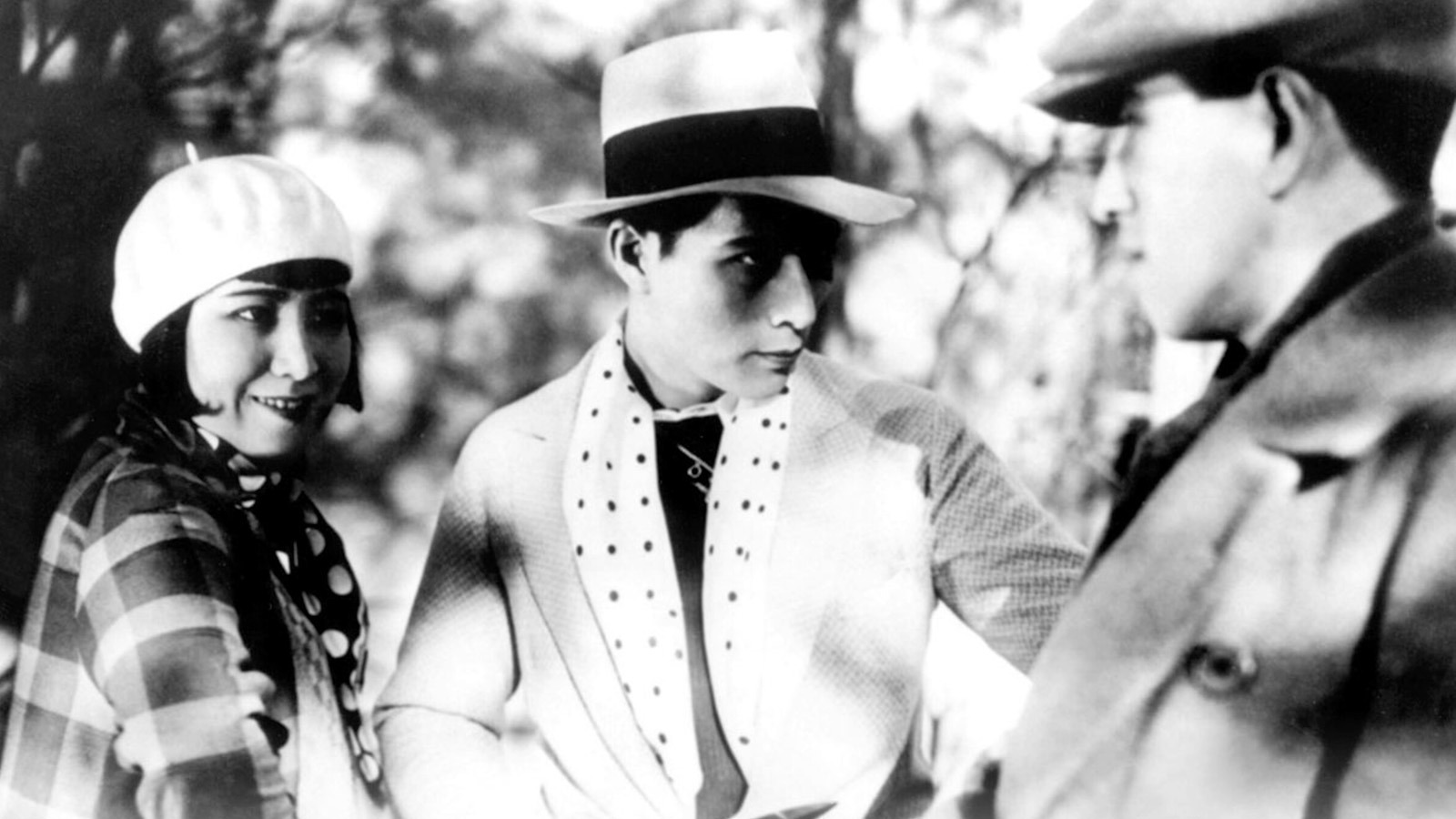
Yasujiro Ozu’s Walk Cheerfully (1930), the story of a small-time gangster whose love for a woman inspires him to go straight, tops off the evening. The film “cheerfully walks the lines between relationship drama, crime thriller, and breezy comedy,” writes Michael Koresky. Walk Cheerfully is “notable for its briskness of tone, camera experimentation, and physicality (clusters of snappy yakuza toughs move with dancelike synchronization).”
Three two-reelers starring Edward E. Horton and produced by Harold Lloyd kick off the final day, and they’re followed by John Ford’s Kentucky Pride (1925), a story that, oddly enough, revolves around a racing horse named Virginia’s Future. “Along the lines of Whitman and Frost, a gratifying poem from John Ford,” finds Fernando F. Croce.
Stefan Drössler, the director of the Munich Film Museum and the recipient of this year’s San Francisco Silent Film Festival Award, will introduce a restoration he supervised. In Henrik Galeen’s Alraune (A Daughter of Destiny, 1928), Paul Wegener—the director and star of The Golem: How He Came into the World (1920), cowritten with Galeen—plays a wealthy professor who impregnates a prostitute with a mandrake, a plant that, so the legend goes, sprouts from the semen of a hanged criminal. The professor raises the child who grows up to be a naughty woman played by Brigitte Helm (Metropolis).
Erich von Stroheim’s The Merry Widow (1925) will wrap the festival’s twenty-sixth edition on Sunday. “A comparison between Lubitsch’s sparkling, all-singing and all-talking 1934 version of Franz Lehar’s operetta and Stroheim’s baroque vision of what is mostly its ‘back-story,’ tells us much about the director’s approach to exposition, character, and the cinematic representation of time and space,” wrote Adrian Danks in Senses of Cinema in 2002. “Not unlike the way in which Scorsese expands the moments of encounter which usher in New York, New York (1977)—to the point where we think they may never end—Stroheim’s The Merry Widow takes considerable time and care to introduce its central characters, and this is largely where its realism or naturalism lies.” The Merry Widow, “despite its fixation upon the infirmities and obsessions of its surrounding characters, is probably Stroheim’s most joyful and genuinely energetic work.”
Subscribe to the RSS feed, and for news and items of interest throughout the day, every day, follow @CriterionDaily.