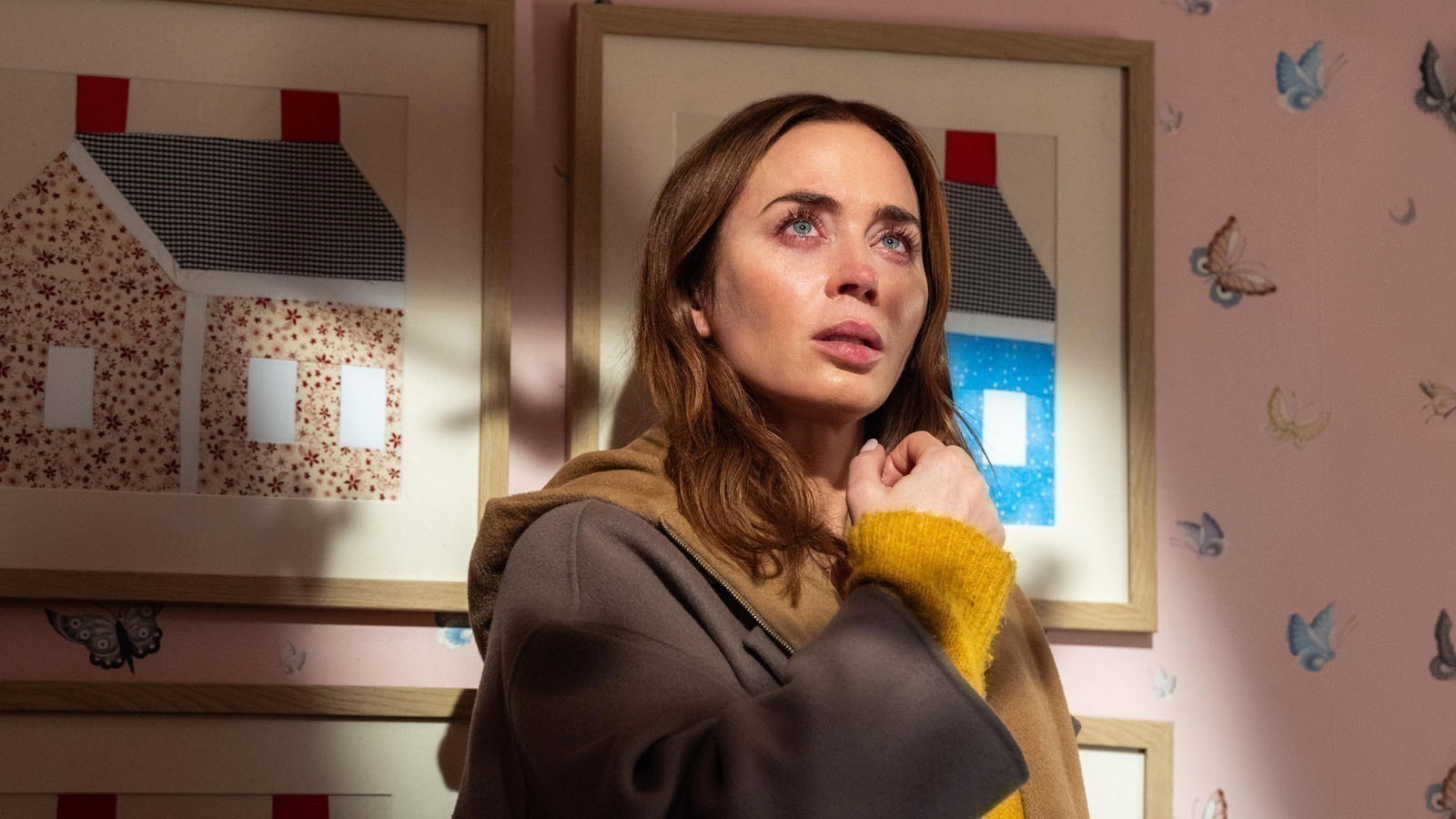
Emily Blunt in Steven Spielberg’s Disclosure Day (2026)
For a film that suggests incontestable proof that we are not alone in the universe could move all of humanity to set aside our differences and come together as one, Steven Spielberg’s Disclosure Day has sparked a remarkably wide range of first reviews. However critical consensus takes shape in the years to come, Time’s Stephanie Zacharek finds that Spielberg’s thirty-fifth feature is “the greatest film he could have possibly made in this moment, at a time when humans worldwide are feeling bewildered and blindsided by a new order in which compassion, creativity, and respect for the natural world have become traits to be crushed, not nurtured. Disclosure Day is majestic, unnerving, and more than little wacky, though its pure unhinged quality is probably its secret sauce.”
Working from a detailed treatment Spielberg tapped out in his Notes app, screenwriter David Koepp toggles between two storylines destined to converge. Cybersecurity expert Daniel Kellner (Josh O’Connor) has bolted from Wardex, a corporation that has been working with the U.S. government to keep a lid on the experiments conducted on aliens over the past several decades. Daniel’s got the evidence and—chased by Wardex reps overseen by company head Noah Scanlon (Colin Firth) and accompanied by his girlfriend, Jane (Eve Hewson), a former nun—he races to what he hopes will be a safe place where he and Hugo (Colman Domingo) intend to air these long-kept secrets via a global broadcast.
Meanwhile, Margaret Fairchild (Emily Blunt), an ambitious weatherperson on a local TV station in Kansas City, is visited by a cardinal that lands on her kitchen table, looks into her eyes, and gives her the ability to speak any language on the planet and to peer into the souls of anyone she comes across. She, too, must be whisked to safety under Hugo’s long-distance guidance. And all the while, simmering in the background, overheard snippets from news reports suggest that nuclear tensions are mounting between the friends and enemies of North Korea.
“There’s a lot going on in this movie,” writes Sean Burns for WBUR, “a ton of running and jumping and driving cars through living rooms and into trains and invisible fire trucks that crash into other cars. There’s also plenty of earnest talk about secrets and healing and childhood and faith, all staged with some of the most offhandedly elegant camera blocking you’ve ever seen. Yet either despite all this running around or because of it, Disclosure Day never feels like it really gets anywhere.”
“On paper,” writes Rolling Stone’s David Fear,Disclosure Day “reads like a 1970s paranoid potboiler. On-screen, it looks like a 1990s summer movie, all big-swing sheen. In reality, this woozy attempt to ride a wave of distrust and lack of faith in our authority figures couldn’t feel more of its moment.”
It’s all “very enjoyable and entirely ridiculous,” finds the Guardian’s Peter Bradshaw. “Disclosure Day is never anything other than entertaining and grade-A fun; rare enough in the movies or anywhere else, rocketing along with barnstorming set-pieces, exhilarating chases, funny lines, and a career-topper of a performance from Blunt.”
Disclosure Day is “immaculately mounted on a moment-to-moment basis, so its inability to cohere at any juncture is frustrating,” finds the Daily Beast’s Nick Schager. “Hansel and Gretel references combine with lousy CG animals and copious religious talk and symbolism to middling effect, and the notion that a civilization on the brink of World War III might not be able to cope with a bombshell about outer-space life (because it would destroy belief in God?) is handled sketchily.” At Little White Lies,Hannah Strong agrees that “Koepp’s screenplay simply isn’t up to the task.” And at the Film Verdict,Alonso Duralde suggests that “even the GOATs can whiff it sometimes.”
“I’ve been on Twitter too long to be swayed by the movie’s conviction that proof of alien life would do more to end wars than inflame them,” writes IndieWire’s David Ehrlich, “and Koepp’s script never puts in the work required to earn its optimism on the subject, but the childlike joy and wonder in seeing Janusz Kamiński’s camera trace impossible circles around a wooden fence, or pivot from one side mirror of Margaret’s car to the other, is contagious enough that even the film’s most credulous ideas feel too sincere to reject outright.”
“It’s been a long time since Steven Spielberg directed a film as quintessentially Spielbergian,” writes the Hollywood Reporter’s David Rooney, who has plenty of time for this cast as well. “O’Connor is one of our most soulful and sensate actors, seemingly incapable of a false note; he brings conviction and a depth of feeling to Daniel that intensifies with each new piece of information concerning who he is and where his abilities originate . . . The standout, however, is Blunt, simply breathtaking and never more magnetic, injecting a whirlwind of emotions into Margaret as she’s hurtled forward by terrifying instincts that she’s powerless to control, and making steady gains in purposeful determination as her situation—past and present—is illuminated.”
Disclosure Day eventually heads toward “an extended, and impeccably put-together final set piece, scored to John Williams’s music, that for all its outward corniness manages to be shockingly moving, often in the simplest of ways,” writes Vulture’s Bilge Ebiri. “Some will call it manipulative, but Spielberg’s secret has always been that he understands something fundamental about the audience’s cinematic imagination. He knows how to move us because he knows what we secretly long for. He taps into our desire to believe in something greater, in all the things that hover at the edge of the possible, whether in our minds, in our skies, or on our screens.”
The ending “plays into every complaint that’s ever been lodged about [Spielberg’s] raging sentimentality,” writes the Atlantic’s David Sims. “I loved every second.”
Spielberg in the Summer of 2026
This week’s release of Disclosure Day follows weeks of marveling at a box-office phenomenon that feels very 2026. Two modestly budgeted scary movies directed by YouTubers in their twenties—Kane Parsons’s Backrooms and Curry Barker’s Obsession—have become smash hits, elbowing aside a Stars Wars movie. If it were just one, it’d be an outlier. But two, appearing practically simultaneously, will suggest—to many studio execs, undoubtedly—that the phenomenon is repeatable. Universal Pictures, in the meantime, is giving Disclosure Day a moment in the sun that should last just over a month before Christopher Nolan’s The Odyssey storms into theaters worldwide to very likely recoup several times over a budget twice the size of Disclosure Day’s.
Spielberg will turn eighty in December, so when he releases a feature every few years, we tend to step back and take measure of a career that has shaped the industry and left its mark on our culture more indelibly than any other filmmaker’s. The New York Times Magazine has put him on the cover and sent its two-time Pulitzer Prize–winning critic, Wesley Morris, to hang with him for a couple of months and then write the profile.
From Firelight (1964), a now mostly lost feature about an alien invasion that Spielberg made when he was seventeen, through The Fabelmans (2022), in which he finally tackled head-on his parents’ divorce—a traumatic episode seeping into the bones of so many of his films, including Close Encounters of the Third Kind (1977), E.T.: the Extra-Terrestrial (1982), Hook (1991), and Catch Me If You Can (2002)—“the movies are the arena in which he has worked on some of the mysteries he couldn’t solve on his own,” writes Morris. “What we experience as sorcery is, for him, a process of exorcism. ‘I can’t express enough how therapeutic and healthy it is for me to keep doing this job over and over and over again,’ he said deliberatively, almost as if he was feeling this out. ‘I work so much out through this process. So much out. I get to bleed off some of the darkness instead of letting it fester inside me. You get to let it fester inside you.’”
With Jack Hamilton’s excellent piece on Jurassic Park and Schindler’s List, both released in 1993—“the most pivotal year of Spielberg’s career, and the beginnings of a change in the way both critics and audiences thought about his body of work”—Slate has launched Spielberg Week. Two more standouts so far are Nadira Goffe’s appreciation of The Color Purple (1985) and Sam Adams’s assessment of War of the Worlds (2005), “Spielberg’s most unrelentingly downbeat movie, and the one that comes closest to fulfilling his lifelong promise to direct an honest-to-goodness horror movie.”
The Jacob Burns Film Center series Steven Spielberg’s Sci-Fi is on through June 21, and in London, the BFI season Close Encounters with Spielberg runs through June 28. As for what’s next, when he was at SXSW in March, Spielberg told Sean Fennessey, cohost of The Big Picture podcast, that he’s developing a Western. “And it kicks ass,” he said. “I never want to quit.”
Don’t miss out on your Daily briefing! Subscribe to the RSS feed.
This month’s roundup spotlights new titles on Murnau, Welles, Capra, Zulawski, and Richard Fleischer as well as forthcoming books from Matías Piñeiro and Tilda Swinton.