The Women Who Wrote Noir
Share
“I never met Ida Lupino, but I always wanted to,” wrote Martin Scorsese in the New York Times in 1995. “The six films she directed between 1949 and 1953 are remarkable chamber pieces that deal with challenging subjects in a clear, almost documentary fashion, and are a singular achievement in American cinema.”
Writing for Slant in 2019, Jake Cole called The Hitch-Hiker (1953) a “vicious noir” and “an extreme outlier in Lupino’s filmography, but it’s also the apotheosis of her work behind the camera. Taking place almost entirely inside a car, the film renders its cramped conditions almost abstractly, a hellacious void where only the streaks of light passing by as the vehicle speeds down country roads suggest that the characters—two buddies (Edmond O’Brien and Frank Lovejoy) on a fishing trip and the hitchhiker (William Talman) they pick up—are still on earth and not some purgatory.”
This evening in Toronto, The Hitch-Hiker will open Secret Beyond the Door: The Women Who Wrote Noir, a TIFF Cinematheque series of eight films screening on 35 mm, all of them written or cowritten by women. Lupino worked with producer Collier Young on the screenplay for The Hitch-Hiker, drawing from the real-life killing spree carried out two years earlier by twenty-three-year-old Billy Cook.
Tomorrow brings an undeniable classic, Howard Hawks’s The Big Sleep (1946), an adaptation of Raymond Chandler’s novel starring Humphrey Bogart and Lauren Bacall and cowritten by William Faulkner, Jules Furthman, and Leigh Brackett, “who Hawks assumed was a man based on her first name,” notes series programmer Bernardo Rondeau. In 2013, the Guardian put The Big Sleep at the top of its list of the ten best noirs, and Peter Bradshaw wrote that “the narrative’s defiance of our comprehension is part of the film’s sensational effect and its remarkable longevity: it means that scenes, characters, moments, and quotable lines (‘She tried to sit on my lap while I was standing up’) float up out of the mesmerizing stew and into your consciousness like fragments of a dream.”
Joseph H. Lewis’s My Name Is Julia Ross (1945), screening Saturday afternoon, is “a gothic thriller about an unemployed London secretary hired as a live-in assistant to a seemingly sweet old lady,” writes Sean Axmaker for TCM. “In fact, she’s hired because she is a dead ringer for the dead wife of the old lady’s psychotic son.” Axmaker pulls a quote from Peter Bogdanovich’s interview with Lewis: “I didn’t rewrite the script,” said the director, “the script came to me, and I would say it was a damn near perfect script.” And it was written by Muriel Ray Bolton, who was adapting the novel The Woman in Red by Anthony Gilbert (the pen name of Lucy Beatrice Malleson).
Following in the evening is Fritz Lang’s Secret Beyond the Door (1947), which is “not quite the [film] Lang and his talented writer Silvia Richards (Possessed, Rancho Notorious, Ruby Gentry) first envisaged, planned, and constructed,” as Cristina Álvarez López and Adrian Martin explained in a 2014 piece for Notebook. “That film—particularly in its opening section concerning how Celia (Joan Bennett) gets to her fated encounter with brooding architect Mark (Michael Redgrave)—was more ample and, perhaps, more explicatory of certain character motivations and plot enigmas.” But Secret Beyond the Door is one of those rare films that actually “benefitted from studio or producer interference.”
Claude Rains leads the cast of Michael Curtiz’s The Unsuspected (1947), which screens this Sunday and next. “A forbidding, dreamlike majesty infuses this undeservedly overlooked noir,” writes Nora Fiore, and Rondeau notes that while Ranald McDougall wrote the first screenplay, “adapted from Charlotte Armstrong’s Saturday Evening Post serial, it was veteran screenwriter Bess Meredyth who shaped the story into a sinuous noir and one of Curtiz’s most underrated pictures.”
Barbara Stanwyck stars in Robert Siodmak’s The File on Thelma Jordon (1950) as a woman who seduces an unhappily married assistant district attorney in order to get him to help her evade a conviction for the murder of her wealthy aunt. Wrapping the first weekend of the series, Thelma Jordan was based on a story by Marty (aka Mary) Holland and written by future Pulitzer Prize winner Ketti Frings.
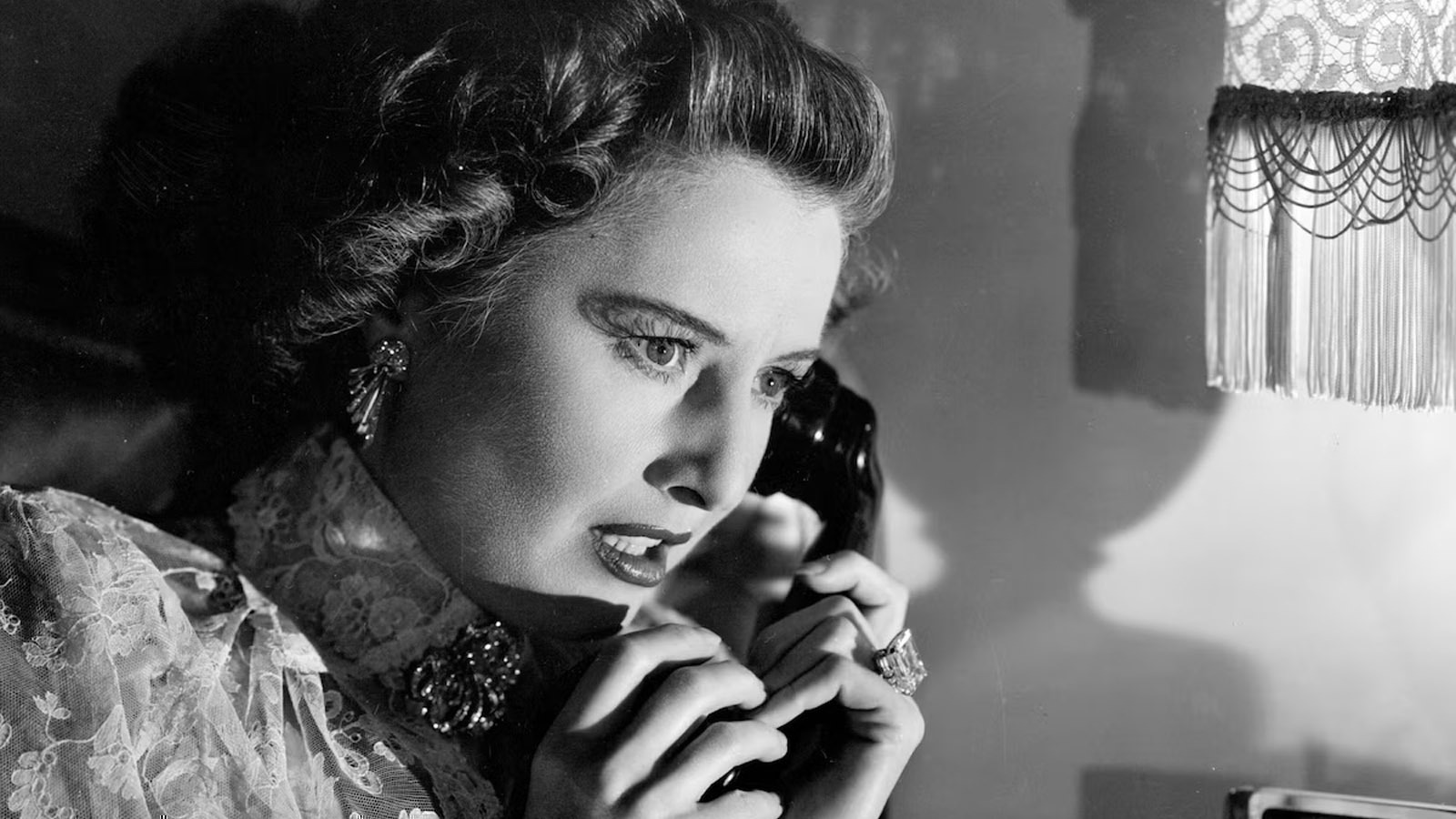
On November 13, both the series and Stanwyck return with Anatole Litvack’s Sorry, Wrong Number (1948). Screenwriter Lucille Fletcher adapted her own hit radio play about a bedridden heiress who is trying to call her husband (Burt Lancaster) at the office when she overhears plans being cooked up for an assassination.
“With so much of the film’s action tethered to one end of a telephone receiver or another,” writes Matthew Thrift for Notebook, “Litvak is forced to create visual interest through dynamic blocking, as characters deliver reams of exposition. Unlike most of his work, Sorry, Wrong Number is all plot, and Litvak rises to the challenge of a very specific set of problems with great ingenuity, crafting elaborate master shots of which Spielberg would be proud.”
The series wraps on November 15 with Sudden Fear (1952), starring Joan Crawford as a successful playwright who fires her leading actor (Jack Palance), then falls for him and marries the guy only to discover that he and his ex (Gloria Grahame) are planning to knock her off. “Based on a novel by Edna Sherry, directed by David Miller, and with a screenplay by Robert Smith and Lenore Coffee (the woman who wrote the 1931 Possessed, one of Crawford’s early triumphs), Sudden Fear is a corker, a noir thriller about a woman deceived,” writes Farran Smith Nehme for Film Comment. “What are the Kübler-Ross stages of ‘my husband wants to murder me’? Crawford gives you every one—only it’s not acceptance that she shows the camera after her character has passed a long, sleepless night. It’s calculation, it’s hatred, and it’s ice-cold.”
Don’t miss out on your Daily briefing! Subscribe to the RSS feed.