Rossellini 120
Share
In 2005, Isabella Rossellini teamed up with Guy Maddin to make My Dad Is 100 Years Old, “a micro-doc packing more intoxicating beauty and invigorating ideas into its seventeen minutes than most other films do in ninety or more,” as Ed Halter wrote in the Village Voice. Rossellini appears as herself, “pondering whether her father’s films were ‘ridiculous or sublime,’” as well as her mother, Ingrid Bergman, and several of her dad’s contemporaries, including Alfred Hitchcock and Federico Fellini.
“Roberto himself takes part,” wrote Halter, “as nothing but a fat naked belly, jiggling as he intones uncompromising manifestos for the ethical demands of cinema. His voice—also provided by Isabella—seems to emerge from his cavernous navel. Compared in Isabella’s narration to a pregnant male seahorse, Roberto is reimagined as both the fecund mother of modern cinema and the strict father who sought to impose its limits. His arguments with contemporaries, here staged within a decaying movie theater, become battles for the soul of cinema itself.”
Isabella Rossellini is in Los Angeles tonight to present My Dad Is 100 Years Old and Rome Open City (1945), that towering landmark of Italian neorealism depicting the partisan struggle against Nazi occupiers during the final years of the Second World War. The evening launches Roberto Rossellini Prefers Real Life, an Academy Museum series that takes its name from an essay by one of Rossellini’s most dedicated champions, François Truffaut.
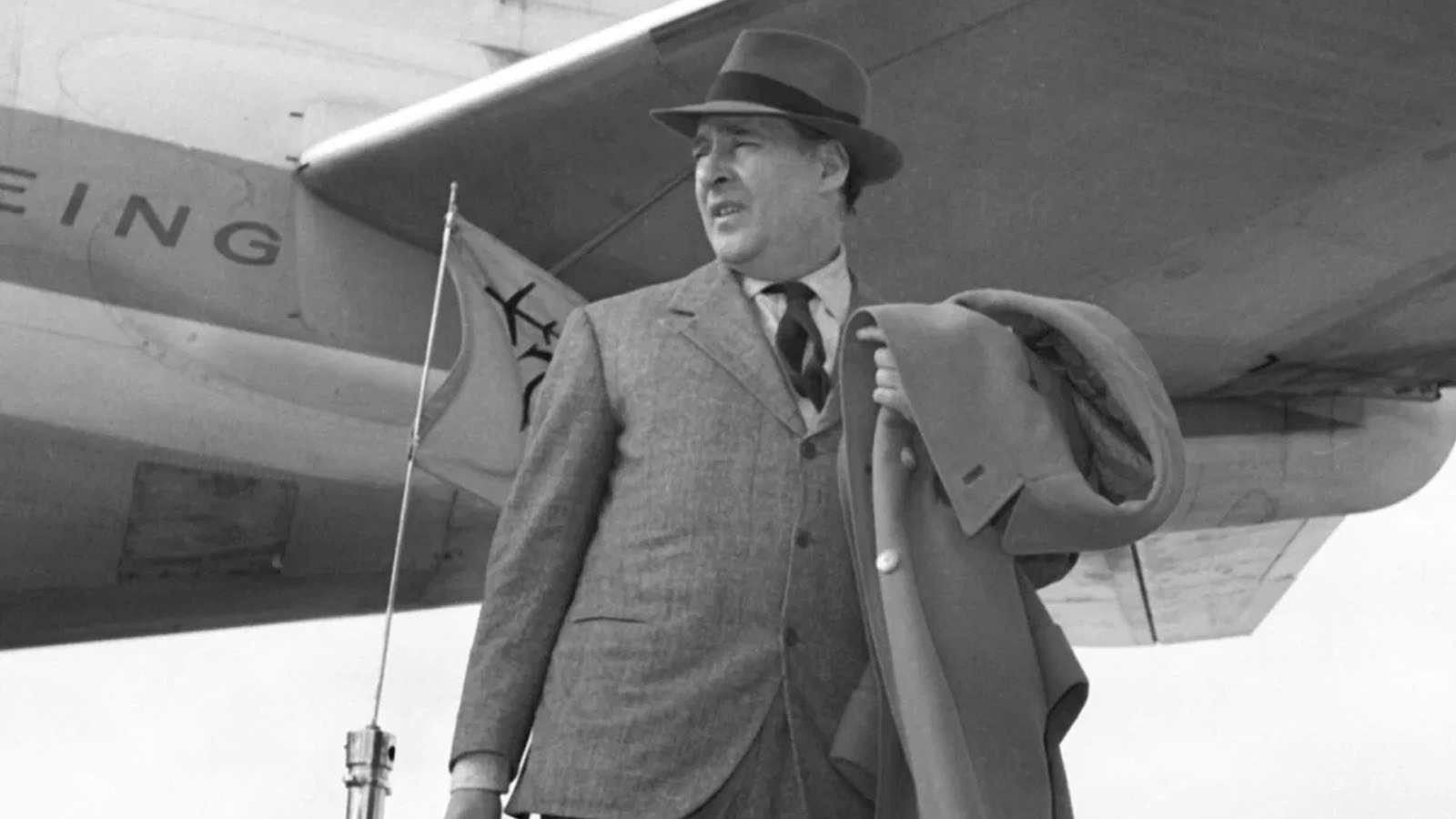
The occasion for the series running through November 30 is neatly summed up in the title of a twenty-five-film retrospective running at Film Forum in New York from November 20 through December 10: Rossellini 120. Born in Rome on May 8, 1906, Roberto Rossellini grew up watching movies in the city’s first modern cinema, the Corso, built by his father. Aided in part by his close friendship with Vittorio Mussolini, son of Benito, Rossellini began his career making propaganda films for the fascist regime.
Rome Open City is a declarative about-face. Shooting began in January 1945, just months after the Nazis had scampered off. “The war in the rest of Italy was still on,” notes Irene Bignardi. “There was no film stock, and so Rossellini and his team had to use abandoned scraps found here and there. It wasn’t possible to check the rushes. Rossellini, little by little, sold all he owned so that the film could go on.”
Shot on location—in part because the famed studio Cinecittà was being used as a shelter for the homeless and displaced—Rome Open City featured a largely nonprofessional cast, the standout exceptions being Aldo Fabrizi as a priest working clandestinely with the partisans and Anna Magnani, turning in an immortal performance as Pina, the pregnant fiancée of a member of the resistance. Rossellini quickly followed up on the first film in what would become known as his War Trilogy with Paisan (1946), a series of six episodes depicting Italians’ struggle to rebuild their decimated country.
“Any simple description of Paisan would make it sound both miserable and despairing,” writes Colin MacCabe, “but the verve of the stories and the sense of the camera finding realities as yet unseen actually make it one of the most inspiring and energizing of films. It was a prizewinner at Venice, although its reception in a politically divided Italy was mixed: too Christian for the communists and too communist for the Christians. Internationally, however, the film was greeted with unanimous critical acclaim—most importantly in France, where [critic and future cofounding editor of Cahiers du cinéma André] Bazin chose it as the key film with which to explicate the importance of Italian neorealism as a whole.”
In 2017, filmmaking brothers Paolo and Vittorio Taviani (Padre Padrone, The Night of the Shooting Stars) recalled the lasting impact made on them when, as young boys, they saw Germany Year Zero (1948). Edmund, a twelve-year-old Berliner scraping by in the ruins of the bombed-out city, is played by Edmund Koehler, who was cast, many believe, because he resembled Romano, the son Rossellini had lost two years before. “A gesture of despair that emotionally fuses personal grief with an intense empathy for the dispossessed,” writes Jonathan Rosenbaum, “Germany Year Zero is finally something closer to a cry of pain than a carefully worked-out and conceptualized statement, and this is what grants it a lasting authenticity.”
In 1947, Rossellini received a now-legendary letter from an admirer: “If you need a Swedish actress who speaks English very well, who has not forgotten her German, who is not very understandable in French, and who in Italian knows only ‘ti amo,’ I am ready to come and make a film with you.” Rossellini and Ingrid Bergman struck up a working partnership and an affair that scandalized Hollywood, the U.S. Senate, and all of Europe. Married for seven years, they had three children and made five features together.
In these films, Rossellini’s “use of the conventions and moods of movie melodrama became self-conscious and reflexive,” writes Richard Brody. “With Bergman, the idea of melodrama—the commercial cinema, Hollywood cinema—filled his work with the cinematic equivalent of quotation marks.”
Brody notes that the enthusiasm of the Cahiers crowd of future French New Wave filmmakers “for the films of Alfred Hitchcock and Max Ophuls, for movies of lavish precision and grand gesture, was matched by a passion for documentary and a desire to film their own experiences with a confessional authenticity. Rossellini proved to them, with the clarity of a mathematical theorem, that the two sides of their cinematic obsession could be brought together—along with an even more radical intimacy, the on-screen exploration of their relationships with their actors at the time of filming.”
The Academy Museum will present the world premiere of a new restoration of Fear (1954), an adaptation of Stefan Zweig’s 1925 novella starring Bergman as a German woman being blackmailed as she tries to end an affair. And a new restoration of Journey to Italy (1954), starring Bergman and George Sanders as a couple whose marriage is falling apart as they travel through Naples and its surrounding countryside, will see its U.S. premiere at the Museum. Here, writes Paul Thomas, “Rossellini is transgressing boundaries others had long taken for granted—which is why Jacques Rivette insisted in the 1950s, and why Laura Mulvey was later to reiterate, that ‘if there is a modern cinema, this is it . . . With the appearance of Viaggio in Italia, all films have suddenly aged ten years.’”
In the early 1960s, European governments were still viewing the relatively new medium of television as a conduit not only for entertainment but also for education and enlightenment. Rossellini was all in. He announced a grand project, an ambitious series of features a year that would bring history to life. The directors he called on to join him in the endeavor, Truffaut and Fellini among them, declined, but he forged ahead. For Colin MacCabe, The Taking of Power by Louis XIV (1966) “is undoubtedly the most striking and successful” of Rossellini’s historical films.
“Like the history of Western thought that they endeavor to present—‘dramatize’ would be far too strong a word—they are interlocked, each a chapter in an unfolding narrative,” writes Nick Pinkerton in Metrograph’s Journal. “Created over the last fifteen years of his life, from 1962 to 1977, they are the products of an ambition little seen in cinema before or since . . . Taken altogether, Rossellini’s histories are difficult films to classify, works belonging to no school but their own. In their own time they were occasionally received with praise, as in the case of Louis XIV, but more often with hostility, incomprehension—though the project seems to have acted as a restorative tonic upon Rossellini, galvanizing him and giving him a zealot’s sense of mission.”
“To say, as many have,” writes Tag Gallagher, the author of The Adventures of Roberto Rossellini, “that these movies lack acting, psychoanalysis, Murnau-like expressionism, overwhelming emotions, and the richest cinematic art is akin to closing one’s eyes at high noon and claiming the sun no longer exists.”
Don’t miss out on your Daily briefing! Subscribe to the RSS feed.