William Greaves 100
Share
When Once Upon a Time in Harlem premiered at Sundance back in January, the A.V. Club’s Jacob Oller called it “a staggering work of archival magic.” In 1972, filmmaker William Greaves, best known for his groundbreaking Symbiopsychotaxiplasm: Take One (1968), invited artists, composers, writers, performers, and activists associated with the Harlem Renaissance of the 1920s and ’30s to Duke Ellington’s townhouse for a cocktail-hour get-together that bubbled along into the early evening.
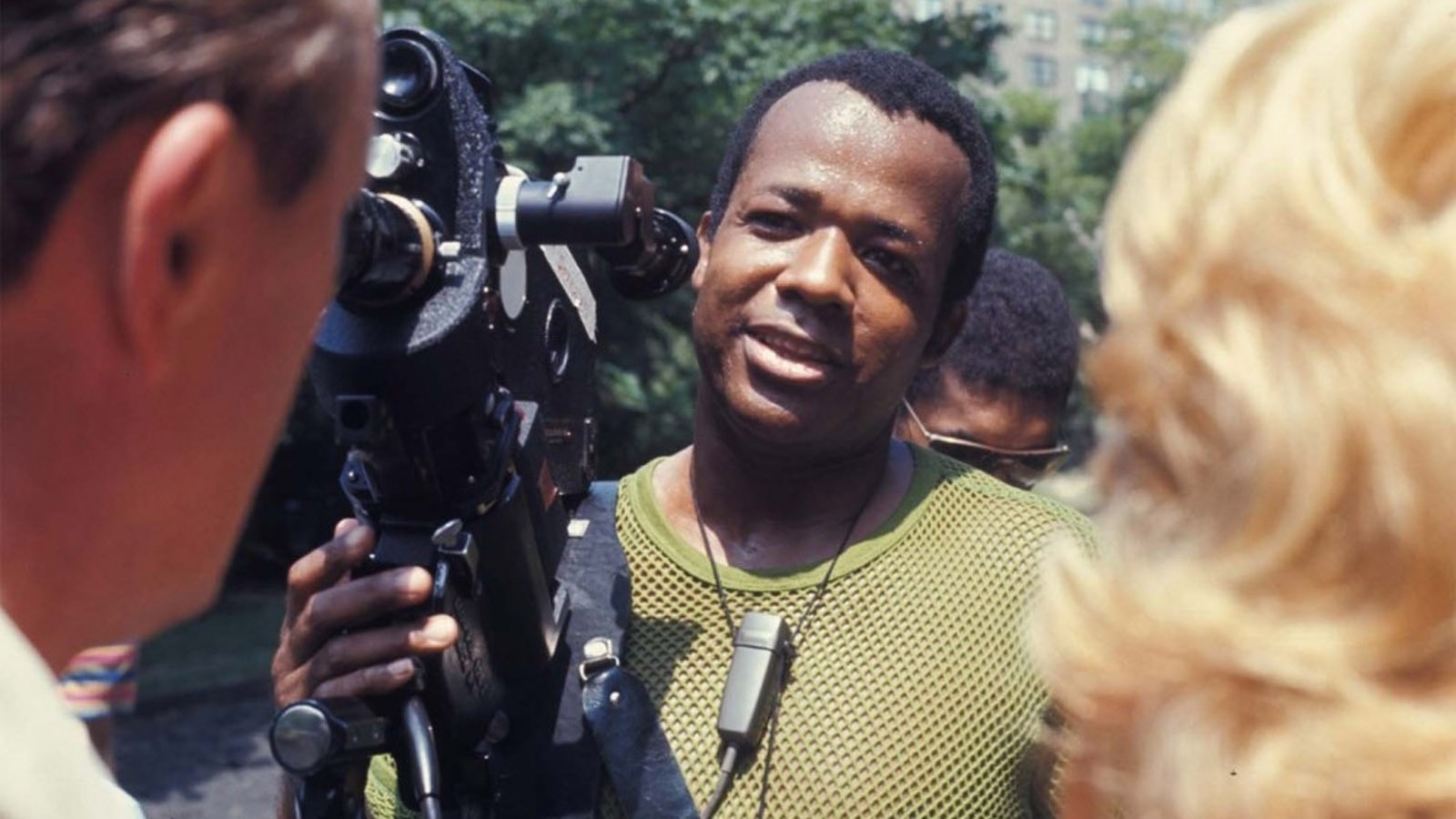
Greaves and his four cameramen—one of them was his son, David Greaves—mingled, capturing boisterous conversations and the occasional one-on-one interview. In Once Upon a Time in Harlem, “the trailblazers aren’t names on a page or plaques on a wall,” writes Oller, “but endlessly bickering, drunkenly funny, sweetly proud, profoundly eloquent members of a recognizable social circle. They are not participating in a stagey or stately oral history about the Harlem Renaissance; it just so happens that a greater history than any that’s yet been written emerges from their organic interactions.”
When Greaves passed away in 2014, David Greaves and his daughter, producer Liani Greaves, set out to restore the nearly thirty hours of footage and, as the Guardian’s Adrian Horton writes, “to seamlessly clip and contextualize the party into a hundred mesmerizing minutes.” The result is “both a sublime hang-out of a film and a celebration of individual achievements, a fascinating map of a long-ago scene and a referendum on legacy. That this sumptuous footage, allowed room to breathe, exists at all feels like a miracle; that it takes shape here as a coherent, inventive yet straightforwardly informative film is an intergenerational feat.”
“The edit employs jazzy ’70s split-screen to offer multiple perspectives of conversations and convey an impression of the story as up for grabs, of history as living,” writes Mark Asch for Little White Lies. “Once Upon a Time in Harlem was made during another profound moment in both New York City and in Black history and culture. The film’s opening and closing montages situate these lions of the past squarely in 1972, juxtaposing archival footage with the iconography, from the Apollo Theater to graffiti-scrabbled stoops.” William Greaves is “a conspicuous presence when he pops up on-screen, less because he’s the director than because he’s a midcareer artist evidently eager to ask questions and soak up knowledge. That he, like his subjects, is no longer with us, makes Once Upon a Time in Harlem doubly precious, as a capsule of two times.”
This eagerness that Asch senses in Greaves reflects the filmmaker’s lifelong connection to the people he was capturing. Born in Harlem in 1926, Greaves grew up in the cultural milieu created and shaped by those he’d invited to the party. This weekend’s launch of a theatrical run for Once Upon a Time in Harlem—David and Liani Greaves are in New York to take part in Q&As at Film Forum tonight and tomorrow and at Film at Lincoln Center on Saturday and Sunday—marks a centennial that will be celebrated with series running at the Barbican in London from Wednesday through November 28 and at Film Forum from October 23 through 29 as well as a Spotlight program at next month’s International Documentary Film Festival Amsterdam.
Greaves started out as a dancer but soon gravitated toward the American Negro Theatre, and by 1948, he was studying at the Actors Studio. He landed substantial roles in theatrical productions and appeared in two films screening in the New York and London series, Jack Kemp’s musical melodrama Miracle in Harlem (1948) and Powell Lindsay’s Souls of Sin (1949), featuring Greaves as blues guitar player Isiah “Alabama” Lee.
In short, his career was rolling along just fine, but Greaves could see that, as a Black actor in the United States, he was facing limited options. In 1950, he left the country to study documentary filmmaking at the National Film Board of Canada. He would eventually make more than two hundred nonfiction films, and a standout from this period is Emergency Ward (1959), a thirty-minute immersion in the urgent goings-on at Montreal General Hospital.
As the civil rights movement began to catch fire, Greaves decided to return to the U.S. Emergency Ward had caught the attention of the United States Information Agency, and after making a few films for the USIA, he convinced them to let him travel to Senegal in 1966 to document an event for a film that became The First World Festival of Negro Arts (1968).
“The year 1968 was a particularly productive one for Greaves,” writes Matthew Barrington, a programmer for the Barbican, in an annotated list of ten standouts from the oeuvre. With Still a Brother: Inside the Negro Middle Class (1968), “Greaves moves beyond the act of countering negative stereotypes, drawing a deeper, complex portrait of how success serves ‘the Black community,’ while simultaneously critiquing and pulling apart the notion of any such singular entity. The film also reflects Greaves’s interest in subverting the idea of the documentary, through the inclusion of an extended docufiction sequence focusing on a group of Black Republicans.”
Greaves also spent that year shooting Symbiopsychotaxiplasm Take One, “a singular, metacinematic experiment in nonfiction that foregrounds the ‘performances’ within it and slyly calls into question notions of authority, sexuality, and other forms of social identity,” as Michael Koresky wrote in 2014. “Symbiopsychotaxiplasm documents the shooting of a strange film in Central Park, although Greaves never intended us to see this movie within the movie. As the director of this film about the filming of a film—the structure and content of which are a mystery even to the baffled crew—Greaves necessarily becomes the central on-screen figure. And although it is never spoken about in the film, the fact that Symbiopsychotaxiplasm was made by an African American man in the 1960s cannot be ignored: Greaves’s race is unavoidable and ever-present.”
“If the production process sounds like a recipe for chaos,” wrote Amy Taubin in 2006, “Symbiopsychotaxiplasm: Take One is anything but. Thanks to Greaves’s lively, innovative editing (involving some of the most surprising contrapuntal double and triple split-screen images in the history of movies), the film has the polyrhythmic elegance of its Miles Davis score.”
After the assassination of Martin Luther King Jr., National Educational Television (NET, soon to be known as PBS) launched the news magazine Black Journal with Greaves as a cohost. During the production of the third program, Black staff members demanded that executive producer Alvin Perlmutter, a white man, be replaced with Greaves, and Perlmutter readily agreed. The Barbican will present a free screening of an episode featuring segments on Black policemen, Ghanaian murals, and liberation movements in South Africa.
Further recommendations from Matthew Barrington include In the Company of Men (1969), in which “Greaves films a series of role-playing workshops where long-term-unemployed Black workers engage with white factory managers who fired some of the people in the room,” and The Deep North (1988): “Therapists invite people of various ethnicities to recount their experiences and encounters with other racial groups. They are then guided to respond by roleplaying the anecdotes being told by group members. The film shows Greaves as a deeply humanitarian filmmaker, working to expose the dark elements of American history while also finding formal ways to explore these ideas filmically. It underlines his optimism that hope can defeat hate.”
When Muhammad Ali died in 2016, the New Yorker’s Richard Brody explained why he preferred Greaves’s The Fight (1974) even to such “excellent films” as William Klein’s The Greatest (1969) and Leon Gast’s When We Were Kings (1996). Greaves was there when Ali faced off against Joe Frazier for the second time in Madison Square Garden, and his film is “about ‘the fight’ in the same way as a work of literary theory might be about ‘the novel,’” wrote Brody. “Greaves’s subject is far more than one particular bout—it’s about the sport, and the business, of boxing, and he realizes his comprehensive and general view by way of a resolutely, obstinately precise attention to the particular details of one particular fight, one which, owing to the supreme virtues of its athletes, is among the supreme events in the history of the sport.”
In 2021, Kino Lorber released a restoration of Nationtime (1972), a chronicle of the 1972 National Black Political Convention held in Gary, Indiana. “Nationtime is an essential document,” wrote Maxwell Paparella at Screen Slate, “charged with portent and embellished by Greaves’s restless camera. Again and again, the frame is filled with indelible images of the occasion: [Jesse] Jackson biting his fingernail as he waits to speak; [Bobby] Seale’s comrades replacing the leather jacket around his shoulders; Betty Shabazz and Coretta Scott King sharing a private word on the dais, their eyes full of loss and life.”
At 4Columns, Melissa Anderson wrote that “although Nationtime hews closely to the conventions of nonfiction filmmaking—a fly-on-the-wall perspective dominates—the documentary showcases Greaves’s gifts for capturing the ways that energy shifts and ricochets among groups of people, a talent earlier demonstrated in Symbiopsychotaxiplasm.”
Don’t miss out on your Daily briefing! Subscribe to the RSS feed.