Venice Classics 2026
Share
It’s becoming a tradition for the Venice International Film Festival to give its Venice Classics program a head start with a pre–opening night screening. On Tuesday, the festival will pay tribute to hometown director Tinto Brass—probably best known for his work in soft-core erotica and for overseeing the outlandish production of Caligula (1979)—with the world premiere of a new restoration of Deadly Sweet (1967). When a comely young woman (Ewa Aulin) is suspected of murdering a mobster in a London nightclub, an out-of-work actor (Jean-Louis Trintignant) takes her under his wing.
“Shot in England by an Italian director with a French leading man and a Swedish sex-doll leading lady (both dubbed into Italian), Deadly Sweet is advertised as a giallo (an Italian horror with cruel and flamboyant murders) but is really a vague murder-mystery romp directed as a pop-art object,” wrote Sean Axmaker in 2009. “The style is appropriated from comic books, experimental cinema, the French New Wave, and the British New Wave, with special attention to Godard and Richard Lester, Antonioni’s Blow-Up (a visit to a photography studio turns into an impromptu fashion shoot), and TV’s Batman.”
This year’s program spans more than half a century, beginning with Ernst Lubitsch’s To Be or Not to Be (1942). “Jack Benny against the Nazis?” asked Geoffrey O’Brien in 2013. “A farce set in occupied Warsaw? Jokes about concentration camps?” To Be or Not to Be “did something rare, then or at any time, by interweaving farce and disaster in such a rigorously structured fashion as to elicit, in the very same scenes, genuine anxiety and a hilarity so acute that it has something like an ecstatic kick.”
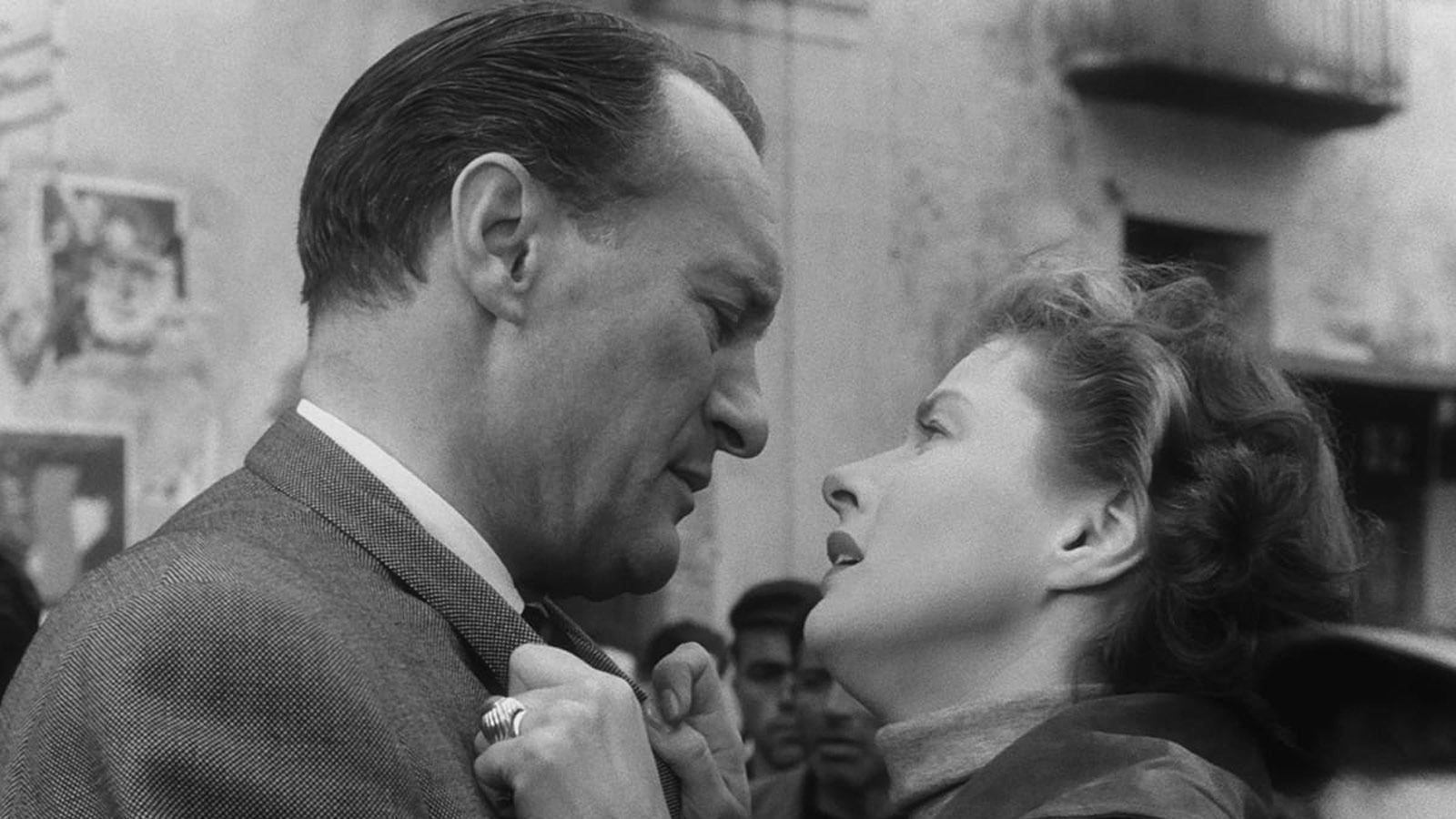
In his 2013 essay on Journey to Italy (1953)—starring Ingrid Bergman and George Sanders as a couple whose marriage unravels as they travel through the countryside near Naples—Paul Thomas noted that Roberto Rossellini was “transgressing boundaries others had long taken for granted—which is why Jacques Rivette insisted in the 1950s, and why Laura Mulvey was later to reiterate, that ‘if there is a modern cinema, this is it . . . With the appearance of Viaggio in Italia, all films have suddenly aged ten years.’”
“Gorgeously photographed by Raúl Martínez Solares,” wrote Slant’s Ed Gonzalez in 2004, Illusion Travels by Streetcar (1954) is “in many ways Luis Buñuel’s most visually intoxicating creation. A municipal transit company decides to retire one of its streetcars, but after a night of drinking, two of the company’s workers, Juan (Carlos Navarro) and Tarrajas (Fernando Soto), decide to take the streetcar out for one last trip, subsequently perpetuating a series of cosmic encounters around Mexico City.”
Ashes and Diamonds (1958), the third film in Andrzej Wajda’s war trilogy, captures a “typically Polish situation, where the urge to live clashes with the sense of duty, where hope is mixed with cynical despair,” writes Paweł Pawlikowski (Cold War, Fatherland). “The way that history gets in the way of love—that obviously stayed with me.”
In Simón Feldman’s Those at Table 10 (1960), lovers José (Emilio Alfaro) and María (María Aurelia Bisutti) defy friends and family to meet at their one safe spot, in a downtown café. Caligarinotes that the film is “regarded as one of the defining works of Argentina’s ‘Generation of the ’60s’” and has been restored from just two 35 mm prints already in “an advanced state of deterioration,” with additional support from Argentina’s National Institute of Cinema and Audiovisual Arts.
Florestano Vancini’s Long Night in ’43, cowritten with Pier Paolo Pasolini and Ennio De Concini, won the Best First Feature Award when it premiered in Venice in 1960. Set in Ferrara, in the German puppet state Italian Social Republic during the late stages of the Second World War, the film is a love story focusing “less on affairs of the heart and, instead, explicitly on holding Italy to account for the horrors of Fascism, something it does with a furiously savage bite,” writes Colin Edwards.
The winner of a Silver Lion, Yesterday Girl (1966), the first feature by the late Alexander Kluge, will head to the New York Film Festival after the new restoration premieres in Venice. A young woman (Alexandra Kluge, the director’s sister), migrates from East to West Germany, and the NYFF programmers note that “Kluge adorns her meandering odyssey with a wealth of intertitles, references, citations, and documentary footage, yielding an allusive and polyvocal work about which one can say, simply, that there was a German cinema before Yesterday Girl and a German cinema after it.”
Kim Morgan has called Roman Polanski’s Cul-de-sac (1966) “so much weird, sexy, subversive, screwy fun” and a “a precursor to themes he would continually dabble in: tortured relationships, bizarre blonde behavior, infidelity, cross-dressing, even film noir via the stalwart Lionel Stander.”
Roger Corman’s The Wild Angels (1966) “may not have been the first movie in which a character exclaimed ‘Out of sight, man!,’” wrote J. Hoberman in 2015, “but, released three summers before Easy Rider and introducing much of the same iconography, this ‘brutal little picture,’ as the New York Times critic Bosley Crowther characterized it, made the hippie youth film possible—and also transformed Henry Fonda’s twenty-six-year-old son, Peter, into Hollywood’s personification of the generation gap.”
Jaromil Jireš’s Valerie and Her Week of Wonders (1970), completed in the wake of the Soviet invasion of Czechoslovakia in 1968, “has peeled off from its historical moment and been embraced by foreign audiences, who have kept it in circulation because of how irresistibly it combines some very soft-core delights with the trappings of horror,” wrote Jana Prikryl in 2015. “One of the pleasures of watching Valerie now, in fact, is seeing it through this bifocal lens: as the lyrical product of filmmakers who dodged certain limits on their freedom of expression, and as a semi-obscure cult film appreciated more wryly in the West.”
Gena Rowlands plays a museum curator who struggles to keep herself from falling in love with an eccentric parking-lot attendant (Seymour Cassel) in John Cassavetes’s Minnie and Moskowitz (1971). “Brutality is everywhere,” wrote the New Yorker’s Richard Brody in 2013, “and there’s a special place in Hell for Minnie’s married ex-lover (played by Cassavetes, Rowlands’s real-life husband), yet, in this shambling tale of punch-drunk love, the rage is a part of romantic passion.”
Nino Manfredi stars in Ettore Scola’s Ugly, Dirty and Bad (1976) as Giacinto, the patriarch of a sprawling family cramped into a shack overlooking a highway on the outskirts of Rome. Giacinto comes into some insurance money after loosing an eye, but he refuses to share it with anyone. When Ugly, Dirty and Bad screened in 2016 at what was then the Film Society of Lincoln Center, the programmers noted that it “contains a pitch-perfect blend of hilarity and brutality, which amounts to a brilliant portrait of squalor and cynicism unlike any other.”
Ann Hui’s The Story of Woo Viet (1981) is “a romantic gangster/social problem film that in many ways established the kind of character that would rocket Chow [Yun-fat] to superstardom a few years later in his work with John Woo and Ringo Lam,” wrote Sean Gilman for Notebook in 2019. “He’s all charm here though, a Robert Redford or Cary Grant type, handsome and untethered by convention yet inescapably drawn to the independent-minded woman who he says represents to him an ideal of Chinese womanhood.”
“I can say with absolute conviction that no Japanese filmmaker makes a film without being conscious of Shinji Somai’s existence,” wrote Ryusuke Hamaguchi for Japan Society a few years ago. “That is how significant Somai’s presence is in the history of Japanese cinema.” And in 2016, Hayley Scanlon wrote that Somai’s The Catch (1983), an “opus of fishermen at home on the waves and at sea on land,” is “a complex examination of masculinity but also of fatherhood in a rapidly declining world filled with arcane ritual and ancient thought.”
When The Blue Eyes of Yonta (1992) screened at the Harvard Film Archive in 2022, Haden Guest called Flora Gomes’s second feature “a bold follow-up to Mortu nega [1998] that extends its critical scrutiny of postliberation Guinea-Bissau through a poignantly nuanced story of ardent dreams fractured across different generations.” Yonta “makes clear Gomes’s talent as both an intuitively astute chronicler of history in the making and a weaver of powerful nuanced allegories of nation and community.”
“Irreverent humor, frustrated idealism, and earnest compassion are blended with a keen sense of character, place, and political reality in the auspicious English, August [1994],” wrote Lawrence Van Gelder in his New York Times review of the first feature by Dev Benegal. Agastya Sen (Rahul Bose), known as August, is a well-educated civil servant from Kolkata dispatched to Madna in West Bengal, and Van Gelder found that Benegal “deftly manages the feat of using the scalpel of humor to lay bare a young man's painful but edifying immersion in an alien culture within his own land.”
The Uncle from Brooklyn (1995), the “deliriously weird” first feature from Daniele Ciprì and Franco Maresco, “starts with the removal of a glass eye and the casual fucking (for money) of a donkey,” noted Geoff Andrew in Time Out. “It’s got great visual gags, and endless farting, belching, gluttony, mother-fixation, and masturbation. All the roles (including the mothers) are played by unattractive men. There are unexpected musical and Brechtian interludes, and allusions to various films including Bicycle Thieves.”
In 2008, the Berkeley Art Museum and Pacific Film Archive presented a retrospective of work by Ning Ying, and in the program notes for On the Beat (1995)—in which the Beijing police are charged with enforcing a ban on raising dogs—Juliet Clark wrote: “With compositions of low-key beauty and protagonists wonderfully played by actual policemen, the centerpiece of the Beijing Trilogy is a deadpan, subtle study of everyday frustrations in a social framework where the trivial is crucial.”
Don’t miss out on your Daily briefing! Subscribe to the RSS feed.