Disappearing Moments
Share
On Tuesday, we lost Dolly Parton, and then, hours later, Tim Curry. As the mad scientist and self-described “sweet transvestite from Transexual, Transylvania” in writer Richard O’Brien and director Jim Sharman’s The Rocky Horror Picture Show (1975), Curry “didn’t simply play Frank-N-Furter,” writes Seth Abramovitch in the Hollywood Reporter. “He established the character’s entire vocabulary of seduction, danger, comedy, and camp, delivering every lyric and raised eyebrow with absolute conviction. The performance was outrageous without ever feeling unserious. Curry understood that the joke only worked if Frank believed completely in his own magnificence.”
“With a mischief-maker’s good looks, a casual athletic grace, and a supple and resonant voice,” writes Bruce Weber in the New York Times, “Curry was a favorite in roles calling for expressive villainy or general cartoonishness. In the first screen version of Annie (1982), he brought more than a dollop of slime to the part of Rooster Hannigan, the con artist who concocts a plot to kidnap the plucky orphan of the title. In Clue (1985), a suspense spoof derived from the popular board game, he played Wadsworth, a logorrheic butler who leads a cast full of murder suspects around a spooky mansion with the fast-talking fervor of a manic Sherlock Holmes.”
Both the Venice and New York film festivals have added the documentary NAZA to their lineups. Directed by Yuval Abraham and Rachel Szor, two of the four codirectors of the Oscar-winning No Other Land (2024), NAZA “reveals the systems behind Israel’s bombing of Gaza and its mass killing of Palestinian civilians,” according to the official synopsis. NYFF artistic director Dennis Lim calls NAZA “an important investigative documentary about one of the gravest catastrophes of our time.”
Ryusuke Hamaguchi, Martin Scorsese, Mike Leigh, Lee Chang-dong, Sofia Coppola, James Gray, and Valeska Grisebach are among the filmmakers who will be taking part in the NYFF Talks program this year. And in Toronto, a fresh round of Tribute Award recipients includes Helen Mirren, Seth Rogen, and Bassam Tariq.
This week’s highlights:
- From Wednesday through September 13, UnionDocs in Brooklyn will present what it’s calling a “singular eleven-day minilab.” Wiseman’s New York is a series of nine films by the late Frederick Wiseman accompanied by talks from and with filmmakers, critics, artists, and community members. “Wiseman first came on the scene in the late 1960s and early ’70s with a series of bracing dissections of the U.S. welfare state, which was then at an apogee that looked like a nadir,” writes Mariana Mogilevich in the current issue of n+1. Seen now, though, “every unflinching depiction of once fraught institutional practices [begins] to look like competency porn, in which schools and courts and boards of directors executed their vexed tasks with comforting aplomb.”
- The films of Tony Ganz and Rhody Streeter are “like Fred Wiseman’s, but funnier and shorter,” writes David Schwartz. “With fly-on-the-wall techniques culled from the Direct Cinema movement and filtered through their offbeat sensibilities, Ganz and Streeter teamed up in the late 1960s to create a prolific body of short films—usually around five minutes in length—that comprise a cinematic cabinet of wonders.” Ganz and Streeter will be at Anthology Film Archives in New York this evening to kick off a series of two programs running through Monday: America—Everything You’ve Ever Dreamed of (and More).
- “In the spring of 2017,” writes Jonathan Kiefer for the San Francisco Bay Area edition of Screen Slate, “after the first wet winter in many dry years, Nathaniel Dorsky walked with his Bolex through Golden Gate Park’s arboretum and noticed the blooming plants. Dorsky’s way of noticing often yields short experimental films of consecrated silence, in which attention becomes ceremonial. In this case, the plants took well both to drought relief and to being noticed, and eventually Dorsky had a series of seven films collectively titled the Arboretum Cycle.” The Berkeley Art Museum and Pacific Film Archive will present the Cycle in full tomorrow, and Dorsky will be there.
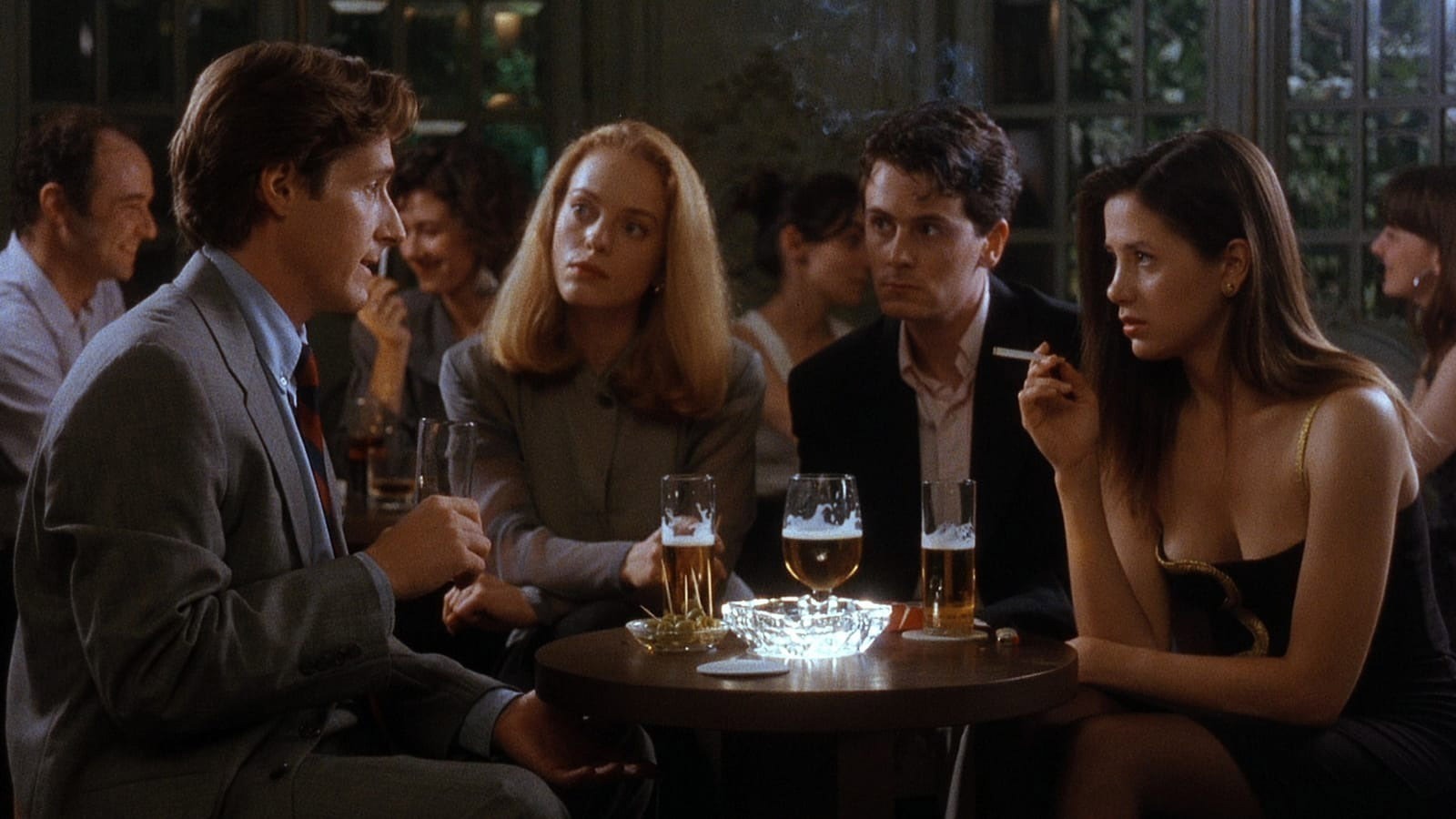
- Whit Stillman’s Barcelona (1994) “plays it very, very cool. Which isn’t to say Stillman’s second film, after his Oscar-nominated Metropolitan, is itself cool,” writes Ryan Chapman in the Guardian. “If you want cool, look to Stillman’s The Last Days of Disco, where Chloë Sevigny frequents an unnamed Studio 54. Barcelona, on the other hand, is my feel-good movie because it’s several movies in one. An Austenesque romantic comedy, with wit dry as an albariño. A slow-boil cold war intrigue, where characters discuss the consequences of American foreign policy. A nostalgic, autobiographical portrait of young Americans abroad. And, however improbably, a defense of business-section self-help books. Where Stillman’s contemporaries riffed on Death of a Salesman, he offers us Willy Loman’s Homage to Catalonia.”
- It’s road-movie season, and for the New York Times, Matt Weinstock asks “a range of creative people” for a few words on a favorite. Kirsten Johnson (Cameraperson) picks Agnès Varda and JR’s Faces Places (2017): “One thing we know about cars is that two people facing forward are able to say things that they’d never say if they were looking into each other’s eyes.” Theda Hammel (Stress Positions) goes for Peter Farrelly’s Dumb and Dumber (1994): “The question in the Farrelly movies is: ‘Can a man who is silly and stupid and gross be loved by a beautiful woman?’ And in a lot of cases the answer is: ‘Maybe, but no. Not here.’” And for photographer Joel Meyerowitz, it’s Ingmar Bergman’s Wild Strawberries (1957): “Bergman knew how to hold your attention with an image, but he didn’t linger. He had a sense of the disappearing moment.”
Don’t miss out on your Daily briefing! Subscribe to the RSS feed.