Bibliomania: A Preface to Chronovisor
Share
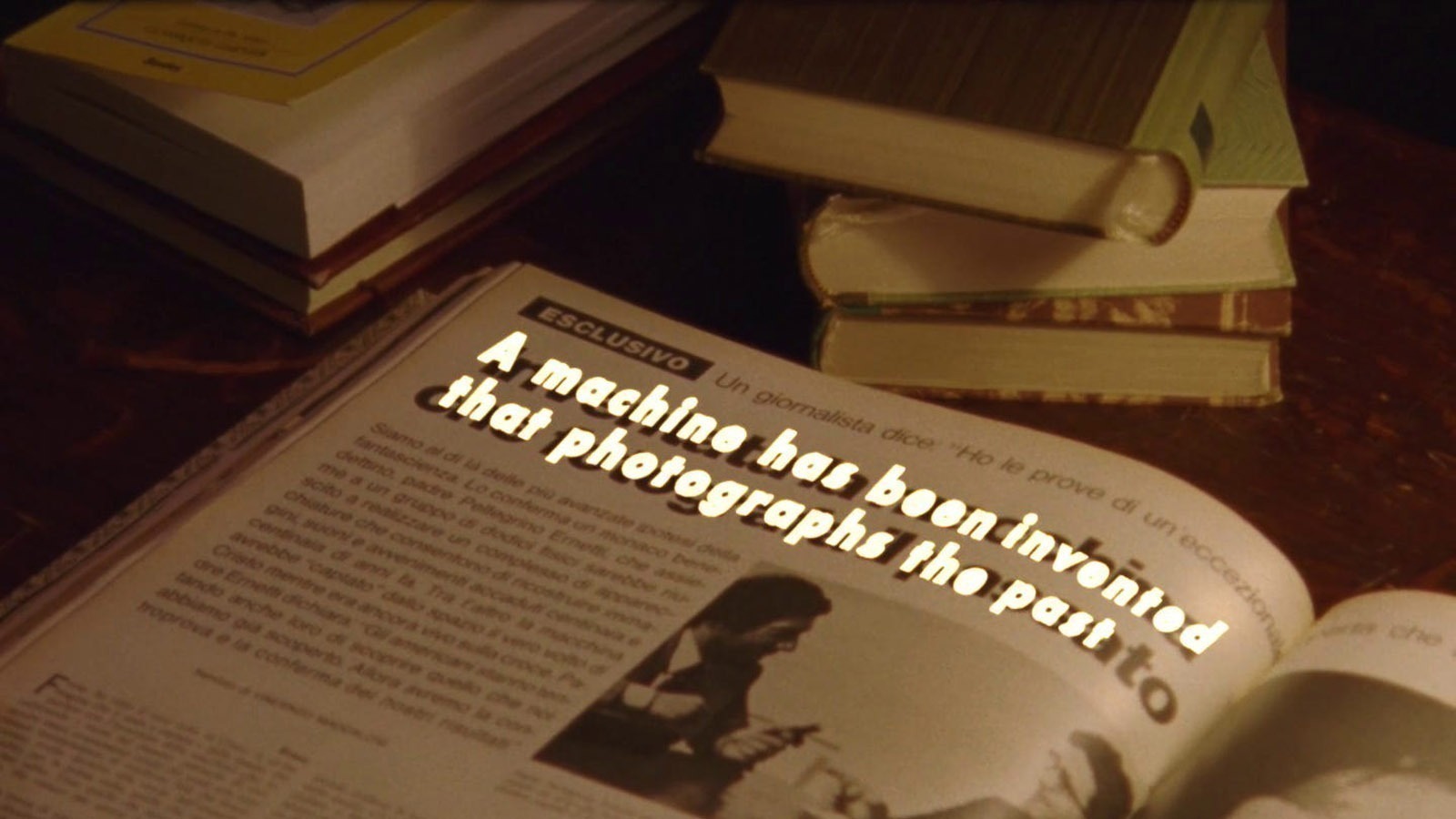
When Chronovisorpremiered this past winter at the International Film Festival Rotterdam, Zach Lewis, writing for In Review Online, called it “one of the most formally inventive and genuinely thrilling new movies in years.” The film—the first feature from directing duo Jack Auen and Kevin Walker—is set to open in New York on September 4, and in the run-up to its theatrical release, Film at Lincoln Center will present Bibliomania: A Preface to Chronovisor, a fifteen-film series starting Friday and featuring a free public book fair on Saturday.
The first thing to know about Chronovisor is the last thing you’d expect if you were to walk in cold. There actually was a Benedictine monk and musicologist by the name of Pellegrino Ernetti who, in the 1970s, claimed to have worked with a dozen scientists over a period of several years to invent an instrument, the Chronovisor, that could pick up on ancient vibrations and translate them into moving images. Ernetti claimed that he could tune into and then witness historical events such as the Crucifixion or a speech being delivered by Cicero himself—as if traveling through time.
But the film’s protagonist, Columbia scholar Béatrice Courte, is Auen and Walker’s invention, and she’s played by Anne-Laure Sellier, a professor of behavioral studies at HEC Paris. During the course of her research, Courte comes across documents (all but one of which are authentic, according to the directors) related to the machine and its supposed suppression by the Vatican. And she’s intrigued.
“Like an internet crank,” suggests Michael Sicinski, “Courte certainly does her own research, and part of the intellectual architecture of Chronovisor pertains to the thin line between curiosity and belief, legitimate scholarship and esoterica. To be clear, Walker and Auen take Courte’s project very seriously, and it is truly rare to see a film that dramatizes research—interviews, phone calls, poring over old manuscripts—so heroically.”
Introducing his interview with Auen and Walker for Notebook, Vadim Rizov writes that Chronovisor “has the starting points of a conventional thriller—an academic on an unpredictable research path, a mysterious lost object suppressed by the Catholic Church, an inventor whose fate is unclear—and the conceptual outlandishness of science-fiction upon reaching its final destination.”
Chronovisor “isn’t too far removed from creepypastas, liminal horror, cosmic horror, and other subgenres that online communities have formed around,” observes C. J. Prince. And at the Film Verdict, Carmen Gray finds the film to be “a fitting parable for our era of disputed facts, conspiracy theories, and identity-consuming virtual realms. In this bibliophilic mystery with shades of Umberto Eco, the only red blood splurge comes from a paper cut.”
The Bibliomania series may skimp on the gore, but not on the scares. Martin Scorsese once put The Changeling (1980)—starring George C. Scott as a composer in a haunted mansion—on his list of eleven of the scariest movies of all time. Steven Spielberg screened it for Tobe Hooper and his crew when they were making Poltergeist, and Guillermo del Toro has told director Peter Medak that his film is “a masterpiece.”
Philip Horne spots The Changeling, “with its tense mood and story of infanticide,” as an influence on Alejandro Amenábar’s The Others (2001), and the FLC series includes Amenábar’s debut feature, Thesis (1996). Ana Torrent stars as Ángela, a film student who discovers a murder recorded on VHS. “Ángela descends into a labyrinth where academia, voyeurism, and genuine brutality intertwine,” writes Eliana Abdel-Khaleq in Double Exposure. “We willingly witness these boundaries dissolve and now fester within each other.”
Program notes for each film in the series include comments from Auen and Walker, who note that Jacques Tourneur’s Curse of the Demon (1957) is “the only feature-length adaptation of the work of M. R. James, the unimpeachable doyen of the short ghost story. No one combined the literate and the ghoulish with as much command of tone as James. Without him, it is possible that the ‘haunted library,’ a crucial element of Chronovisor’s image-grammar, may have never entered the cultural consciousness.”
The series offers comedy (Howard Hawks’s Balls of Fire), adventure (Spielberg’s Indiana Jones and the Last Crusade and Jon Turteltaub’s National Treasure: Book of Secrets), crime thrillers (Phillip Noyce’s The Bone Collector and Jon Amiel’s Copycat), murder mysteries (Barbet Schroeder’s Reversal of Fortune and Jean-Jacques Annaud’s The Name of the Rose), and a good handful of films in which bibliophilia is neither a motif humming in the background nor the subtext but the actual text.
David Gatten will be on hand next Wednesday to discuss three of his films. “Few filmmakers have more thoroughly explored the possibilities of ‘text-based cinema’ and its psychological impact on audiences than David Gatten,” write Auen and Walker.
Alain Resnais’s 1956 short All the Memory in the World, shot in the Bibliothèque nationale de France, will screen with Ted Fendt’s Classical Period (2018). As Christopher Small writes in his introduction to a Notebook interview with Fendt, the latter film follows “a trio of introverted Dante enthusiasts whose lives are lived—seemingly, at least—precisely for their esoteric, specialized interests in the literature of antiquity . . . Fendt has no agenda other than to portray these passions with a schlubby finesse worthy of his heroes.”
Don’t miss out on your Daily briefing! Subscribe to the RSS feed.