Somewhere In-Between
Share
Many have spent much of this week reflecting on the tragic end of the difficult life of Hayden Panettiere, whose acting career began with a toy commercial she appeared in when she was just eleven months old. Her “momager,” as Panettiere called her in her memoir, This Is Me: A Reckoning, kept her busy with a steady string of soap-opera roles throughout her childhood, and she eventually came into her own playing a figure skater in the 2005 Disney movie Ice Princess and a high-schooler crazy about horror movies in the Scream franchise. Panettiere is probably best known for her work on television shows such as Heroes and Nashville.
And she was only thirty-six when she died on Sunday. In the Los Angeles Times, Mary McNamara notes that in her book and in countless interviews, Panettiere openly addressed her struggles with addiction, the abuse she endured at the hands of her first boyfriend, and most importantly for McNamara, “society’s seemingly willful ignorance of the symptoms and realities of postpartum depression . . . She called out a truth that has been too long ignored and gave millions of women a chance to ask for help.”
Mark Rydell, who passed away last week at the age of ninety-seven, was an actor who appeared with John Cassavetes and Sal Mineo in Don Siegel’s Crime in the Streets (1956) before turning to directing for television. Rydell will mostly likely be remembered first and foremost for directing Henry Fonda, Katharine Hepburn, and Jane Fonda in On Golden Pond (1981), but he also made The Reivers (1969) with Steve McQueen and The Cowboys (1972), a western notorious for the killing of John Wayne’s character by Bruce Dern’s—with forty minutes of the movie left to unreel.
At one point during the making of The Cowboys, Wayne called “Action,” and Rydell snapped at him in front of the entire cast and crew. “Rather than being sacked as Rydell expected,” notes Ryan Gilbey in the Guardian, “he was instead congratulated by the actor for having had the guts to stand up to him. ‘He took to calling me “Sir” for the rest of the picture.’” Rydell also directed The Rose (1979), starring Bette Midler, who calls him “the actor’s whisperer; just a few words was all it took to understand what was needed.”
Keiko Kishi, known for her work in Yasujiro Ozu’s Early Spring (1956) and Masaki Kobayashi’s Kwaidan (1964) and for cofounding the independent film company Ninjin Club with Ineko Arima and Yoshiko Kuga, has died at ninety-three. And we can be glad that Ardak Amirkulov saw his 1991 historical epic The Fall of Otrar restored and revived before he passed away earlier this month. He was seventy.
Writing for Slant, Jake Cole calls The Fall of Otrar, which depicts Genghis Khan’s conquest of the Khwarazmian Empire, “one of the greatest movies ever made about irreconcilable culture clash, of what happens when two civilizations have such radically different values that neither can comprehend the other and sees annihilation as the only logical response.”
Festival Updates
Looking back on this year’s Locarno for Film Comment, Imogen Sara Smith writes about three standouts—Mohanad Yaqubi’s Revolutionaries Never Die, Isabelle Stever and Anna Melikova’s I Rarely Wake Up Dreaming, and Gurvinder Singh’s Rehmat—before turning to the retrospective, Red & Black: Hollywood Left and the Blacklist, “a bountiful selection of feature films, documentaries, and newsreels that urgently remind us of an all-too-familiar era when the U.S. government shredded the constitution, enforced ignoble rituals of capitulation, and branded political dissent as dangerous treason.” Marya E. Gates surveys the full program at RogerEbert.com.
Venice (September 2 through 12) will open in less than two weeks, and artistic director Alberto Barbera has issued a statement in response to Ukrainian criticism of the selection of Russian director Ilya Khrzhanovsky’s Dau for the main competition. “Dau is not a Russian film; it is not pro-Putin propaganda,” argues Barbera. “It is a film that denounces totalitarian regimes” and “the work of a Russian dissident who ended up on the regime’s prohibition lists as a terrorist and enemy of the state.” In his own statement, Khrzhanovsky emphasizes that he has been publicly supporting Ukraine since 2014.
The New York Film Festival (September 25 through October 12) has announced a Revivals lineup that includes Ken Russell’s The Devils (1971), Michael Powell and Emeric Pressburger’s Gone to Earth (1950), the late Alexander Kluge’s Yesterday Girl (1966), Barbara Hammer’s Nitrate Kisses (1992), and one of the most talked-about restorations in this year’s Berlinale Classics program, director Pradip Krishen and screenwriter Arundhati Roy’s In Which Annie Gives It Those Ones (1989).
The Official Competition of the seventieth BFI London Film Festival (October 7 through 18) is set and will feature new work from Hirokazu Kore-eda (After Life), Sergei Loznitsa (Two Prosecutors), Lili Horvát (Preparations to Be Together for an Unknown Period of Time), May el-Toukhy (Queen of Hearts), Giovanni Tortorici (Diciannove), and Benjamín Naishtat (History of Fear).
This Week’s Highlights
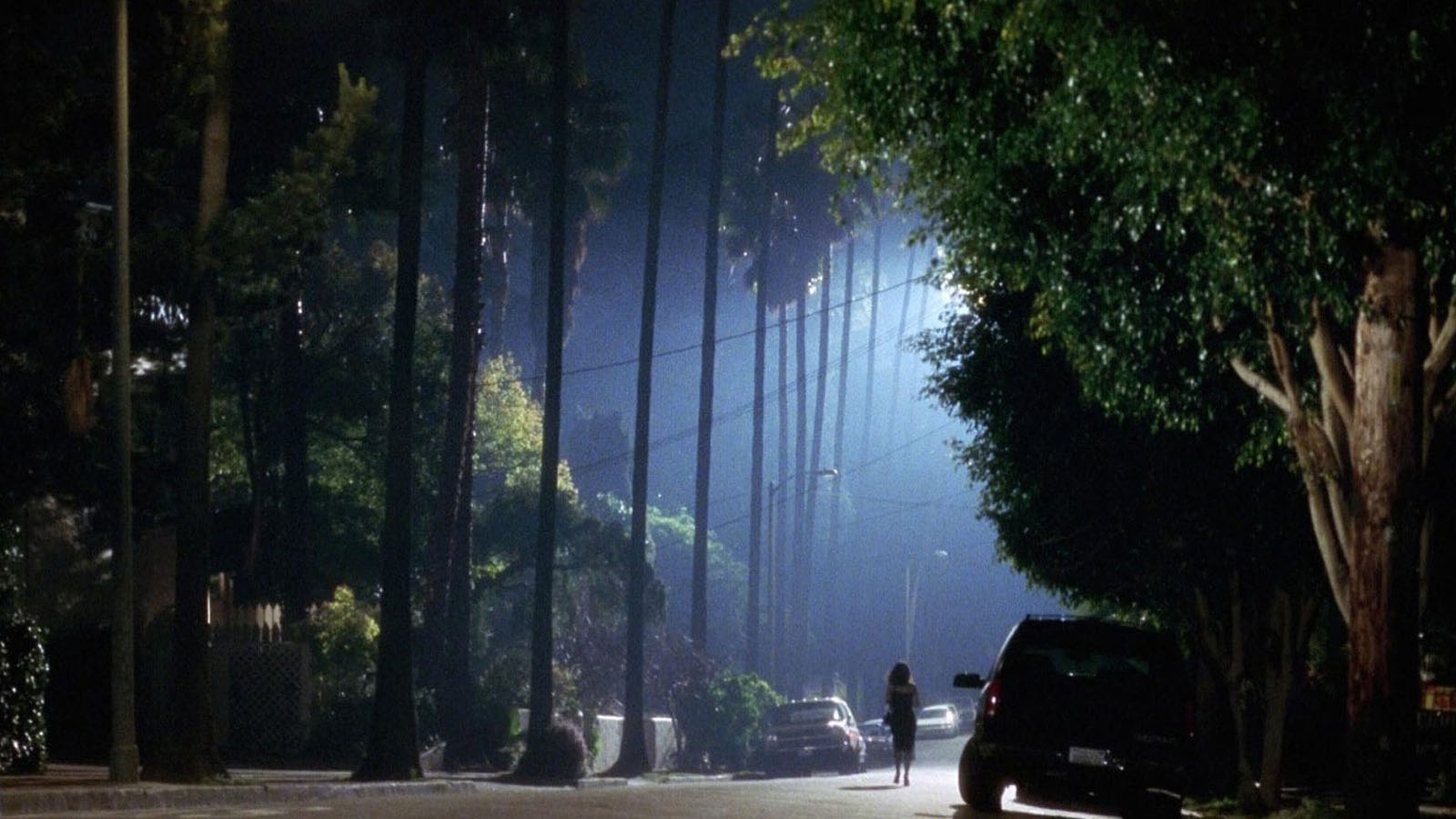
- David Lynch’s Mulholland Dr. turns twenty-five this year, and on the New Books Network, J. M. Tyree and Eileen G’Sell discuss a dossier they’ve put together for a forthcoming issue of Film Quarterly. Lynch “loved the old glamour of Los Angeles,” writes Amanda Karkoutly, who conducts a generously illustrated tour of the city in the pages of the Los Angeles Times. “The majestic Tower Theater in downtown Los Angeles was used in Mulholland Dr., Inland Empire, and Twin Peaks: The Return. His characters lived in equally memorable spaces, with the women of Mulholland Dr. going from the grandeur of the Il Borghese apartments (architect Charles Gault, 1929) to meet tragic endings in the fairy-tale-esque ‘Snow White’ apartments (architect Ben Sherwood, 1931) that are believed to have also inspired Walt Disney.” Stops along the tour include Bob’s Big Boy in Burbank, Franklin Canyon Park (an occasional stand-in for the northwestern woods surrounding Twin Peaks), the Doheny and Greystone Mansions, and Lynch’s own Pink House, designed by Lloyd Wright Jr.
- San Sebastián (September 18 through 26) will open with the world premiere of Fatih Akin’s Ghost Song, in which a woman who has died too young meets her living lover in his dreams. Akin’s previous feature, Amrum (2025)—named for the island just off Germany’s North Sea coastline—was cowritten with Hark Bohm, the late actor and director best known for his work with Rainer Werner Fassbinder. Set at the end and in the immediate aftermath of the Second World War, Amrum is essentially the story of Bohm’s childhood. In the New York Review of Books, J. Hoberman notes that Akin has succinctly summed up the gist of the film with a question: “What do you do when your mother is a Nazi?” Hoberman: “That a child might recognize a parent’s unrepentant, criminal complicity and love her nonetheless is Amrum’s heart of darkness, and perhaps Amrum’s as well.”
- When Samy Burch was nominated for an Oscar for her screenplay for Todd Haynes’s May December (2023), she seemed to have come out of nowhere, but in fact, she’d been working for years in casting and making her own short films—and had written several spec scripts. Now two more films she’s written are in theaters, Late Fame (2025), directed by Kent Jones, and Coyote vs. Acme, “the first movie I’ve written for hire,” as she tells Filmmaker’s Chloe Lizotte. It’s also, she emphasizes, very much director Dave Green’s movie. “There is a tendency to want to understand what a character is about, or what a film’s tone is,” says Burch. “I see that kind of response to movies all the time. There’s this critique: The movie didn’t know what it wanted. But maybe that is what it wanted.”
- In New York, Bram Stoker’s Dracula (1992) screens tomorrow and Sunday as part of the Metrograph series Gary Oldman: The Protean Man and on August 28 and 31 and September 5 at Film Forum, which is currently presenting a twenty-five film retrospective of Francis Ford Coppola’s work. Coppola “endows his vampire with something approximating a soul,” writes Genevieve Yue in Metrograph’s Journal. “Oldman’s Dracula broods with pathos and melancholy. Undoubtedly, as he says, he loves. Maybe it’s the way Oldman hangs his head while lifting his eyes, a posture that suggests a combination of weariness and madness, but here, as in Sid & Nancy (1986) and Immortal Beloved (1994), it seems like he loves harder than everyone else, whether he’s playing someone dead, alive, or more often somewhere in-between.”
- Ahead of the Adam Curtis Party Conference taking place in Bournemouth on September 12, David Moats offers a primer at the Quietus on how the filmmaker “assembles his monumental films out of found archive footage and compelling events you’ve never heard of” to reveal “the many ways elites, technology, and finance have foreclosed on our political future.” Curtis is “often parodied for his well-known turns of phrase [such as] ‘this is a story about,’ ‘but it was all a fantasy,’ ‘unleashed powerful forces’; his weaponization of grainy, Kodachrome nostalgia, ambient music, and non-sequitur pop; and his monomaniacal commitment to sans-serif fonts. But this vulnerability to parody is simply because no one in the last thirty years of documentary filmmaking has developed such a recognizable style, worked with such big ideas, or pushed the documentary form further (at least within the limits of mainstream TV). There are parodies but no imitators.”
Don’t miss out on your Daily briefing! Subscribe to the RSS feed.