Magnificent Melodramas
Share
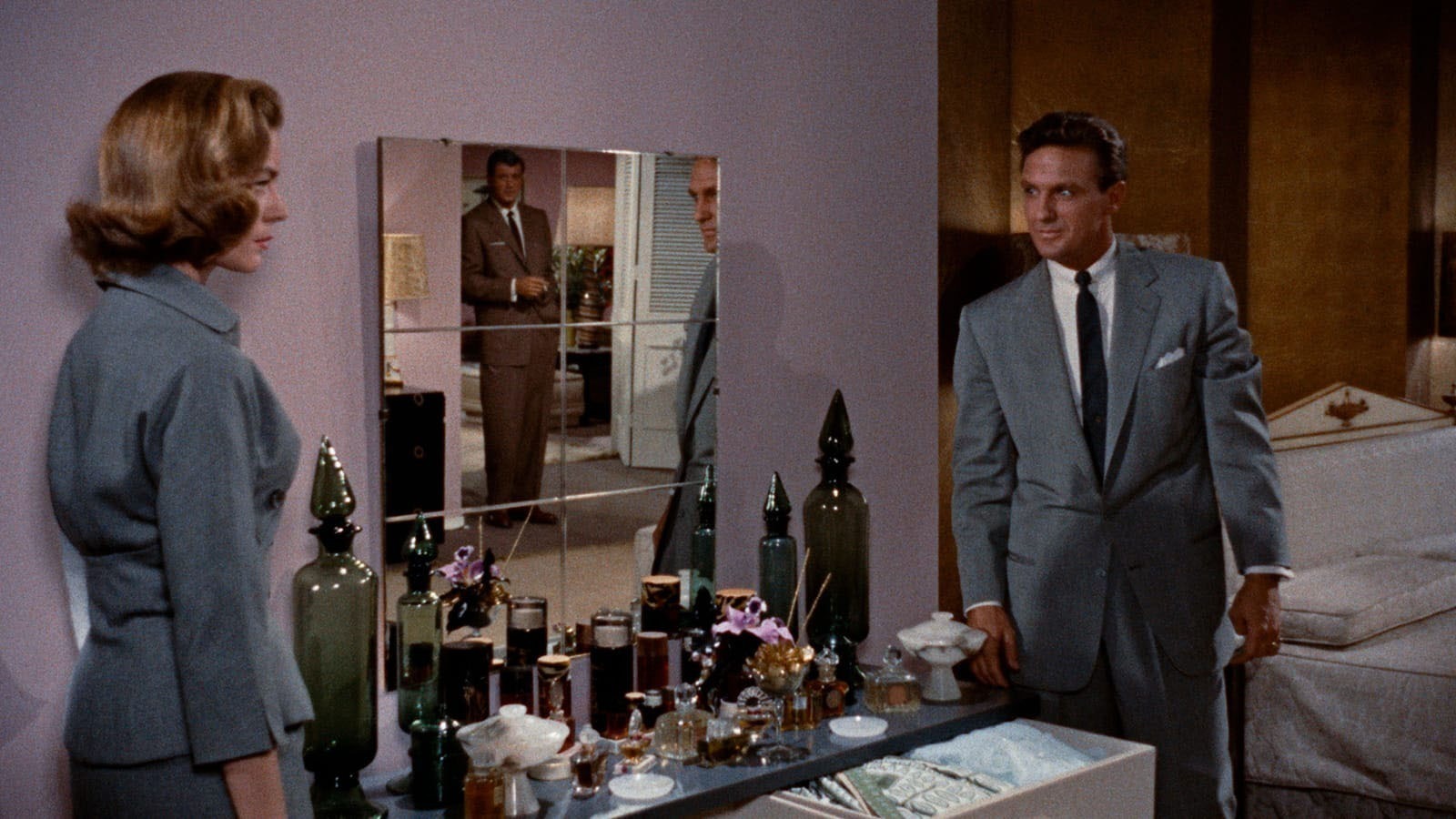
Douglas Sirk “has made the tenderest films I know,” wrote Rainer Werner Fassbinder in 1971. “They are the films of someone who loves people and doesn’t despise them as we do.” Magnificent Melodramas: Douglas Sirk & Russell Metty, a series of six of the eleven films the director and cinematographer made together between 1952 and 1959, is currently running at the American Cinematheque in Los Angeles through September 19.
For too many years before Fassbinder, Andrew Sarris, and others rescued Sirk from what Jon Halliday, writing in 1972, called “a kind of critical limbo,” the films “fell into the utterly disreputable category of ‘women's pictures,’” wrote Dave Kehr in the New York Times in 1999. “Though few, if any, critics registered what Sirk was up to, his work, seen today, amounts to a careful, Technicolor cataloguing of the fears and anxieties, the frustrations and contradictions, of an America then at the height of its postwar power and prestige.”
Five of the six films in the series are in searing color, and Metty would go on to win an Oscar for Best Cinematography, Color—from 1939 to 1966, there were separate Academy Awards for black-and-white and color cinematography—for his work on Stanley Kubrick’s Spartacus (1960). But Metty also collaborated with Orson Welles on The Stranger (1946) and Touch of Evil (1958), offering more than enough evidence of his mastery of black and white.
Sirk and Metty decided to go monochrome with There’s Always Tomorrow (1956), starring Fred MacMurray as a businessman whose family suspects that he’s having an affair with an old employee (Barbara Stanwyck). The film “depicts the suburbs as a charming, cheerful, prosperous, frivolous wasteland,” wrote the New Yorker’s Richard Brody in 2013.
“It’s very hard for me to pick a favorite Douglas Sirk movie,” noted novelist Megan Abbott in 2016, but in the end, she went with All That Heaven Allows (1956), which screens Thursday. Jane Wyman stars as a lonely widow who falls for her plaid-shirted gardener (Rock Hudson) but can’t bring herself to cross the social barriers between them. “No one understood melodrama like Sirk, or how to sharpen it into the dagger it’s meant to be,” wrote Abbott. Ryusuke Hamaguchi finds Metty’s work here “sublime. The way indoor spaces are flooded with warm colors while the outdoor ones are cool and blue creates this beautiful dynamic.”
Wyman and Hudson first appeared together in Magnificent Obsession (1954). He’s a playboy who crashes his speedboat and is then saved by the town’s only resuscitator—just when the doctor who’d been keeping it suffers a heart attack; without it, he dies. Wyman is the doctor’s widow who—spoiler alert—is going to end up with the playboy.
“Perhaps 1954 was the last time this material could have been filmed with a straight face, and Sirk films it with a ferociously straight face, one might say a demonically straight face,” wrote Geoffrey O’Brien in 2009. “Nothing could be further from the mood of Magnificent Obsession than cynical mockery, no matter how acute the director’s awareness that ‘this is a damned crazy story if there ever was one.’ Crazy it may be, but so were the situations favored by so many of the playwrights whose work Sirk had staged: Calderón, Kleist, Strindberg, Pirandello. He forces the questions: What if this weren’t crazy? What if it were real? What sort of a world would that be, and how different would it be from the one we inhabit?”
“American life is melodramatic,” writes Blair McClendon, “full of color, music, desire, pressure, and violence.” Depending on who’s doing the remembering, America in the 1950s was “either a populuxe wonderland or a country on the verge of a nervous breakdown.” Written on the Wind (1956), starring Hudson, Lauren Bacall, Robert Stack, and Dorothy Malone and “based on Robert Wilder’s racy 1946 novel, was the perfect vehicle to see how far Hollywood could go. It is a frenzied dance among changing partners who all want badly and behave poorly.”
John Gavin, who would later become president of the Screen Actors Guild and a U.S. ambassador to Mexico, stars in Sirk’s 1958 adaptation of Erich Maria Remarque’s 1954 novel A Time to Love and a Time to Die. Gavin plays a German soldier wrestling with his conscience while fighting on the Eastern Front in the Second World War. With this film, Sirk “confronted Nazism more directly than ever before, creating one of his most psychologically perceptive and profoundly personal works,” wrote David Sterritt for Film International in 2014.
Ann Sheridan stars in Take Me to Town (1953) as Vermilion, a singer and dancer on the run in the wild, wild West. She finds work in a theater run by Rose (Lee Patrick), and the three young sons of a widowed preacher (Sterling Hayden) decide she’d make a great mom. “Sirk’s direction of the boys is among his loopiest comic inventions,” wrote Richard Brody in 2015, “but he uses the full Technicolor palette to display Vermillion and Rose in deep shadow and lurid streaks, conjuring vast depths of feeling and funds of wisdom arising from tawdry circumstances.”
Don’t miss out on your Daily briefing! Subscribe to the RSS feed.