Five Films Lead the Gotham Nominations
Share
Ready or not, the Gotham Film & Media Institute has launched this year’s awards season, nominating forty-two features and twenty-five performances across eleven categories for the thirty-ninth edition of the Gotham Awards. Last year, there was a clear front-runner, Paul Thomas Anderson’s One Battle After Another, which went on to win six Oscars, including Best Picture.
This year, five features are out front with four nominations each, followed by a cluster of seven with three each: Sandra Wollner’s Everytime, Beth de Araújo’s Josephine, Andrey Zvyagintsev’s Minotaur, Lee Chang-dong’s Possible Love, Lance Oppenheim’s Primetime, Jane Schoenbrun’s Teenage Sex and Death at Camp Miasma, and Bassam Tariq’s Your Mother Your Mother Your Mother.
For what it’s worth, the movie of the moment, Nathan Fielder and Lance Oppenheim’s You Can See Everything, has scored just two, Best Documentary Feature and the Gotham Audience Award, which returns after a six-year hiatus. The five nominating committees are made up of critics and programmers, and the winners—to be announced at a ceremony in New York on November 30—will be determined by separate juries of writers, directors, actors, producers, editors, and other film industry players.
For now, let’s take a brief look at the five films in the lead:
All of a Sudden
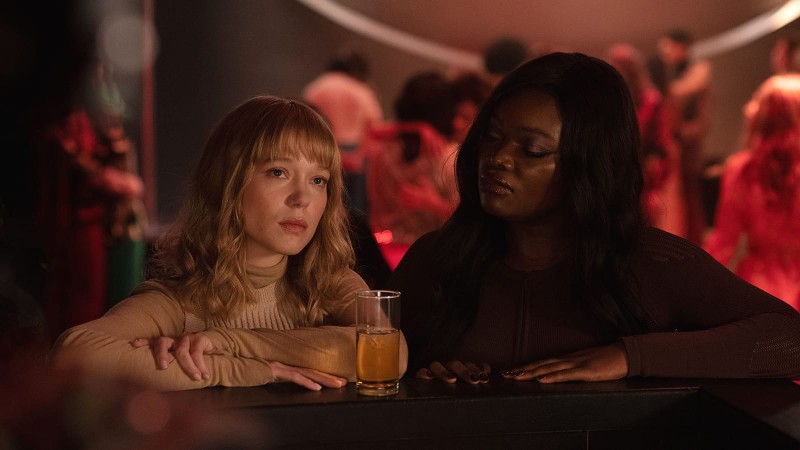
Virginie Efira, soon to be celebrated with a spotlight series at New York’s Metrograph, and Tao Okamoto shared the prize for Best Actress when Ryusuke Hamaguchi’s All of a Sudden premiered in Cannes. Efira’s Marie-Lou, the director of an elderly care center in a suburb of Paris, and Okamoto’s Mari, a theater director whose terminal illness might take a severe turn for the worse at any time, meet, bond, and discuss—among other things—the tendency inherent in capitalism to create a ravenous “inside” that sucks all the resources away from an ever-expanding “outside.”
“Marie-Lou and Mari’s tête-à-têtes, reflecting their mutual growing admiration, are Hamaguchi’s most persuasive element,” writes Reverse Shot’s Michael Koresky. “The women’s therapeutic, teasingly homoerotic bond, an unforeseen human connection between two needy souls, becomes an ethereal expression of pure kinship wholly devoid of conflict that allows the film’s general lack of dramatic tension to feel more like a feature than a bug.” All of a Sudden is “a highly prescriptive movie, in both form and feeling, and the ecstatic response to it leads me to believe that its political directness and its occasionally saccharine emotionality (safely couched in an art-film package) are precisely what many people believe they need at this moment of world collapse and generalized inhumanity.”
Clarissa
As noted in June, Virginia Woolf has been having quite a year at the movies, and one of the most critically acclaimed films drawing from her work is Clarissa, an adaptation of Mrs. Dalloway (1925) set in present-day Lagos and directed by twin brothers Arie and Chuko Esiri, whose debut feature, Eyimofe (This Is My Desire), was released in 2020. “Clarissa, played with terrific restraint by Sophie Okonedo, is now a Nigerian society woman preoccupied by the infamously jammed Lagosian traffic, interactions with her housekeepers, and memories of youthful summers spent debating the meaning of democracy in Nigeria and the intellectual and political priorities of a developing nation-state,” writes Lovia Gyarkye in the Hollywood Reporter.
Gyarkye finds that the film “embraces the cinematic grammar employed by filmmakers like Raven Jackson (All Dirt Roads Taste of Salt), Savannah Leaf (Earth Mama), RaMell Ross (Nickel Boys), and, most recently, Akinola Davies Jr. (My Father’s Shadow).” Woolf “wrote the novel to reveal the madness of a postwar society and the disjointed nature of a nation undergoing significant change. And for all the ways she sharply articulated the oppressed condition of women, she also relied on a colonial framework and deployed racist tropes. A sly achievement of Clarissa is in how it not only acknowledges this history, but upends it too.”
La Gradiva
Cinematographer Marine Atlan’s directorial debut and the winner of this year’s Grand Prize at Critics’ Week in Cannes, La Gradiva rumbles along with a class of French teenagers on a trip to Naples and nearby Pompeii. Writing for Film Comment, Beatrice Loayza finds that “there’s an ebb and flow to the way Atlan builds out a sense of community, shifting from hazy moments of solitude to the combative yet weirdly intimate dynamics of a class lecture overlooking Mount Vesuvius; a boozy nighttime discussion about the French education system; and a forlorn but beautifully sincere conversation about sex and dating in the girls’ hotel room. Atlan and DP Pierre Mazoyer’s grainy, sun-dappled images of rustic Naples and its ancient art objects lend the teens’ soul-searching a kind of ageless mystique.”
La Gradiva “winds toward a tragedy that lands with the emotional heft of a classical weepie,” writes Loayza, “and yet the triumph of the film is how it manages to maintain this narrative backbone while so breezily and cleverly illuminating the lives of its smaller characters. Its detours and minor self-discoveries are not born of angsty introspection but of talking, touching, and communing with different people—the stuff of tourism, yes, but also an antidote for a generation raised amid unprecedented social isolation.”
The Invite
Olivia Wilde directs herself and Seth Rogen as Angela and Joe, a married couple living in a renovated San Francisco apartment inherited from Joe’s parents. She went to art school, and he teaches music. Joe is thrown off when Angela reminds him that she’s invited the upstairs neighbors, Piña (Penélope Cruz) and Hawk (Edward Norton), for dinner, especially because the noise of this couple’s boisterous sex has been driving him up a wall for months.
“In the annals of double-date-from-hell movies, The Invite is neither as good as Who’s Afraid of Virginia Woolf? (1966), Mike Nichols’s still crackling adaptation of Edward Albee’s play, nor as bad as Carnage (2011), Roman Polanski’s mirthless film version of Yasmina Reza’s God of Carnage,” finds the New Yorker’s Justin Chang. But Wilde is “a terrific director of actors, herself included.” Norton “can turn on the charm and the smarm as if they were side-by-side faucets,” and as for Rogen, “the let-it-all-hang-out comic boisterousness of his Judd Apatow days has hardened into a shell of middle-aged aggression.” Cruz’s Piña is, “on paper, the character who drifts closest to caricature—the hot-blooded Euro-chic seductress—and yet, onscreen, she’s the one figure the movie can’t bring itself to mock.”
Tender Loving Care
Now eighty-three and suffering from myositis, an at-times painful immune system disorder, Mike Leigh has said that it’s “more than probable” that Tender Loving Care will be his last film. “Leigh has been adamant that his latest not be read as a totalizing reflection on his career,” notes Saffron Maeve in her Filmmaker review, “but I struggle to write about Tender Loving Care without also writing about finality, unforeseen endings, and grief—themes which attach themselves perhaps too easily to the retirement of one of our greatest living talents.”
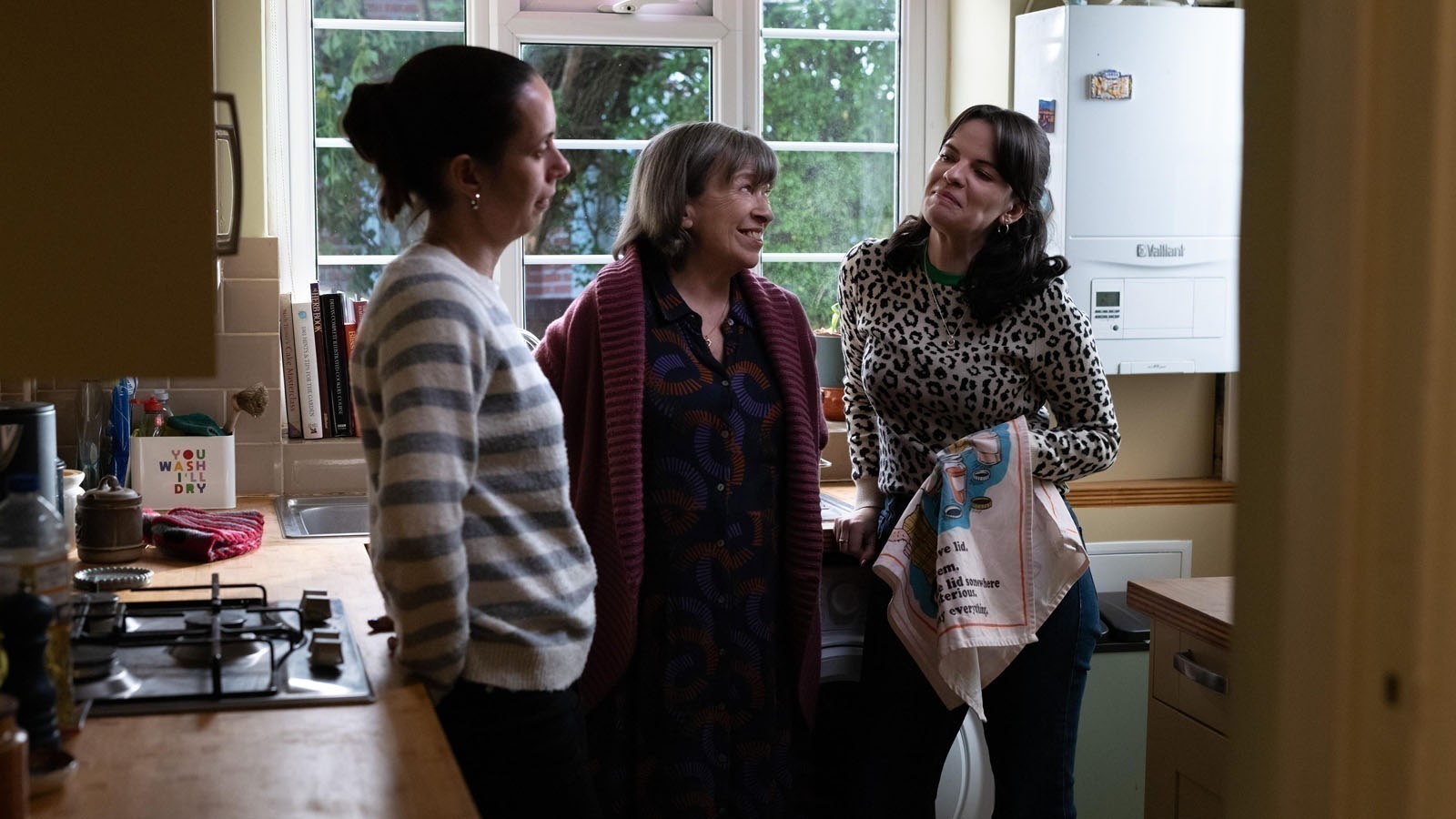
Kate O’Flynn—who has appeared in Leigh’s Happy-Go-Lucky (2008), Mr. Turner (2014), and Peterloo (2018) and won an Emmy for her breakout performance in the hit series Widow’s Bay—costars with Alice Bailey Johnson (Leigh’s Hard Truths, 2024). The actors play social workers and best friends Amy and Rosie, who often “drop in on Amy’s parents, Birdie (Marion Bailey) and Geoff (Paul Jesson), for a spot of tea and abbreviated gossip,” writes Maeve, “with Rosie, who is estranged from her own family, nestled into the fold as if she is their second daughter. In Leigh’s typical style—precise social realism achieved through months of improvisational workshops—the film strings together vignettes of bite-sized routine to fill out the lives of these characters with unwavering curiosity.”
Maeve also observes that “the plight of the social worker who cannot use her tools to sufficiently improve the larger system might also be applicable to the social realist filmmaker who, after sixty years directing for theater, television, and cinema, is still using his camera to bear witness to the daily hum of the otherwise unremarkable.”
Don’t miss out on your Daily briefing! Subscribe to the RSS feed.