Otar Iosseliani: Fables of Modern Life
Share
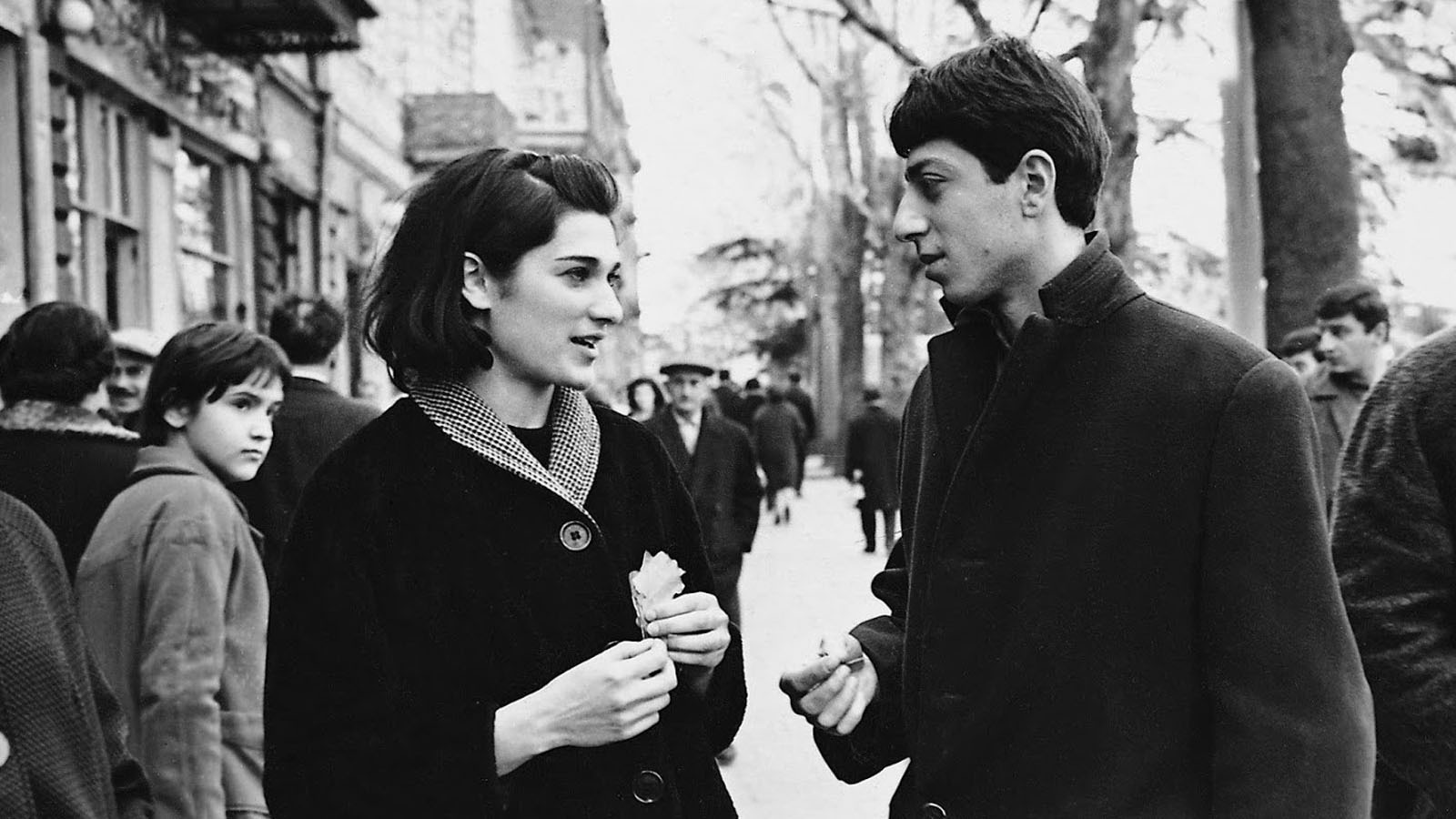
When Georgian director Otar Iosseliani passed away at the end of 2023, Locarno artistic director Giona A. Nazzaro remembered him as “probably the most mysterious filmmaker of the twentieth century.” Born in Tbilisi in 1934, Iosseliani first studied music before heading to Moscow and enrolling at the famed All-Union State Institute of Cinematography (VGIK), where his teachers included the renowned Soviet filmmakers Alexander Dovzhenko and Lev Kuleshov.
Back home in Georgia, Iosseliani made several short films and three features—Falling Leaves (1966), There Was Once a Singing Blackbird (1971), and Pastorale (1975)—and new restorations of all three will premiere on Friday and Saturday at Asia Society in New York. Starting on August 8, Metrograph will present a more extensive retrospective, Otar Iosseliani: Fables of Modern Life, featuring early shorts, the three Georgian features, and four more films Iosseliani made after relocating to France in 1979.
Whether shooting in Georgia or France, Senegal or Italy, “Iosseliani’s work remained remarkably consistent throughout his career,” wrote Geoff Andrew in his remembrance for the BFI. Iosseliani’s films “give the impression of being fables, parables, or allegories, the precise meaning of which it is usually difficult to define; the subtle blend of realism and low-key surrealism (he was a great admirer of Jean Vigo), the gentle absurdist humor, and the leisurely pace are repeatedly applied to microcosms of society where age-old tradition seems to be threatened by the ways of the modern world. Iosseliani doesn’t take sides so much as stand back to observe, often with a wry affection, the failings of both.”
“Tending toward the use of a withdrawn, observational perspective and the patient development of minutely calibrated non-gag gags,” wrote Nick Pinkerton at the top of a 2015 interview for Film Comment, “Iosseliani works in a mode which we might indulge in calling Tati-esque, if only to give the vaguest idea of how his films play. This shorthand, however, fails to account for Iosseliani’s occasional incursions into the realm of fairy tale logic . . . or his peculiar political perspective, a sort of bemused outrage.”
“Call him the heir to Renoir and Tati,” wrote Michael Atkinson in the Village Voice in 2006, “but Iosseliani is also a contemporary of Tarkovsky’s and Muratova’s, and an equal master at hyperextended mise-en-scène. But his vision of contemporary life, however bound with economic tension, is warm, wry, sardonic, and almost Buddhist.”
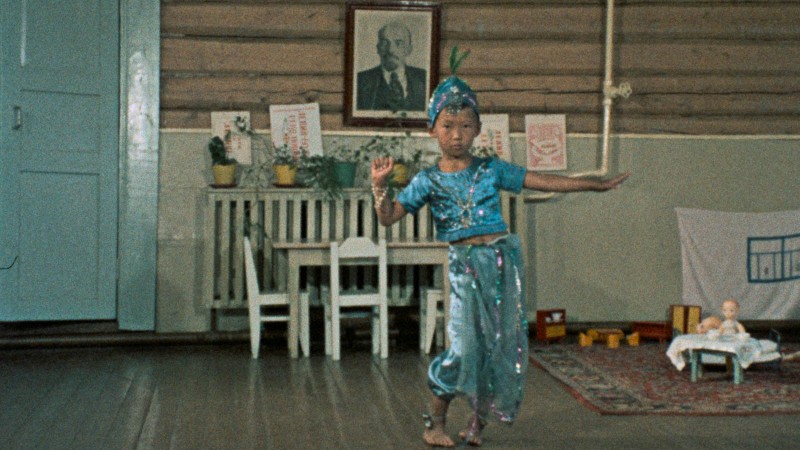
Tarkovsky was “rather effusive toward Iosseliani’s work,” notes Alex Lei at Splice Today, “a rarity for Tarkovsky in talking about anything coming out of the USSR.” Falling Leaves, the story of two winemakers on a collective farm, was one of the features Tarkovsky singled out for praise. Writing for Paste, Lei observes that it “opens with an eight-minute, dialogue-free sequence of Georgian villagers going through the whole of their traditional, ancient winemaking process . . . It’s a truly loving sequence that seems like it rips Dovzhenko’s pastoral poetry from the wheat fields of Ukraine to the mountains of Georgia.”
In a feature on Iosseliani that ran in a 2005 issue of Film Comment, Phillip Lopate called There Was Once a Singing Blackbird “one of his best” works. It centers on “an appealing, distracted young scamp,” an orchestra timpanist habitually late to rehearsals and performances. He “keeps various girlfriends dangling,” making promises he won’t keep. Iosseliani “treads delicately between sympathy and detached objectivity in his psychologically acute portrait of this Georgian Alfie who keeps disappointing everyone,” wrote Lopate. “The filmmaker’s one instance of a sustained conventional narrative about a single protagonist, it shows what Iosseliani was capable of achieving had he pursued realistic storytelling with professional actors.”
In Pastorale, four young members of a string quartet head to the countryside to touch grass, but squabbling breaks out among the villagers—and between the musicians as well. “The simple narrative spine functions as a magnet for many delicious, throwaway moments of daily rural life,” wrote Lopate. “With this film, Iosseliani starts to perfect the dispersed narrative, using figure-eight camera movements that follow one character and then drop him to pursue another who has crossed his path.”
Favorites of the Moon (1984) was Iosseliani’s first French-language feature, and writing for Film Comment in 2014, Max Nelson found that it offered “enough narrative material to fill ten films. A police chief, a prostitute, an arms dealer, a hairdresser, a punk singer, a street cleaner, a group of terrorists, and a pair of thieves—among others—spend the film sleeping with one another, unknowingly trading possessions, and obliviously crossing paths.” For Nelson, much of the “comic energy” of the film “comes from the endlessly surprising opportunities it deftly creates to float from one character to the next, often in the space of a single shot.”
And Then There Was Light (1989) “probably counts as the sole instance of a white filmmaker filming Africa and its inhabitants with neither liberal-progressive guilt, anthropologic pretension, or emancipatory aspirations,” wrote Celluloid Liberation Front for Cinema Scope. “A beautiful woman getting tired of her lazy husband, a group of idiotic defoliators coming to the village, empty wells that get magically filled with water, and the arcane rites ‘civilization’ can do without are the tangential protagonists of this unassuming story.”
The “near wordless” Chasing Butterflies (1992) “unfolds in a series of elegant long shots” with “physical precision and absurdity,” wrote Ronald Bergan for the Guardian. “This parable, set in contemporary France, revolves around the aristocratic lives of two elderly women who live in an opulent though dilapidated chateau. Outside their charmingly dusty world of old letters, art, and contentment, the jaws of commerce, thieves, and covetous heirs await their deaths.”
Writing in the Village Voice in 2001, J. Hoberman called Farewell, Home Sweet Home (1999) “a movie of mysterious maneuvers, both business and romantic. The ensemble is dispersed; such narrative as exists concerns a family of eccentrics (headed by the filmmaker himself) whose particular ‘home sweet home’ is a stork-haunted chateau on the outskirts of Paris. Rich people want to be ordinary; ordinary people want to be special.” Iosseliani’s “droll, elaborately off-handed sight gags amount to a sort of genteel circus. The movie exudes a cheerful energy—laying out a deck of narrative cards, then reshuffling them in the final ten minutes.”
Don’t miss out on your Daily briefing! Subscribe to the RSS feed.