Christopher Nolan’s The Odyssey
Share
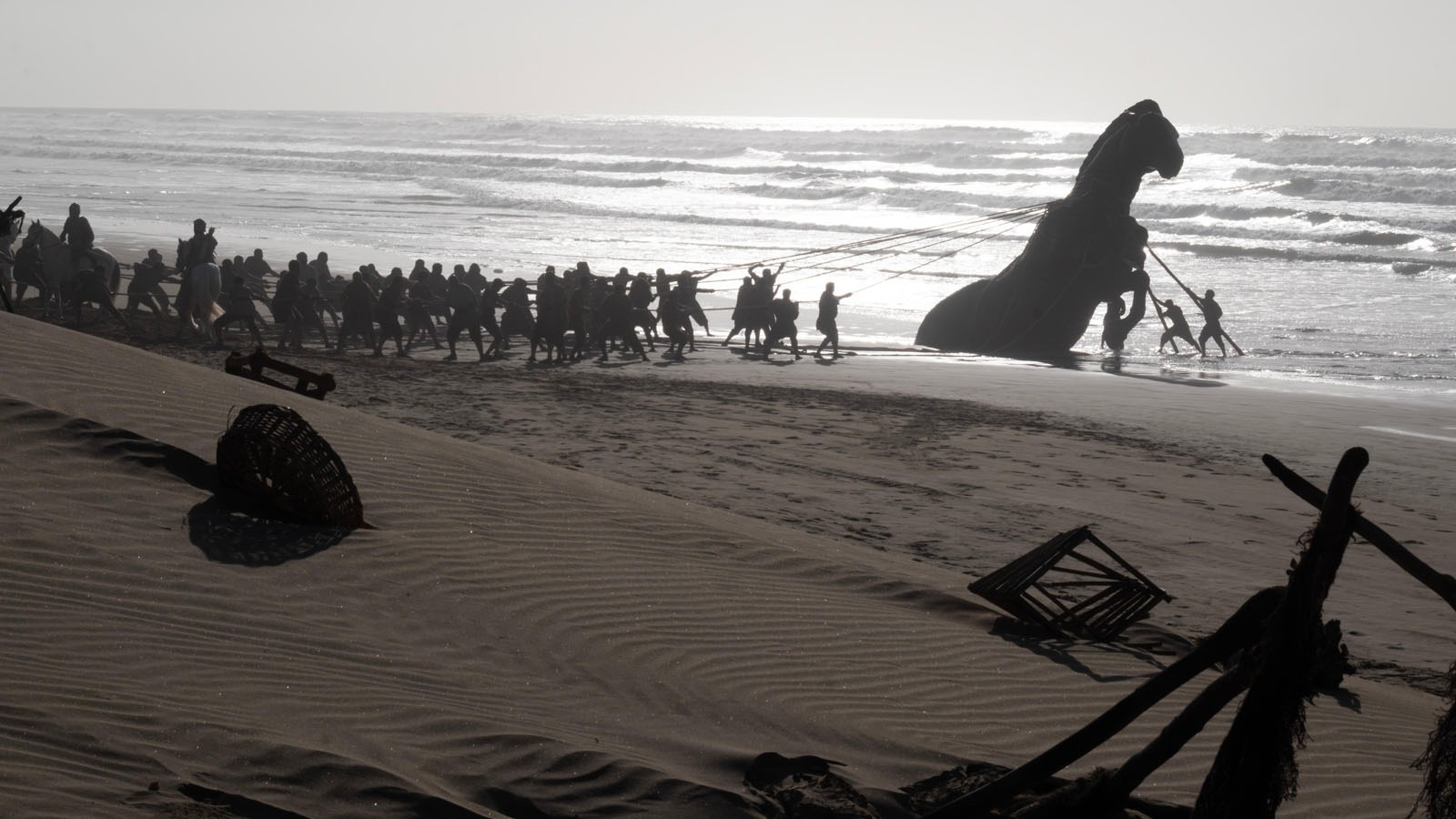
Reviewing Christopher Nolan’s The Odyssey in the New York Times, Manohla Dargis reminds us that Homer’s original epic poem “consists of 12,109 lines of nonlinear, nonstop talk and action featuring gods, mortals, monsters, weird doings, hospitality rituals, and oceans of blood, tears, and wine. Whatever the adaptation, the tale is so ingrained in our cultural DNA that even those who haven’t read the original—or Joseph Campbell on the hero’s journey—will be familiar with it, having seen a movie or two. It’s Luke Skywalker’s path and WALL·E’s, too.”
As a quick refresher, let’s briefly dip into the back story. Greek goddesses Hera, Athena, and Aphrodite are arguing over who among them is the fairest when they decide to let a simple shepherd be the judge. That country bumpkin turns out to be the Trojan prince Paris, who goes for Aphrodite. She rewards him by having the most beautiful woman in the world, Helen, fall in love with him. Off she goes to Troy.
Helen’s husband, Menelaus, king of Sparta, is naturally furious and calls on all the armies of Greece to go fetch her. Menelaus’s brother, Agamemnon, king of Mycenae, leads the charge. Toward the end of the ten ruthlessly grinding years of war chronicled in Homer’s Iliad, Odysseus, king of Ithaca, has an idea that the Roman poet Virgil found particularly worthy of developing into the entire second book of his Aeneid.
The Greeks will fake a departure, leaving behind a giant wooden horse secretly harboring himself and several good and strong men. As the Trojans celebrate victory, those men pop out, open the city gates, and the Greek forces in hiding race back to slaughter Trojan warriors and ordinary citizens alike. The Greeks head home, but it’s going to take Odysseus ten years to get there.
The journey is the backbone of Nolan’s screenplay, but he does incorporate a few passages from the Iliad and the Aeneid as well. “Nolan refuses to tremble before the canon,” writes Amy Nicholson in the Los Angeles Times. “Grabbing mighty scissors, he cuts and rejiggers Homer and a bit of Virgil to transform these classical texts into his type of tale: one fixated on memory, self-identity, destructive genius, and the slippage of time. As ever, it’s light on sex, heavy on wine-dark angst.”
“The primary impression that remains after a first viewing of this nearly three-hour-long movie is one of scale,” writes Slate’s Dana Stevens. “Scale, not size: Though many of the images (the towering walls of Troy, the vast bulk of the Cyclops, the endless expanse of the sea) are indeed monumental in their proportions, what’s memorable is the way Nolan’s camera, wielded as usual by the superb cinematographer Hoyte van Hoytema, shows us at once those awe-inspiring sights and the human-sized details that drive the story forward . . . The result is a twenty-seven-century-old legend that plays like a thrilling Saturday-afternoon matinee—sword fights, sea monsters, sexy mermaids, cosmic vengeance—when it isn’t reducing the viewer to tears with a brief dialogue exchange conducted in a whisper.”
Most reviewers agree wholeheartedly, but a few outliers have not been quite as moved. “A genuinely grand, gutsy vision, The Odyssey thrills generously,” writes Variety’s Guy Lodge. “Every few minutes, it seems, it throws at its audience another mighty set piece that, in almost any other summer studio spectacle, would be a climactic standout . . . But if this Odyssey is consistently involving and frequently dazzling, it’s never exactly moving; it keeps the eyes and ears so lavishly occupied, while engaging the mind with its structural games of cat’s cradle, you almost don’t notice, or mind, that your heart isn’t quite in it. Almost.”
Time’s Stephanie Zacharek goes so far as to call The Odyssey an “eye-glazing dud of a movie,” adding that “almost every landscape—a churning sea here, a set of cliffs there—just looks like business as usual, only bigger. There’s soil, but you don’t feel its texture; there’s sun, but you don’t feel its warmth.”
As for the pans that hit the movie well before this weekend’s release, let’s leave what Nick Newman, writing at the Film Stage, calls the “troglodytic braying about ‘woke casting,’ metallurgic inaccuracies, and their supposed desecration of our western canon” to Matt Zoller Seitz’s succinct retort at RogerEbert.com: “One might as well complain that the actors aren’t all speaking Greek.”
Instead, they speak plain American English—even the British actors. “That’s fine!” declares Emily Wilson, the renowned classicist best known for her English-verse translation of the Odyssey. Wilson, by the way, delves into the original text with novelist Madeline Miller (Circe) on a recent episode of the Daily podcast, and so, too, does Daniel Mendelsohn on Wednesday’s edition of Private Life from the New York Review of Books.
Some admire Nolan’s film but miss the gods. With the exception of Athena, played by Zendaya as a goddess only Odysseus can see, Zeus and company appear strictly as natural phenomena. “The film repeatedly turns its back on the divine,” writes Chris Power in the Observer. “While in Hades—despite the film’s rationalist agenda, there is still a land of the dead—the prophet Tiresias tells Odysseus his crew will die but he will make it home. ‘I can still save them from the gods,’ Odysseus protests, establishing a conflict that is nowhere to be found in Homer, while marking Nolan’s adaptation as a deliberate severing from the belief system expressed in the original. His Odysseus is a proto-rationalist; in psychological terms, virtually a modern man.”
For Jake Cole at Slant, this excursion to Hades, “rendered in an eerie day-for-night Prussian blue dotted with the pitch-black shades of Odysseus’s fallen comrades, is one of the most arresting sequences in Nolan’s filmography, a depiction of hell shorn of all Christian interpretations of torture in favor of the eternal horror of pure emptiness, a place where warriors learn too late the true worthlessness of valor.”
“Homer depicts a strange and troubling world, in which human existence is continuously subject to the deliberations and whims of deities who have motives of their own,” writes the New Yorker’s Richard Brody. “By suppressing this continuity between the natural and the supernatural realms, Nolan omits much of what makes the Homeric age so different, including the ambience of the divine and the distinctive moral realm that goes with it.”
Justin Chang, the New Yorker’s other film critic, suggests that Nolan’s “rationalism is an armor against kitsch, obviousness, familiarity, and visual-effects bloat; it provides just the note of real-world groundedness that a great fantasy needs to achieve liftoff. It’s also a bridge between the ancient and the modern, ushering us into the minds of characters who inhabit a kind of polytheist-secularist limbo, and who suspect, for all their prayers and offerings, that the gods have long since abandoned them.”
Vulture’s Bilge Ebiri notes that Nolan has told him that he “considered depicting the gods in more overt fashion but decided against it. ‘For me, having these remote gods with chess pieces or whatever, all the things you’ve seen in the past, felt alienating,’ he says. ‘It’s not so much about trying to be realistic; it’s just trying to see the gods the way these characters would have seen them.’ When asked by Odysseus why the gods don’t speak in ways mere mortals can understand, Athena replies, ‘Who doesn’t understand thunder or fire?’ Her words might as well be the director’s own statement of principles.”
Famously among those principles is a loyalty to film as film. The Odyssey is the first feature to be shot entirely on 70mm IMAX cameras, and it “unfolds in that odd dual register of grandeur and intimacy that Nolan has been busily making his own,” writes the Telegraph’s Robbie Collin. For Rolling Stone’s David Fear, this is “one of the most dynamic movies in recent memory, simply in the way it attempts—and largely succeeds—to balance such incredible highs and delicate lows, deafening bursts of divine wrath with quiet pauses of contemplation.”
Matt Damon plays Odysseus as “an action hero who is all too familiar with violence, but the strength of his performance comes from how heavily he wears the years that pass, letting them seep into his pores,” writes Vulture’s Alison Willmore. “By turns loving, arrogant, sensitive, guilt-stricken, blameless, pig-headed (almost literally), brilliant, and foolish,” writes IndieWire’s David Ehrlich, “Damon’s Odysseus is a monument to his multifacetedness as an actor.”
As the wife left at home to fend off rowdy suitors helping themselves to Odysseus’s wine, Anne Hathaway “subtly conveys the canniness with which Penelope is playing a long game by stringing along her suitors, most notably Robert Pattinson’s sleazy, manipulative Antinous,” writes Jake Cole, “but it’s her operatic expression of the character’s anger at being underestimated that is truly unforgettable.”
Other performances coming in for critical praise include John Leguizamo’s as Eumaeus, Odysseus’s faithful servant and blind swineherd; Elliot Page’s as Sinon, a Greek soldier making the ultimate sacrifice in Troy; and Bill Irwin’s masterful puppetry as the Cyclops. “Another extended sequence of surreal peril, as the men fall under the literal spell of predatory enchantress Circe, is as strange and darkly, hilariously sensual as anything Nolan has ever directed, galvanized by a raw, wily, volatile Samantha Morton, giving the film’s most indelible performance,” writes Guy Lodge.
“All of Christopher Nolan exists within The Odyssey,” writes Hannah Strong at Little White Lies. Like many, she sees strong thematic ties with 2023’s Oppenheimer: “A brilliant man, ravaged by the horrors of war, struggles to come to terms with the damage he’s done on a macro and micro level. (This time he has a beard.) A weepy stay-at-home wife mourns an undead husband. (This time she’s not an alcoholic.) Zoom out and you can see the longer threads: a child reckons with their father’s absence (Interstellar); an amnesiac puts their life back together (Memento); a wizened mentor keeps the home fires burning (The Dark Knight trilogy); dreams hold crucial real-world significance (Inception); magic is made manifest (The Prestige). Perhaps there are no new stories left in the world, just new ways to tell them.”
Don’t miss out on your Daily briefing! Subscribe to the RSS feed.