Three by Elaine May
Share
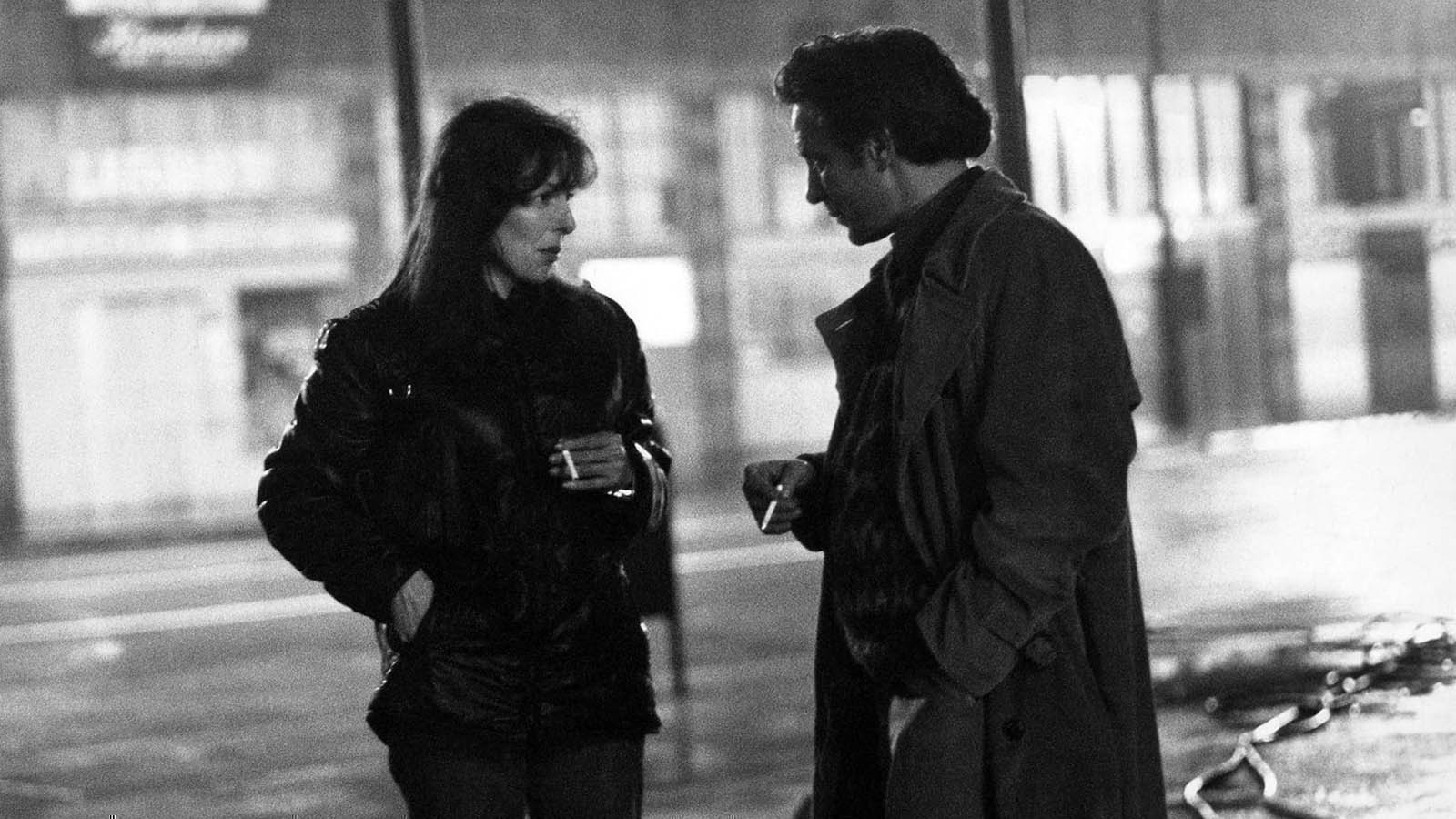
Elaine May hadn’t seen her third feature, Mikey and Nicky (1976), in twenty years when she introduced a screening at the Harvard Film Archive in 2010. “I hope I enjoy it,” she told the audience, and naturally, her delivery drew appreciative laughter. “The milieu, the people in this movie, are actually my milieu. I’m a Chicago, sort of gangster girl. And the events aren’t exactly true, but they have happened. So it’s sort of a kind of a true story, but nobody knows this about me except you guys, and I’m afraid you all have to die.”
Peter Falk and John Cassavetes star as small-time mobsters and lifelong friends. When Cassavetes’s Nicky hears that a hit has been put out on him, he reaches out to Falk’s Mikey for protection. The two spend a long night roaming city streets and bickering as only the closest of friends can. Mikey tries to convince Nicky that he’s not a target, but over time, it becomes clear that his reassurances are merely a delay tactic.
“Seemingly improvised by two Method actors, Mikey and Nicky was totally scripted,” noted J. Hoberman in the New York Times 2019. “To watch Cassavetes and Falk inhabit their roles is to watch two great jazz musicians riffing on a score.” Cassavetes “begins the film in a place of weary, scared, wired, vibrating intensity that he maintains to the bitter end,” wrote Nathan Rabin that same year. “He’s burning with desperation even in his most hushed moments.” In Mikey, Falk “has the less showy but arguably more challenging role, as a nurturer who cannot show his true face to his old friend without exposing the simultaneously deadly and banal betrayal at the film’s core.”
As the film turns fifty, Muscle Distribution is sending the 2019 restoration out to theaters across North America, and on Friday, May and producer Julian Schlossberg will take part in a Q&A after an evening screening at Film at Lincoln Center in New York. Todd Berliner, the author of Hollywood Renegade: Elaine May, Mikey and Nicky, and the Making of a Masterpiece, will introduce Tuesday’s screening, and during the weeklong run, FLC will also present May’s first feature, A New Leaf (1971), and her fourth and last, Ishtar (1987).
A New Leaf is “one of the best romantic comedies ever made,” wrote the New Yorker’s Richard Brody a few years ago. Walter Matthau stars as Henry, “a Manhattan trust-fund princeling” who has frittered away his wealth and aims to marry back into it. His mark is Henrietta, a clumsy but brilliant botanist played by May herself. Once he’s cashed in, Henry plans to kill his new wife.
“The keen depravity of May’s comedy of murder is all the sharper for the outrageous precision of its humor,” wrote Brody. “Matthau adds Henry to his unique gallery of the pompous and the orotund,” and “May brings enormous pathos to Henrietta—the true-hearted innocent who finally finds love, but with the wrong man—and centers on the character (and on her own performance) some of the most inventive humor of modern cinema.”
“With A New Leaf,” wrote 4Columns film editor Melissa Anderson in 2019, “May established a theme that runs through the quartet of films she’s directed: the derangements of coupledom, whether sexual or platonic, with a breezy but still biting focus on the pitiful vanities and obtuseness of men.”
Warren Beatty and Dustin Hoffman star in Ishtar as Rogers and Clarke, a ludicrously untalented team of songwriting performers who get caught up in a bit of Cold War intrigue in Morocco. May spent more time and money making Ishtar than the press at the time deemed acceptable for a female director, and the film suffered both commercially and critically from the verdict handed down long before the movie was released.
“I didn’t catch up with this film maudit until 2013,” Anderson recalled. “That screening remains one of the most memorable of my life, an event that provided the rare opportunity to discover a wildly unpredictable movie more than a quarter century removed from its initial ignominy. Ishtar’s genius operates on many levels: the painfully inept, unfailingly hilarious lyrics Rogers and Clarke concoct, several written by May (‘Water! / My lips are on fire / with my desire / for you’); the bumbling twosome’s deluded but touching belief in their talent and each other (the pair of putatively straight guys are easily the most loving couple in May’s oeuvre); the scathing satire of Reagan-era foreign policy.”
Don’t miss out on your Daily briefing! Subscribe to the RSS feed.