Three at Beyond Fest
Share
Opening on Tuesday with Park Chan-wook’s No Other Choice and wrapping on October 8 with Yorgos Lanthimos’s Bugonia, this year’s Beyond Fest—“the highest-attended genre film festival in the U.S.,” according to the American Cinematheque—will present a total of ninety features. We’re spotlighting just three of them here, but the roster of special guests alone is pretty remarkable.
Guillermo del Toro will be on hand during the festival’s retrospective dedicated to his work, and Meiko Kaji will take part in three Q&As when Beyond Fest presents five of the films she stars in, including Toshiya Fujita’s Lady Snowblood (1973). Other guests set to appear in Los Angeles include Al Pacino (Dick Tracy), Bi Gan (Resurrection), Jafar Panahi (It Was Just an Accident), Mona Fastvold (The Testament of Ann Lee), Karyn Kusama (The Invitation), Luca Guadagnino (After the Hunt), and Rob Reiner (Stand by Me and Misery).
Sirāt’s director and star, Oliver Laxe and Sergi López, are invited, and so, too, are The Secret Agent’s Kleber Mendonça Filho and Udo Kier. John Carpenter and cinematographer Dean Cundey will discuss Big Trouble in Little China (1986) when the festival screens a 70 mm print, and Mary Bronstein will be joined by Rose Byrne, Conan O’Brien, and Danielle Macdonald, three of the stars of If I Had Legs I’d Kick You, a critical favorite at both Sundance and the Berlinale.
David Kittredge’s Boorman and the Devil
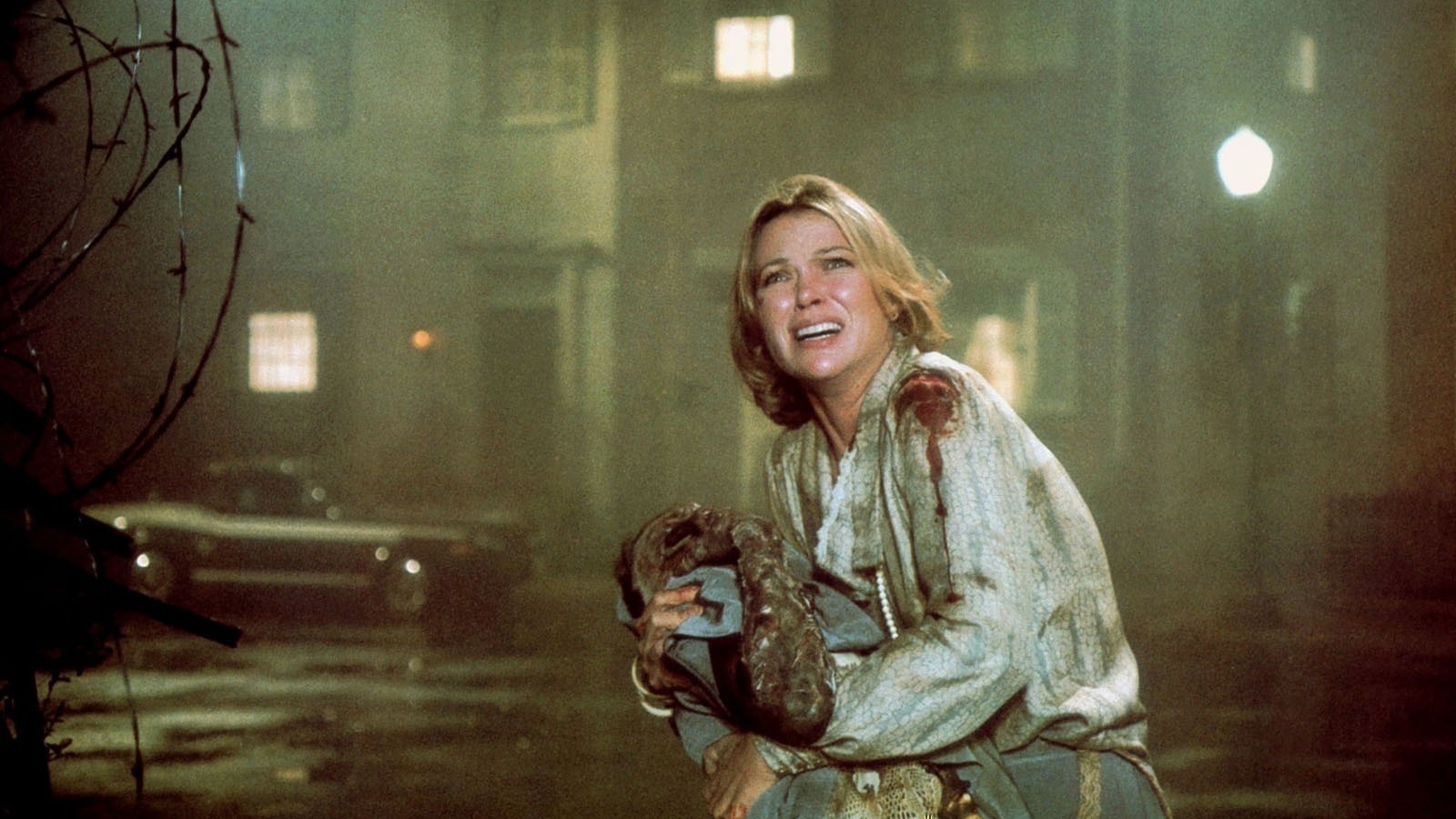
William Friedkin’s The Exorcist (1973) has no greater fan on the planet than critic Mark Kermode, who has written a book and hosted a documentary about the film he has often said changed his life. Kermode has famously called John Boorman’s 1977 sequel, Exorcist II: The Heretic, “clearly the worst film ever made by anyone ever.”
Not many would go quite that far, but before David Kittredge’s deeply researched documentary on the film’s making, Boorman and the Devil, premiered in this year’s Venice Classics program, the Hollywood Reporter’s Jordan Mintzer revisited The Heretic and found that it was “easy to see what so many fans hated about it. The film is indeed a total muddle, with moments of craptastic dialogue and acting, and it certainly isn’t as scary as the first one. In fact, the movie isn’t really scary at all—just extremely weird, as well as increasingly incomprehensible toward the end. But there are also flashes of visual splendor, like tiny shards of some kind of exotic broken vase—fragments of what could have been.”
Talking with Scott Tobias at the Reveal, Kittredge, an editor and one of the producers of the 2022 Shudder series Queer for Fear: The History of Queer Horror, argues that The Heretic belongs in the company of two other films from 1977 that were once shunned and have since come in for more positive reevaluation: Martin Scorsese’s New York, New York and Friedkin’s own Sorcerer. Friedkin’s The Exorcist is “basically a conservative treatise about how secularism is never the answer,” says Kittredge. “The Heretic is an extremely progressive, extremely feminist film. And I think that was also one of the reasons it was so completely rejected in 1977.”
“Attempts to reclaim once-vilified movies as misunderstood masterpieces can seem like special pleading,” writes Geoffrey Macnab in the Guardian. “Even so, Kittredge makes a strong case for admitting The Heretic into the canon. There is astonishing Steadicam work from Garrett Brown (later to work on Stanley Kubrick’s The Shining); Ennio Morricone’s mesmerizing score; Richard Macdonald’s stylized production design; buzzy mind-bending shots from a locust-eye point of view; a rip-roaring race back to Georgetown to confront the evil one; and, above all, the sheer, crazy ambition of Boorman’s storytelling.”
Beyond Fest will present both Boorman and the Devil and Exorcist II: The Heretic on Wednesday evening, and Kittredge and producers Travis Stevens and Jim Fall will be taking questions.
Radu Jude’s Dracula
From Tuesday through October 11, Radu Jude will be in Paris, where mk2 Bibliothèque and Centre Pompidou will present a full retrospective, complete with master classes and onstage conversations. Earlier this year, Jude won a Silver Bear in Berlin for his screenplay for Kontinental ’25, and his latest feature, Dracula, premiered last month in Locarno.
“An almost three-hour burp in the face of good taste, subtlety, and those laboring under the delusion that, after his terrific but comparatively sedate Kontinental ’25, Jude was getting respectable,” wrote Jessica Kiang in a dispatch to Film Comment, “Dracula is a discordant riff on a classic text that is astonishingly stupid, stupefyingly brilliant, and quite often flat-out irritating.”
Charged by studio execs with turning one of the most enduring characters in Romanian history, Gothic literature, and Hollywood lore into a crowd-pleasing, money-making movie, an emerging director (Adonis Tanța) turns to an AI program—dubbed Judex and voiced by Jude—for ideas. “The results vary in length, time period, and style,” writes David Robb for Slant, “but are uniformly vulgar, chaotic, and stuffed with metatextual references to philosophy and film history that soon become no less overwhelming than Jude’s relentless dick jokes.”
“For all its overflow of ideas, stories, trends, diversions, and citations,” writes Arta Barzanji at Ultra Dogme, “the movie orbits a simple, apt metaphor: AI as vampire, surviving only by sucking the blood of the living—our data, our images, our labor.” In Screen, Jonathan Romney suggests that it’s “redundant to complain that Jude’s film is overstated—that is entirely the point—although some of its excesses are labored, and some gags just not that funny. But the whole affair keeps reanimating itself with furious, facetious energy.”
At Films in Frame, Romanian critic Georgiana Mușat finds the final scene to be a “gut punch. For all his wild, anti-cinematic, devilish, satirical, revisionist digressions, Jude’s cinema is, above all, humanist.” Dracula will screen at Beyond Fest and the New York Film Festival on Saturday before heading to Vancouver and Vienna.
Lucile Hadžihalilović’s The Ice Tower
The Ice Tower “continues director Lucile Hadžihalilović’s cinematic fairy tales of female transformation after the Cronenbergian English-language fable Earwig (2021), but in a leaner, more abstractly atmospheric style,” wrote MUBI’s Daniel Kasman when Hadžihalilović’s fourth feature premiered in Berlin, where it won a Silver Bear for Outstanding Artistic Contribution. “Nominally taking place in the 1970s, The Ice Tower in fact exists in that uncanny Lynchian space between the conventional world and that of a dream.”
At sixteen, Jeanne (Clara Pacini) is the oldest foster child in a home tucked away in the French Alps. She reads fairy tales to young Rose (Cassandre Louis Urbain), and a favorite is Hans Christian Andersen’s “The Snow Queen.” One morning, Jeanne slips away, hitchhikes to the city, and later that night, takes refuge in a vast empty building. But the building comes alive the following morning as a movie studio, teeming with crew members at work on the lavish sets of an adaptation of “The Snow Queen” starring the renowned and enigmatic Cristina van den Berg (Marion Cotillard). Enchanted, Jeanne catches Cristina’s eye.
“Cristina’s somewhat louche director Dino, played by Hadžihalilović’s partner Gaspar Noé, is in the habit of telling likely young actresses that he might cast them in his next project, a Hitchcockian thriller,” notes the Guardian’s Peter Bradshaw. “In fact, there is something Hitchcockian in this shoot, with an attack carried out by a bird, and in Cristina’s own cold, cruel detachment from the victim’s suffering. Hadžihalilović might intend us to notice in one shot a movie poster for The Red Shoes, but the Powell and Pressburger film that this more resembles is surely Black Narcissus with its female desire and delirium in the bitter mountain cold.”
“The Ice Tower’s allegiance to the fairy tale might suggest that it’s all about twists and turns of plot,” writes Diego Semerene at Slant, “but Hadžihalilović pays much more attention to the sensuous qualities of cinema. From the kaleidoscopic shots that open and close the film, as though through the point of view of a child looking through an ornamental snowball, to a marvelous shot of red blood sullying pristine ice, Hadžihalilović’s camera is profoundly alive to the texture of things. It has the puerile fascination, in the best sense of the term, of a silent-cinema gaze.”
Don’t miss out on your Daily briefing! Subscribe to the RSS feed.