A Few Standout Performances
Share
An eccentric musical about the founding of a mid-eighteenth-century religious sect, an adaptation of a Korean sci-fi black comedy, and the story of the rise, fall, and rise of a mixed-martial-arts and UFC fighter have all been earning strong reviews since their premieres in competition in Venice. But critics are also lavishing extra praise on their lead performers.
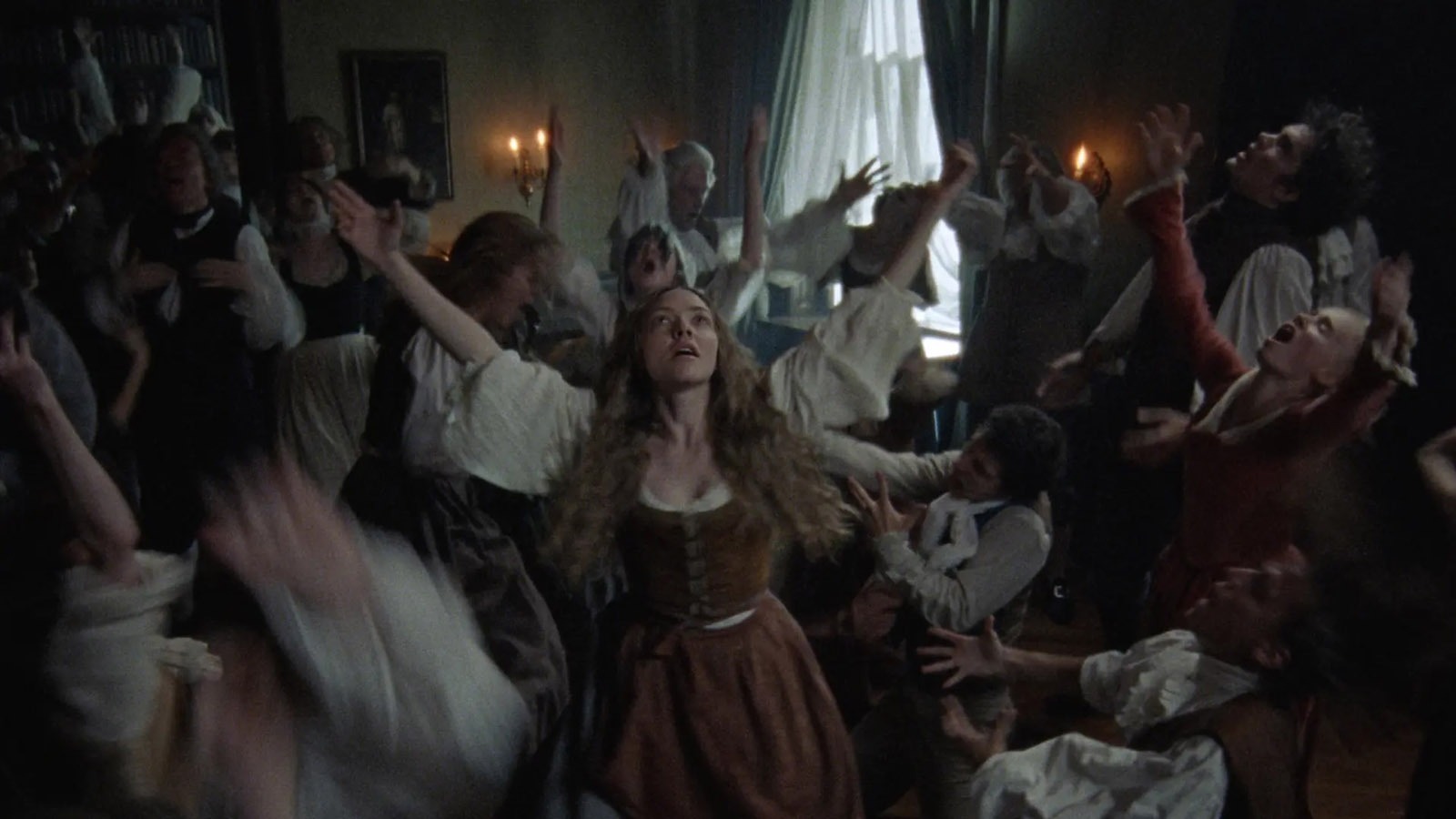
Amanda Seyfried in The Testament of Ann Lee
Last year, partners Mona Fastvold (The World to Come) and Brady Corbet (Vox Lux) took a break from working on her third feature, The Testament of Ann Lee, to head to Venice to promote his third one, The Brutalist. Narrated by Mary (Thomasin McKenzie), Testament begins in Manchester, where a blacksmith’s daughter marries a laborer (Christopher Abbott) and bears four children, all of whom die before their first birthday.
Fornication, she decides, alienates us from God. Celibacy will be the core tenet of a new offshoot of Shaking Quakerism, a sect whose ecstatic singing and dancing aims to rid the body of sin. In 1774, Mother Ann Lee and her followers, the Shakers, who would eventually come to believe that she was a female incarnation of God, left England to establish a new community in upstate New York.
“Core beliefs, including pacifism, spiritual and physical purity, the collective expunging of sin as a kind of exorcism, social equality extending to gender and race, and the nonbinary representation of God, doubtless are not all shared by Fastvold,” writes the Hollywood Reporter’s David Rooney. “But the filmmaker clearly identifies with the dedication of the Shakers to common goals that parallel the clarity, collaboration, and discipline demanded by any creative endeavor.”
“On paper, this might all sound quite bloodless and conceptual,” writes Guy Lodge in Variety. “In practice, it has an earnest, full-hearted sweep, in large part thanks to a performance of redoubtable commitment and nerve-deep feeling by Amanda Seyfried—far from the musical terrain of either Mamma Mia! or Les Misérables, but fully in command of her gifts—in the title role.” Seyfried, “her extraordinary eyes never wider or more steeled with conviction, is quite dazzling as Ann the self-made icon, wielding a poised, peaceable but controlling authority in scene after scene while rarely raising her voice except in lilting song.”
For the Irish Times’ Donald Clarke, “as cinema of melodic effect, The Testament of Ann Lee could hardly be bettered.” As Stephen Dalton notes at the Film Verdict, Testament features musical numbers choreographed by Celia Rowlson-Hall and scored by Daniel Blumberg as “a densely layered electro-orchestral tapestry of percussive thumps, nerve-jangling strings, and airy woodwind while the songs themselves set the lyrics from genuine antique Shaker spirituals to Blumberg’s avant-folk arrangements. Most are performed to camera by the cast in solo or choral mode, but with guest vocals in the mix from left-field luminaries including Scottish free jazz singer Maggie Nicols and Alan Sparhawk of U.S. indie-rock trio Low. Tastes will vary but these are exquisitely crafted songs of faith and devotion.”
“Comparisons to The Brutalist are inevitable,” writes the Telegraph’s Robbie Collin, “and the two do make an intriguing pair of his ’n’ hers immigrant epics, each shot on 70 mm film stock and crafted with a mad single-mindedness of which their subjects would no doubt approve. The free-range majesty and fine-grained, muddy-fingernailed detail of Fastvold’s film, though, is entirely its own thing: like Ann, I was left wobbly and breathless by its grandeur and nerve.”
Jesse Plemons and Emma Stone in Bugonia
Freely adapted by Will Tracy (The Menu) from Jang Joon-hwan’s 2003 cult favorite Save the Green Planet!, Yorgos Lanthimos’s Bugonia is “the first picture of his populated by characters who feel like they exist in the real world, people you could run into if you walked out the door,” writes Vulture’s Bilge Ebiri. “The power of Lanthimos’s work has always come from his ability to provide surreal but dead-on metaphors that take on lives of their own: a futuristic resort where one must debase oneself to find a mate, in The Lobster; or a family where the parents have trained their kids to accept absurdities as reality, in Dogtooth. With Bugonia, it feels like he’s entered our world at last, at least for a while. Which also makes it maybe the saddest film he’s ever made.”
As Michelle Fuller, the hard-driving CEO of the pharmaceutical company Auxolith, Emma Stone “gives great ice-queen diva,” writes Stephen Dalton, while Jesse Plemons “radiates volatile Unabomber-style intensity” as Teddy, a beekeeper whose mother (Alicia Silverstone) lies in a coma thanks to one of Auxolith’s experimental drug programs. Teddy has come to the conclusion that aliens are planning to wipe out humanity—and that Michelle is one of them. Teddy convinces his neurodivergent cousin Don (Aidan Delbis) to help him kidnap Michelle and force her to set up a meeting with her leader.
“Plemons channels paranoia, grief, and righteousness into something both absurd and unnervingly sincere,” writes Josh Rottenberg in the Los Angeles Times. “The ‘I do my own research’ archetype could easily veer into SNL sketch territory but he plays it heartbreakingly straight, creating a chillingly familiar portrait of a man lost in an algorithmic maze of internet rabbit holes and desperate for clarity in a world that no longer makes sense.”
As for Stone, she’s “often led with her empathy, and it’s that very quality that renders her cutthroat performance in Bugonia so ironically exquisite,” finds Variety’s Owen Gleiberman. Lanthimos “pushes each to the edge of their corporeal capacity,” writes Marshall Shaffer at the Playlist, “and they match the narrative’s escalations with furious intensity each time.”
“Despite Lanthimos and Tracy’s past form for unbridled cynicism, there’s a strangled sort of sadness about Bugonia,” writes Hannah Strong at Little White Lies, “a tangible pang of regret that humanity can’t seem to help fucking itself over, time and time again. This is no screed against the dangers of online conspiracy rabbit holes (though the warning is implicit) or the many competing crises fighting for attention on a daily basis, but rather a lament for humanity’s own ‘suicidal gene,’ as Michelle puts it, and the parasitic nature of capitalism that exploits our biological vulnerabilities.”
Dwyane Johnson in The Smashing Machine
When Dwyane Johnson saw Uncut Gems (2019), he approached the directors, Josh and Benny Safdie, with the idea of turning John Hyams’s 2002 documentary The Smashing Machine: The Life and Times of Extreme Fighter Mark Kerr into a feature. The pandemic put the project on hold, Benny appeared in films by Paul Thomas Anderson and Christopher Nolan, and Josh started working with writer and editor Ronald Bronstein on Marty Supreme, which A24 will release on Christmas Day. Benny took over The Smashing Machine, the tale of Kerr’s rise to global fame in the late 1990s, followed by a crippling opioid dependency and a struggle to regain his health and success.
“Safdie doesn’t tie the story into excessively dramatic pretzel knots, and he doesn’t try to apply any Rocky-style narrative formulas,” writes Time’s Stephanie Zacharek. “Instead, he simply trusts his star, Dwayne Johnson, to lead us through Kerr’s story of escalating fame, addiction, and recovery, without resorting to the clichés of so many addiction-recovery dramas. Kerr kicks his habit early in the film—there’s no real spiraling decline, no horrific bottoming out. So what we see through most of the movie is a champion who’s fallen and gotten back up again, asking, Now what? It’s the persistent drive of the ‘Now what?’ that makes the movie work.”
“Marking the director’s first feature made apart from his brother,” writes Jordan Mintzer in the Hollywood Reporter, “the film retains much of what rendered the Safdies’ work so original: a stylized moody realism; a cast mixing trained actors with regular people; an overall downbeat vibe enlivened by flashes of raw humor and kinetic energy; and stories carried by protagonists often addicted to something, whether it’s theft (The Pleasure of Being Robbed, Good Time), drugs (Heaven Knows What), or gambling (Uncut Gems).” Robbie Collin finds that Safdie “summons up the thrilling on-the-hoof and out-in-the-wild energy for which he and his brother, Josh, are renowned. The streetscapes of Phoenix and Tokyo throb and surge with life.”
“We know the Rock can act,” writes Bilge Ebiri. “He was terrific in films like Snitch and Pain & Gain before he disappeared into franchise fare and the purgatory of streaming. He also has an innate magnetism that, when given the opportunity, can really seduce an audience. But here, the outward charm feels hollow, purposefully so. Instead, the actor absorbs the soft-spoken Kerr’s wounds and translates them into physical language.”
At his side is Emily Blunt as Dawn, Kerr’s former wife, who was dealing with addictions of her own. “They had this insanely codependent, passionate, loving relationship that was like two comets coming together, and the collision could end very badly,” Blunt tells Joshua Encinias in MovieMaker. Hannah Strong finds that “there’s a realism to their bickering which is often comedic but occasionally horrifying.” Dawn “is sparky and self-determined, and even in a film largely dedicated to Johnson’s impressive performance, she doesn’t disappear into the background.”
The Smashing Machine “proves that Johnson can do much more than simply outrace explosions and glower at Vin Diesel,” writes the New York Times’ Kyle Buchanan. “A lot of times,” says Johnson, “it’s harder for us—or at least for me—sometimes to know what you’re capable of when you’ve been pigeonholed. Sometimes it takes people that you love and respect, like Emily and Benny, to say you can.”
Don’t miss out on your Daily briefing! Subscribe to the RSS feed.