Locarno 2025 Lineup
Share
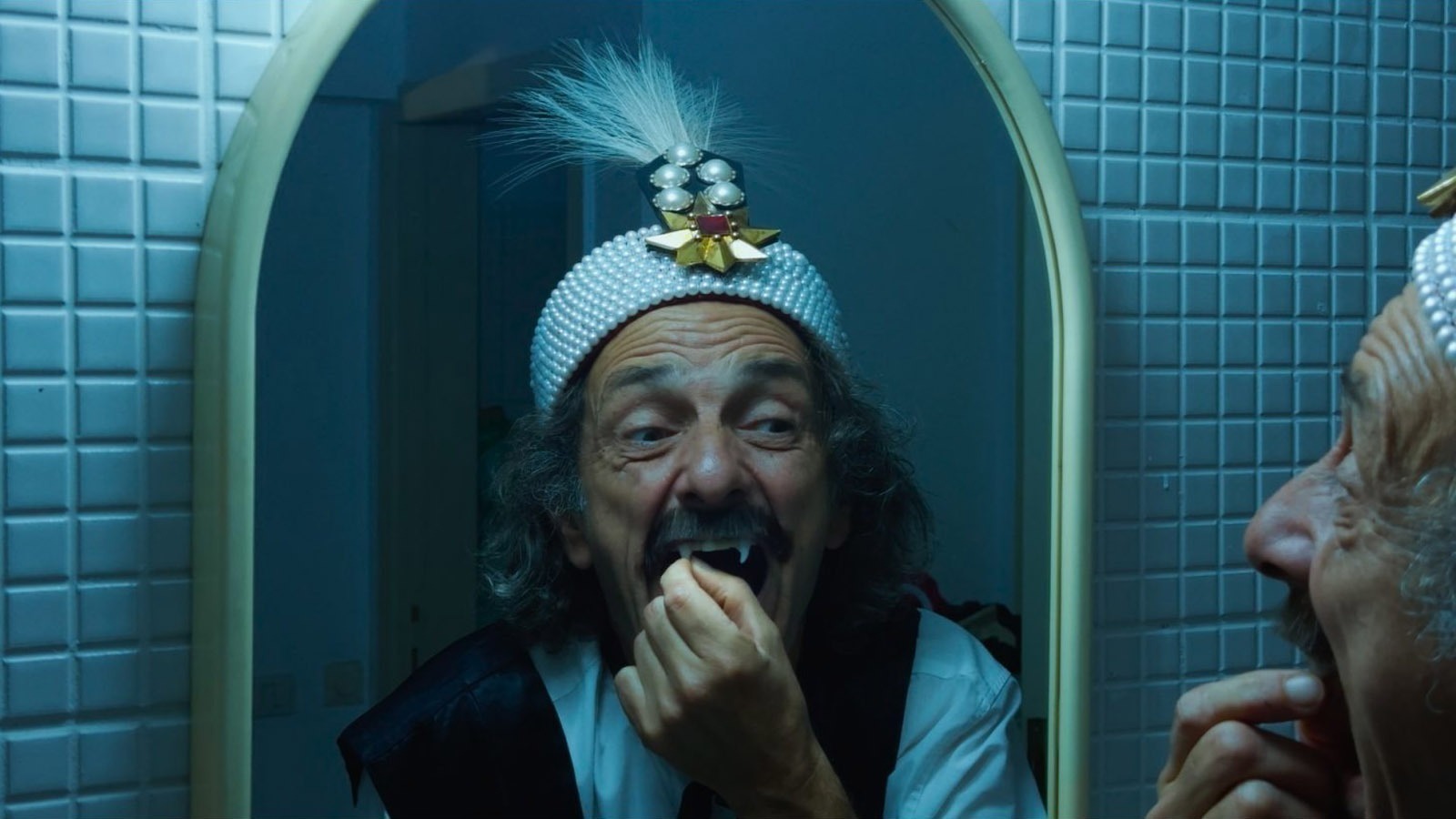
“It’s time that someone from Romania does a Dracula film,” declared Radu Jude in Locarno last year. “It’s only Hollywood that has done it a thousand times.” With his own 170-minute version—shot and set in Transylvania, where his father was born—Bucharest native Jude aims, he says, to deliver a movie for everyone, “a commercial film, a meditation on national myths and the history of film, an essay, a vampire film, a popular comedy, a political film, a satire, an erotic film, an action film,” and a work of “literary cinema.”
Dracula is one of seventeen films lined up this year to compete for Locarno’s top prize, the Golden Leopard. As Marta Bałaga reports for Variety, when he unveiled the full lineup for the seventy-eighth edition (August 6 through 16) on Tuesday morning, Locarno artistic director Giona A. Nazzaro called Dracula “a very radical film, a crazy political comedy.” 1-2 Special has picked up North American rights, prompting further comment from Jude: “When I am asked who is Dracula in the film, I always reply that the film itself is Dracula. I would also add that this film is my humble homage to some great American underrated auteurs: Ed Wood, Andy Warhol, and the Fluxus filmmakers.”
Among the other titles slated to premiere in the Concorso Internazionale are Dry Leaf, Alexandre Koberidze’s long-awaited follow-up to What Do We See When We Look at the Sky? (2021); Desire Lines, a journey through Belgrade and beyond from Dane Komljen (All the Cities of the North, Afterwater); and Two Seasons, Two Strangers, stories of chance meetings adapted from manga artist Yoshiharu Tsuge’s Mister Ben of the Igloo and A View of the Seaside and directed by Sho Miyake (Small, Slow but Steady; All the Long Nights).
In 2021, Fabrice Aragno, who at that point had been working closely with Jean-Luc Godard for two decades, spoke with Variety’s Will Thorne about his own feature, Le lac. “The story is quite simple. It’s about a couple who want to feel again,” said Aragno. “I’m using everything I’ve discovered with Godard, playing with the freedom of image and sound. It will be a real spectacle cinématographique.”
In Ben Rivers’s Mare’s Nest, a young girl (Moon Nanook Guo-Barker) explores a world where all the adults have disappeared. Rivers tells Variety’s Annika Pham that the pandemic, when children were “locked away in their houses, not free to play and be wild,” was on his mind as well as Don DeLillo’s 2007 one-act play, The Word for Snow. Mare’s Nest, he says, is “a kind of near future road movie, a world that has an underlying sense of uncertainty and disturbance, but also about possibilities and joy.”
Julian Radlmaier (Self-Criticism of a Bourgeois Dog, Bloodsuckers) says that his new film, Phantoms of July, is “about the alchemy of encounter.” It’s divided into three sections, the first set in Germany’s Harz mountains in the late eighteenth century, the second at a factory in the same town, and the third focusing on the friendship between a German waitress and an Iranian YouTuber.
Abdellatif Kechiche won accolades, a César, and the Louis Delluc Prize for The Secret of the Grain (2007) and then the Palme d’Or—shared with his leading performers, Léa Seydoux and Adèle Exarchopoulos—for Blue Is the Warmest Color (2013). The big win in Cannes was followed within days by accusations of harassment and misconduct that he’s been battling all the way through the productions of Mektoub, My Love: Canto Uno (2017) and Mektoub, My Love: Intermezzo (2019). Mektoub, My Love: Canto Due, an adaptation of François Bégaudeau’s 2011 novel La blessure, la vraie and set in 1994, will tell the story of a screenwriter who meets a producer who offers to finance his film—for a price.
In 2001, when he was twenty-eight, Palestinian director Kamal Aljafari returned to Gaza to look for a former prison mate and shot three MiniDV tapes as he traveled from the north to the south accompanied by Hasan, a local guide. He has now reshaped his recently rediscovered footage into With Hasan in Gaza, “a cinematic reflection on memory, loss, and the passage of time.” Abbas Fahdel’s Tales of a Wounded Land chronicles of the war that devastated southern Lebanon for a year and a half.
Also premiering in the Concorso Internazionale are Hana Jušić’s God Will Not Help, the story of a Chilean woman who shows up in an isolated mountain community of Croatian shepherds; Janicke Askevold’s Solomamma, in which a single mother unexpectedly discovers the identity of the father of her five-year-old son; Elsa Kremser and Levin Peter’s White Snail, in which a Belarusian model finds herself drawn to a loner who works the night shift at a morgue; The Seasons, Maureen Fazendeiro’s documentary on the Portuguese region of Alentejo; Rosanne Pel’s Donkey Days, centering on two sisters competing for their mother’s attention; Valentina and Nicole Bertani’s coming-of-age comedy Mosquitoes; and Sorella di Clausura, a parody of romantic melodrama from Ivana Mladenović (Ivana the Terrible).
Locarno’s famed outdoor screenings on the Piazza Grande draw thousands each evening, and this year’s program will offer premieres such as Brian Kirk’s The Dead of Winter, starring Leopard Club Award winner Emma Thompson; Cannes favorites, including this year’s winner of the Palme d’Or, Jafar Panahi’s It Was Just an Accident; and revivals. Police Story (1985), for example, spotlights career achievement honoree Jackie Chan.
In its Histoire(s) du Cinéma program, Locarno will pay tribute to Alexander Payne, the recipient of an honorary Golden Leopard, and screen films by Jean Vigo, Robert Rossellini, Ang Lee, Liliana Cavani, Carlos Reygadas, and Mario Bava. And one of the main highlights of Locarno 2025 will naturally be the retrospective, Great Expectations: British Postwar Cinema 1945–1960.
Don’t miss out on your Daily briefing! Subscribe to the RSS feed.