A French March in New York
Share

Of the two awards ceremonies that took place over the weekend, only one offers a few hints as to who might be taking home gold when the Oscars are presented on March 27. As IndieWire’s Anne Thompson and the Los Angeles Times’ Glenn Whipp read the winners’ fortunes following Sunday night’s Screen Actors Guild Awards, it turns out that Sian Heder’s CODA, which won best ensemble and a supporting actor award for Troy Kotsur—the first deaf actor to win a sole acting prize at the SAG Awards—is a stronger contender than many may have thought.
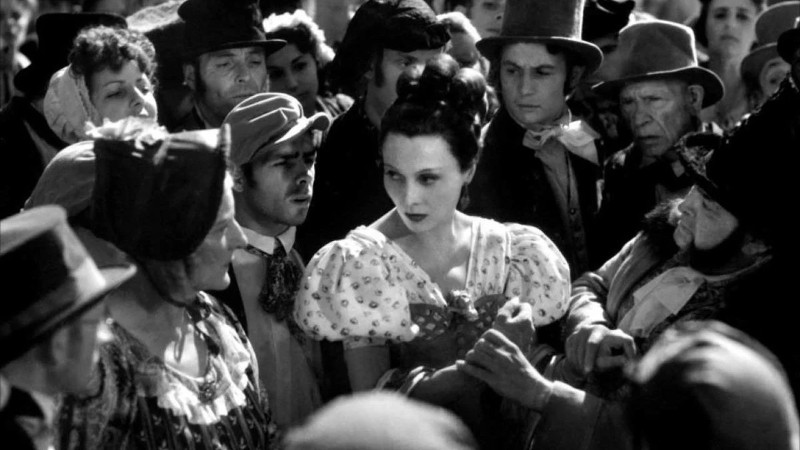
Friday night’s presentation of the César Awards tells us nothing about the Oscars since France has been shut out of the race for best international feature. But with Film at Lincoln Center’s Rendez-Vous with French Cinema opening on Thursday, they may be of more immediate interest. Xavier Giannoli’s Lost Illusions, screening in New York on March 8 and 11, won seven Césars, including best film. An adaptation of the serial novel that Honoré de Balzac wrote between 1837 and 1843, Lost Illusions is “one of the funniest and most romantic films of the year,” writes Adam Solomons for Little White Lies. “Following upstart writer Lucien Chardon (Benjamin Voisin) as he seeks fame and fortune in a nineteenth-century Paris defined by its new freedoms and raunchiness, Lost Illusions quickly swerves any indication it might be a staid or unadventurous period piece.”
Voisin won the César for best male newcomer, and the cast also features Vincent Lacoste (best supporting actor), Gérard Depardieu, and Jeanne Balibar. “Wisely focusing on the second section of Balzac’s ungainly triptych novel, Giannoli and his cowriters bring to the fore everything that makes the book so remarkably prescient in its depiction of the origins of the tabloid press and its application to our own media age,” writes Jonathan Romney for Screen. “Clickbait, sponsored content, fake news, trolling—it’s all already there in Balzac’s Paris, where careers are made and destroyed depending on who is signing the check.”
The César for best first film went to Vincent Maël Cardona’s Magnetic Beats, which screens this Saturday and the following Wednesday. Set in Brittany in the early 1980s, the story focuses on two brothers—Philippe (Thimotée Robart), a shy teen, and his outgoing older sibling, Jérôme (Joseph Olivennes)—who set up a pirate radio station and fall for a single mother, Marianne (Marie Colomb). “Inventively glitchy sound design and a well-chosen soundtrack bring a distinctive personality to a film which combines coming-of-age story, a love triangle, and a persuasive sense of time and place,” writes Screen’s Wendy Ide.
Claire Denis, who won the Silver Bear for best director in Berlin two weeks ago, will open this year’s Rendez-Vous when she introduces Fire along with two of the film’s stars, Juliette Binoche and Vincent Lindon. Arnaud Desplechin will take part in a Q&A following Saturday’s screening of Deception, starring Léa Seydoux. When Deception premiered in Cannes last summer, Guy Lodge, writing for Variety, found it to be “a strange, stifling, but frequently intriguing attempt to find a cinematic match for the literary voice of Philip Roth, from his autofictional 1990 novel of the same name. It often succeeds, which is to say the filmmaking often appropriates the self-aggrandizing indulgences and knowingly oppressive masculinity of a work that isn’t among the author’s finest. But it’s Seydoux’s sly, bright presence, as an obscure object of desire who gradually places the protagonist’s failings in relief, that keeps us involved.”
Desplechin has also programmed a series for the French Institute Alliance Française that he calls “an appreciation of infidelity in cinema.” Our Love Affairs: Arnaud Desplechin Selects opens tomorrow with Eric Rohmer’s Love in the Afternoon (1972), and on March 8, Desplechin will talk with Kent Jones about his 2018 fictional feature debut, Diane. The month of Tuesday screenings then carries on with Desplechin’s video introductions to Max Ophuls’s The Earrings of Madame de . . . (1953), Ingmar Bergman’s The Touch (1971), and Martin Scorsese’s The Age of Innocence (1993).
For news and items of interest throughout the day, every day, follow @CriterionDaily.