Gold for Jarmusch, Silver for Ben Hania
Share
Cool as ever in his dark sunglasses and a sharply cut maroon jacket as he sauntered up to the stage in Venice to accept the Golden Lion for Father Mother Sister Brother, Jim Jarmusch seemed slightly ill at ease. The reception was more than warm, and when someone called out, “We love you, Jim!,” an appreciative murmur of agreeable laughter rippled through the theater.
Moments earlier, though, that same crowd had risen to their feet with a roar when jury president Alexander Payne announced that Kaouther Ben Hania’s The Voice of Hind Rajab had won the Grand Jury Prize, which is essentially the festival’s second-place award. Ben Hania’s fiery speech hit like the crest of a wave of fury on an evening in which the winners of one award after another called for an end to the ongoing devastation in Gaza. Like many in the room, both Jarmusch and Ben Hania wore buttons with a single-word demand: “Enough.”
The Voice of Hind Rajab, a reconstruction of the night that Israel Defense Forces killed a five-year-old Palestinian girl, is “soul-shaking,” writes Sheri Linden in the Hollywood Reporter. For Jessica Kiang in Variety, Father Mother Sister Brother is a “lovely triptych melancomedy,” and Vulture’s Bilge Ebiri suggests that the film “finds the director in a minor key, which is sometimes his best key.”
Jarmusch thanked the jury for “appreciating our quiet film,” and added that “art does not have to address politics directly to be political. It can engender empathy, which is the first step toward solving our problems.” Jarmusch “has been doing his idiosyncratic thing for so long we sometimes take him for granted,” writes the Hollywood Reporter’s David Rooney. “But then he comes along with a film as delicate and lovely, as singular and perfectly realized as Father Mother Sister Brother and quietly floors you.”
Like Night on Earth (1991) and Coffee and Cigarettes (2003), Father Mother is an anthology film, a collection of three separate yet thematically linked stories about adult siblings and their parents. In “Father,” Jeff (Adam Driver) and Emily (Mayim Bialik) drive through the northeastern countryside to pay a visit to their dad (Tom Waits), who may be doing better—physically, mentally, and financially—than he lets on.
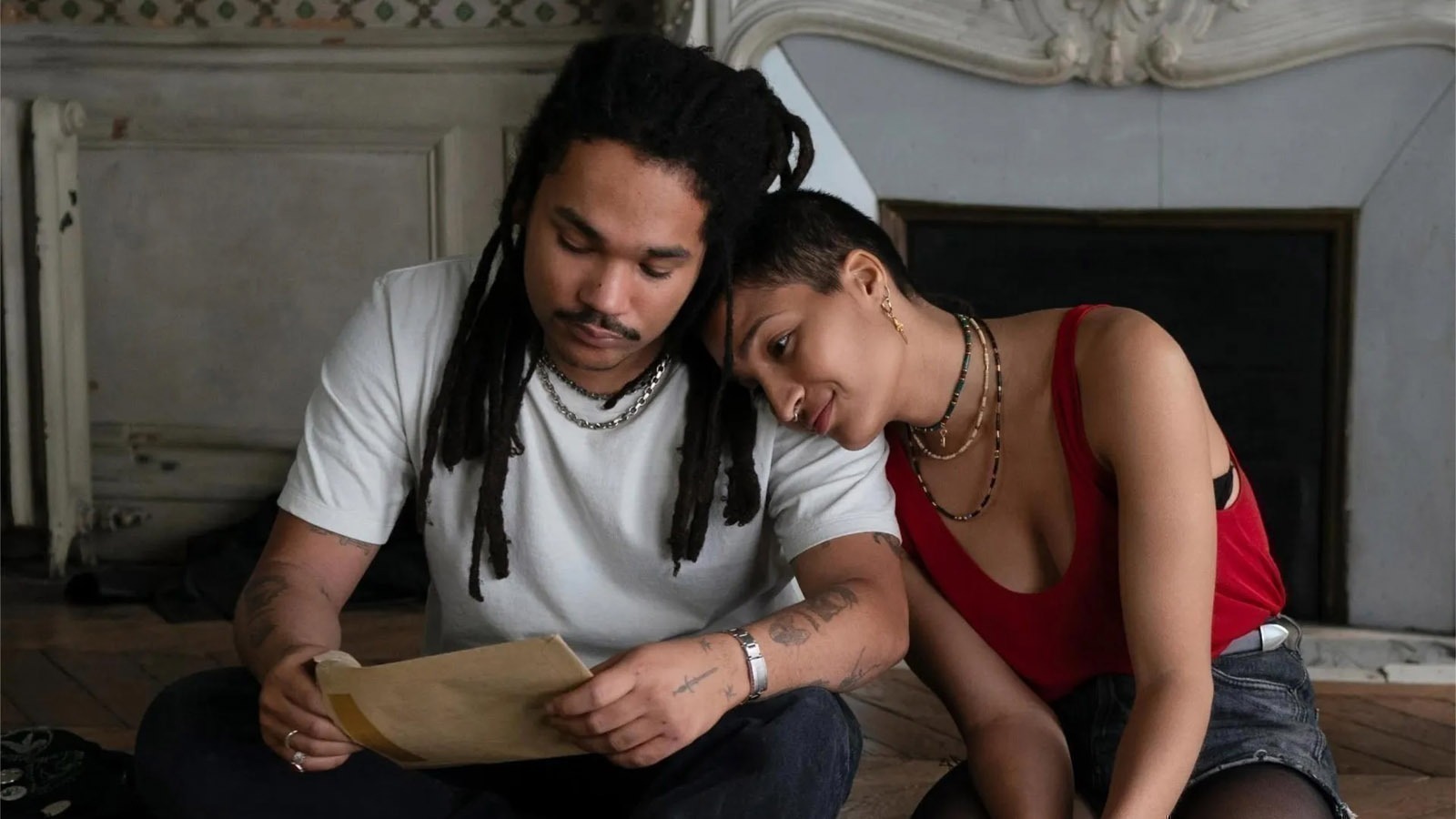
Set in Dublin, “Mother” finds a novelist (Charlotte Rampling) doing very well indeed, though she’s not looking forward to the annual drop-in from her daughters, Timothea (Cate Blanchett) and Lilith (Vicky Krieps). Awkward small talk bridges the pauses in both “Father” and “Mother,” but “Sister Brother” finds twins Billy (Luka Sabbat) and Skye (Indya Moore) already on the same wavelength as they walk through the Parisian apartment now left nearly empty by their recently deceased parents.
“It is not easy to create visual variety and interest in scenes in which by design the most important thing that is happening is that nothing is apparently happening,” writes Jessica Kiang. “Yet, alert to the way dead air between family members can actually be teeming with life, each segment is beguilingly immersive from the first shot.” Jarmusch’s “way with his ensemble is borderline uncanny here: not one moment between the actors feels inauthentic.” And David Rooney notes that there are “no star turns, no parts that are discernibly meatier, no actor without a fully dimensional character to play.”
Silver Lions
On the night of January 29, 2024, the office of the Palestine Red Crescent Society in Ramallah received a desperate call for help from a fifteen-year-old fifty miles away in Gaza City. The office heard her screams, and then machine-gun fire. The workers in Ramallah immediately reestablished contact and discovered that the sole survivor in a car strafed with more than three hundred bullets was five-year-old Hind Rajab, who told them that her uncle, aunt, and her three cousins were “sleeping.”
Kaouther Ben Hania, the Tunisian director of the Oscar-nominated films The Man Who Sold His Skin (2020) and Four Daughters (2024), combines the actual audio recording of Hind Rajab’s increasingly urgent pleas for help with reenactments of four workers in the Ramallah office—Omar (Mataz Malhees), Rana (Saja Kilani), Mahdi (Amer Hlehel), and Nisreen (Clara Khoury)—to reconstruct the events of that night. Given the restrictions on freedom of movement that Israel has placed on Palestinians, including first responders, it could only end in tragedy.
“Some viewers will be fully immersed in the horror and despair of the moment,” writes Guy Lodge in his review for Variety of The Voice of Hind Rajab, “while others may have greater misgivings regarding Ben Hania’s layering of tearjerker tactics over material that hardly requires extra emotional amplification. Her filmmaking choices, from fevered editing rhythms to an urgently swelling score, rarely favor understatement, while the performances benefit from a heartfelt, in-the-moment intensity, but little modulation or finesse.”
“Some will find the very attempt to make a movie about this event an act of exploitation,” writes Bilge Ebiri. “Others will surely consider it propaganda.” Ben Hania “navigates this discoursal minefield admirably, largely by identifying the powerlessness of her characters as an existential condition in the face of indiscriminate and endless horror.” Accepting her Silver Lion, Ben Hania noted that “Hind’s mother and little brother are still in Gaza. Their lives are still in danger. I urge the leaders of the world to save them.”
Benny Safdie won the Silver Lion for Best Director for The Smashing Machine, a film we took a first look at last week. Since then, Jessica Kiang has reviewed this one as well. “Without waggling an eyebrow or popping a pec,” she writes for Sight and Sound, “Dwayne Johnson (formerly and forever the Rock) is so damn good in The Smashing Machine, Benny Safdie’s biopic of MMA pioneer Mark Kerr, that you kind of want to take him apart to see how he does it.”
Volpi Cups and More
The Volpi Cup for Best Actor, though, went to Toni Servillo for his portrayal of a fictional Italian president in Paolo Sorrentino’s La grazia. “Servillo, as always, makes for a compelling lead, and somehow manages to subtly showcase the stores of wit and charisma hidden by this apparently dull, dithering man,” writes Little White Lies’ David Jenkins.
Xin Zhilei won the Volpi Cup for Best Actress for playing a shopkeeper whose ex-lover (Zhang Songwen) has reentered her life in Cai Shangjun’s The Sun Rises on Us All. In the Hollywood Reporter, Jordan Mintzer notes that one crucial scene in particular “showcases the impressive range of both lead actors, who aren’t afraid to go overboard in the film’s more fiery moments, of which there are quite a few. Xin is especially a revelation here, portraying a character who shifts from fake-smiling into her phone so she can sell dresses online to begging for the kind of life-changing reprieve she may never be granted.”
The Marcello Mastroianni Award for Best Young Actor or Actress went to Luna Wedler for her performance as Grete, the first female student admitted to the University of Marburg in 1908. Her story is just one of a few strands in Ildikó Enyedi’s Silent Friend, and for Jonathan Romney in Screen, “arboreal adoration has never blossomed on screen as lushly as it does in this contemplative, nature-focused feature.”
Valérie Donzelli and Gilles Marchand won the award for Best Screenplay for writing Donzelli’s At Work, which Sophie Monks Kaufman describes at IndieWire as a “modern riches-to-rags tale about a man who gives up life as a successful, well-remunerated photographer in Paris in order to scrape a living as a casual laborer and use his free time trying to become an author that his children want to read.” At Work is a film “attuned to the fact that, when your work is underpaid, you can never get enough of it.”
Gianfranco Rosi won a Special Jury Prize for Below the Clouds, which the Guardian’s Peter Bradshaw suggests might be thought of “as the last of a conceptual trilogy about normal life and spiritual life in Italy: the first was his Sacro GRA from 2013 about Rome, for which Rosi won the Venice Golden Lion; the next was Fire at Sea about the migration crisis as experienced in Lampedusa in Sicily. Now there is Below the Clouds, in luminous black and white. It’s another of his brilliantly composed docu-mosaic assemblages of scenes and tableaux.”
Orizzonti
Like Un Certain Regard in Cannes, Venice’s Orizzonti program spotlights promising directorial talent, and this year’s jury, chaired by Julia Ducournau (Titane, Alpha), awarded their top prize to David Pablos’s On the Road. “Picture Brokeback Mountain crossed with a particularly gruesome episode of Narcos: Mexico, then filled with enough sex and nudity to earn an NC-17 rating, and you’ll get an inkling,” suggests Jordan Mintzer. “As tough and uncompromising as that pitch may sound, what’s most surprising [is] how tender and ultimately moving it is.”
Anuparna Roy won Best Director for Songs of Forgotten Trees, a story of two women keeping to pretty much themselves while sharing an apartment in Mumbai. “With subtlety and elegance in the apartment’s confined spaces,” writes Diego Lerer, “and with clever framing and camera angles that capture feelings the characters cannot express verbally—chiefly loneliness and isolation—Roy weaves a story about friendship, companionship, and connection between two women who, without fully admitting it, need one another.”
Lerer also admires writer-director Ana Cristina Barragán’s The Ivy, the winner of the award for Best Screenplay and “a tale of mothers and children, of encounters and missed connections, of repressed emotions and shared needs.” Akio Fujimoto’s Lost Land, which tracks the journey of a four-year-old boy and his nine-year-old sister from a Rohingya refugee camp in Bangladesh to Malaysia, won the Orizzonti Jury Prize. At Cineuropa, David Katz notes that Lost Land is “the first feature to be shot entirely in the Rohingya language and was made in collaboration with over two hundred people from the community; it transcends the relative artifice of its making to become a powerful account of the displacement and continual trauma they’ve faced.”
Benedetta Porcaroli won Best Actress for playing Holly, a young woman convinced that seven-year-old Arabella (Lucrezia Guglielmino) is her younger self in Carolina Cavalli’s The Kidnapping of Arabella, which the Hollywood Reporter’s Leslie Felperin calls “the sort of quirky road movie Italian audiences usually love (see Dino Risi’s 1962 Il sorpasso for the one that set the template).” Best Actor went to Giacomo Covi, who plays one of three Italian teens who befriend a newcomer from Sweden in Laura Samani’s A Year of School. “Key to the film’s success is the casting of the four youths,” writes Max Borg at the Film Verdict. Together, they “provide a solid emotional roadmap all the way up to the joyfully melancholic resolution.”
Spotlight, Classics, Debut
There’s no jury for Venice Spotlight, a program as nebulously defined as Cannes Premiere, but attendees do get to vote on an Audience Award. The new winner is Maryam Touzani’s “gentle, toasty-warm later-life drama,” Calle Málaga, “an ode to the physical spaces that sustain us, and quite winning as such,” writes Guy Lodge. “It is also an ode, even more winningly, to the indefatigable screen presence of Carmen Maura.”
Joe Beshenkovsky and James A. Smith’s Mata Hari, the story of the film David Carradine started making with his daughter, Calista, in 1975 but never completed, has won the Venice Classics Award for Best Documentary on Cinema. At the Playlist, Christian Gallichio finds it “equally fascinating and repulsive the way that Carradine mines Calista’s life for inspiration.”
The award for Best Restored Film went to Bahram Beyzaie’s Bashu, the Little Stranger (1986), the story of a boy who flees southern Iran after a bomb wipes out his family. Bashu is taken in by a family in the north, and Kevin Thomas, writing in the Los Angeles Times in 1990, found that Beyzaie’s film is “a testament to the transforming power of love and its ability to transcend the limits of experience, education, and ethnicity.” Bashu is “as modest as it is flawless.” Toronto will host the North American premiere of the new 4K restoration completed at Roashana Studios with the support of the Institute for the Intellectual Development of Children and Young Adults (KANOON).
Chaired by Charlotte Wells (Aftersun), the jury awarding the Lion of the Future, the festival’s award for the best debut feature, selected Nastia Korkia’s Short Summer. Eight-year-old Katya (Maiia Pleshkevich) whiles the season away at her grandparents’ home in the Russian countryside. A war rumbles off in the distance. At Cineuropa, Muriel Del Don finds that the film “catapults us into a fluctuating world; an everyday reality which veers between moments of lightheartedness and moments of fear.”
Giornate degli Autori
Short Summer premiered at the Giornate degli Autori, the sidebar formerly known as Venice Days. Novelist and filmmaker Dag Johan Haugerud, who won the Golden Bear in Berlin in February Dreams (Sex Love), headed up this year’s jury, and the GdA Director’s Award went to Amir Azizi for Inside Amir, “a film that takes time to listen,” as the jury puts it, “and that shows how unexpected, spontaneous encounters build a rich life.” A young man prepares to leave Iran for Italy, and for International Cinephile Society member Marc van de Klashorst, Inside Amir is “a love letter to the city of Tehran and its people.”
The Europa Cinemas Label, presented by a separate jury, was awarded to Stergios Dinopoulos and Krysianna B. Papadakis’s Bearcave, the story of two best friends’ journey into the Balkan mountains. “Both a clash and a fusion of the old and new,” reads the jury’s statement, Bearcave is “constructed a little like a thriller, but there is also more than a touch of the supernatural.”
The People’s Choice Award was split between Vladlena Sandu’s Memory and Cyril Aris’s A Sad and Beautiful World. Born in Ukraine, Sandu grew up in Grozny in the 1990s during the First Chechen War. “As a poetic, deeply cinematic recollection of that turbulent era,” writes Jessica Kiang in Variety, “told in densely allusive imagery, in grave Tarkovsky compositions and saturated Parajanov colors, Memory is already powerful. But as an evocation of all we lose to conflict—not just our personal histories, but any hope for a peaceful shared future too—it is extraordinary, tracking in acutely intimate detail the process by which trauma tumbles through generations like a virus moving from host to host, intent only on perpetuating itself.”
Heading next to London, A Sad and Beautiful World is a love story that spans thirty years and “echoes Lebanon’s constant swing between hope and despair,” says director and cowriter Aris. Talking to Deadline’s Melanie Goodfellow, he adds that “at some point, it really makes you wonder if there’s really any hopeful future for future generations in Lebanon. At the same time, it’s a place we’re all very deeply attached to, and we are very much in love with. And I think this is often reflected in our cinema.”
Venice Critics’ Week
Straight Circle, the first feature from music video and commercial director Oscar Hudson, has won the Grand Prize at Venice Critics’ Week. Twins Elliott and Luke Tittensor play border guards on opposing sides of two fictional countries. Straight Circle is “a through-the-looking-glass absurdist nightmare about realizing that the otherness of your enemy is an illusion,” writes Peter Bradshaw. “This is a boisterous, lively picture: I can imagine Richard Lester having directed it in 1968.”
The Audience Award went to Ish, directed and scored by multimedia artist Imran Perretta and cowritten with playwright Enda Walsh. Ish (Farhan Hasnat) and Maram (Yahya Kitana) are Muslim boys in Luton, and as David Katz points out at Cineuropa, this is “an area outside London notoriously targeted by counter-terrorism police, and even these two guileless kids and their wider group of friends find themselves encircled by its racist social profiling.” At Little White Lies, Hannah Strong finds that Perretta “makes the leap to film director with impressive ease, his vision confident and compassionate, echoing the work of Shane Meadows in its sensitive but never condescending portrait of childhood.”
Don’t miss out on your Daily briefing! Subscribe to the RSS feed.