The Robert Altman Centennial
Share
Born on February 20, 1925, Robert Altman grew up in Kansas City; flew more than fifty bombing missions during the Second World War; cowrote the screenplay for Richard Fleischer’s Bodyguard (1948); made scores of industrial films; directed his first feature, The Delinquents, in 1957; became an in-demand director-for-hire in television; struck out with another feature, That Cold Day in the Park (1969); and then, after more than a dozen other filmmakers had passed on it, took on M*A*S*H (1970), which won the top prize in Cannes (before it was renamed the Palme d’Or) and was nominated for five Oscars.
The Altman centennial is currently being celebrated with a series running through August 26 in Boston, two more running through August 30 in Chicago and Berkeley, and another one opening tomorrow in Los Angeles. M*A*S*H has been or will be a highlight of all of them.
Donald Sutherland and Elliott Gould, who play insubordinate combat surgeons stitching up soldiers wounded during the Korean War, found the barely orchestrated chaos of the set so discombobulating that they tried to get Altman fired. Once they saw the movie, though, they were won over.
Gould went on to star in two more Altman features and to pop up in cameos in a few more. Altman suggested that Gould’s Philip Marlowe in The Long Goodbye (1973) had fallen asleep in Raymond Chandler’s world and woken up in the California of the early 1970s. Gould and George Segal play gamblers—Altman was one himself—in California Split (1974), and when MoMA staged an Altman retrospective in 2014, Alan Scherstuhl noted in the Village Voice that the film “has never been heralded as one of the key Altmans. But the few things it does—friendship and disappointment and the drab and desperate thrill of the gambler’s life—it does superbly.”
“Other directors tell stories,” writes Sean Burns for WBUR. “Robert Altman explored ecosystems. No filmmaker more playfully examined the hierarchies in which we humans like to arrange ourselves, every movie a bustling community that seemed more discovered than staged. Altman’s improv-heavy, overlapping dialogue, and roving camera made his pictures feel caught on the fly, brimming with babbling, picaresque ensembles who’ve been there before the movie started and will continue to live long, loopy lives after the closing credits roll.”
Altman’s immediate follow-up to M*A*S*H, Brewster McCloud (1970), “amply showcases the intrepid director’s willingness to gamble away the carte blanche from his previous box office hit on an intransigently obscure and personal freak-out,” wrote Fernando F. Croce for Slant in 2010. Having discovered Bud Cort and cast him as Pvt. Lorenzo Boone in M*A*S*H, Altman gave him the lead in this one (and a few months later, Cort would costar with Ruth Gordon in Hal Ashby’s Harold and Maude). Brewster is a loner building a flying machine in the basement of the Houston Astrodome, where Suzanne Davis works as a tour guide.
Suzanne is played by another fortuitous Altman discovery, Shelley Duvall, who appeared in six more of his features. In McCabe & Mrs. Miller (1971), set in 1902, her Ida Coyle works in a brothel for a gambler (Warren Beatty) and a madam (Julie Christie). As Nathaniel Rich wrote in 2016, “the defiance Altman brought to his ‘antiwestern’ was radical enough to derange his Hollywood studio bosses. To them, McCabe & Mrs. Miller was not merely antiwestern; it was anti-rational, anti-audience, anti-film.” Altman “did not so much reproduce a lost past as create a new world, with its own logic and texture. This is the source of the film’s honesty, which is to say its beauty.”
Duvall took a leading role alongside Keith Carradine in Thieves Like Us (1974), a lovers-on-the-run movie that Pauline Kael called “a serenely simple film—contained and complete.” Both actors joined twenty-two others playing the main characters in Altman’s ensemble masterpiece Nashville (1975). “The offhand magic of Nashville is that it feels modest, despite a who’s who of two dozen stars convening for an epic that offers Music City as a microcosm for America herself,” wrote Scott Tobias for the Guardian when the film turned fifty this summer. “Rarely are great films this casually profound.”
Buffalo Bill and the Indians, or Sitting Bull’s History Lesson (1976), starring Paul Newman, Geraldine Chaplin, Burt Lancaster, Joel Grey, Harvey Keitel, and, as the First Lady of the United States, Shelley Duvall, “could not help but suffer in comparison with Nashville,” writes Jonathan Kirschner, “but it is much better than its reputation suggests, and in poking subversively at inspired-by-actual-events Americana, as is Altman’s revisionist wont, it holds up surprisingly well today.”
Duvall won a Best Actress award in Cannes for her portrayal of a character she essentially cocreated with Altman. In 3 Women (1977), which famously came to Altman in a dream, Duvall’s Millie is a talkative physical therapist at a health spa in a dusty California town, where she takes in a teenaged roommate, Pinky (Sissy Spacek). “It’s an inexplicable story of personality theft and spiritual transference, paced, shot, and edited as though an emanation from some unidentified interior space,” wrote Michael Koresky in 2011. “Yet as it plays out, the saga of Millie and Pinky (and Janice Rule’s Willie, a local artist and the most difficult of the film’s main characters to pin down) has an affectionate naturalism, like all of Altman’s best work.”
Altman’s “most idiosyncratic pictures of this period, from Images (1972) to Quintet (1979), are so wildly adventurous that it’s hard to imagine them having come from the American film industry,” writes David Sterritt. With A Wedding (1978), Altman seemed to be making good on some private bet, doubling the number of main characters in Nashville from twenty-four to forty-eight. For Roger Ebert, the result was “a lot deeper and more ambitious than we might at first expect. It begins in comedy, it moves into realms of social observation, it descends into personal revelations that are sometimes tragic, sometimes comic, and then it ends in a way that turns everything back upon itself. The more you think about what Altman’s done, the more impressive his accomplishment becomes.”
With a screenplay by Jules Feiffer, songs by Harry Nilsson, and a cast led by Robin Williams and Shelley Duvall, Popeye (1980) had a lot of potential that was nearly thwarted by a notoriously troubled (and ridiculously coked up) five-month-long shoot on the coast of Malta. It turned a profit, but the critics pounced. In 2014, Scott Tobias joined a chorus of voices setting out to rehabilitate Popeye’s reputation.
“What’s initially abrasive and sloppy later seems offhand and winning,” wrote Tobias at the Dissolve. “But the embodiment of all that is good about Popeye is Duvall’s Olive Oyl, who only needs the big shoes and the ornate headdress to look exactly how [cartoonist E. C.] Segar imagined her in 1919.” In 2015, Sean Burns called Popeye “a wonderful movie, beguiling and deeply strange” and “a reminder that however big-budget and seemingly easy the assignment, Robert Altman could only ever make prickly Robert Altman movies.”
Despite a cast headlined by Carol Burnett, Glenda Jackson, James Garner, Lauren Bacall, and Paul Dooley, Health (1980) was, for all practical purposes, shelved by its studio. Altman turned to adapting plays on a smaller scale. He directed Sandy Dennis, Karen Black, and Cher in a 1982 Broadway production of Ed Graczyk’s Come Back to the 5 & Dime, Jimmy Dean, Jimmy Dean and held onto his cast for the film he shot a few months later.
He self-financed an adaptation of David Rabe’s Streamers the following year, and his cast, which included Matthew Modine and David Alan Grier, collectively won the Volpi Cup for Best Actor in Venice. In Secret Honor (1984), “perhaps the least seen and appreciated of all the great American films of the 1980s,” Richard Nixon “emerges as not quite the comic villain of liberal imagination and not quite the conservative’s tragic hero but as an odd mixture of both,” wrote Michael Wilmington in 2004. “And he is portrayed by the brilliant but then little known actor Philip Baker Hall in a performance of such bravura skill and burning intensity that it all but blows you out of your seat.”
Altman convinced Sam Shepard to adapt his own 1983 play Fool for Love and star in the 1985 production. Critically acclaimed, it flopped at the box office. The 1987 adaptation of Christopher Durang’s 1981 play Beyond Therapy fared worse, and the teen comedy O.C. and Stiggs—shot in 1984 but held for three years—worse still. In 2007, Nathan Rabin laid out an argument for the defense at the A.V. Club.
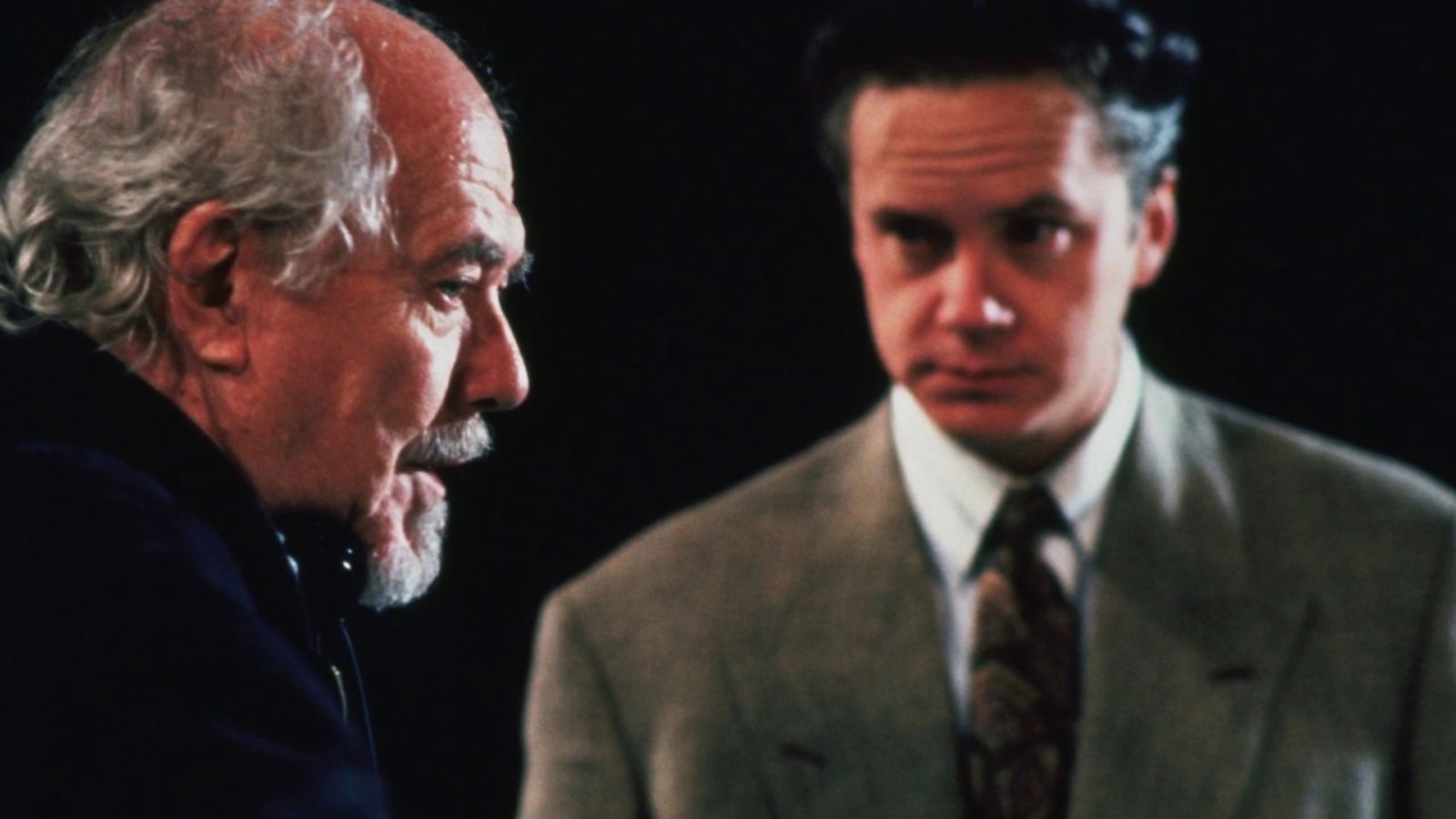
The warm reception critics gave Vincent & Theo (1990), starring Tim Roth and Paul Rhys as the van Gogh brothers, laid the groundwork for a comeback fully realized with The Player (1992), an adaptation of Michael Tolkin’s 1988 novel starring Tim Robbins as a studio executive who suspects that a screenwriter is out to kill him. “Robert Altman got a kick out of Hollywood,” wrote Sam Wasson in 2016. “Far from making the trenchant, bitter satire so many critics would describe even after they saw the movie, Altman bypassed The Day of the Locust for Our Town and actually made a charmed, even gleeful movie about his so-called nemesis. That’s why so many people in Hollywood love The Player.”
Inspired by nine short stories and a poem by Raymond Carver, Short Cuts (1993) is “a Los Angeles jazz rhapsody that represents Robert Altman at an all-time personal peak,” wrote Michael Wilmington in 2004. “It was a larger, riskier effort than The Player, but it shared that film’s wide LA canvas, daring, omniscient technique, and scathing take on modern life. Both films opened the way to Altman’s remarkable achievements of the next decade, including that sparkling ensemble blend of Agatha Christie and The Rules of the Game, Gosford Park (2001).”
Stops along the way from Short Cuts to Gosford Park include Prêt-à-Porter (1994), shot in Paris during Fashion Week with a cast that includes Anouk Aimée, Marcello Mastroianni, Sophia Loren, Kim Basinger, Julia Roberts, Lili Taylor, and Sally Kellerman; Kansas City (1996), a 1930s-set tale of jazz and kidnapping; The Gingerbread Man (1998), based on a story John Grisham had set aside before Kenneth Branagh, who stars as a high-flying lawyer, picked it up again; Cookie’s Fortune (1999), which Wesley Morris called a “Southern-Gothic-lite tapestry” that “allows Altman to do some of his most nuanced storytelling”; and Dr. T & the Women (2000), starring Richard Gere as a gynecologist with some of the wealthiest patients in Dallas.
Oddly enough, we can, at least indirectly, thank or blame Altman for Downton Abbey. Looking to tackle a whodunit, he called up actor and Conservative peer Julian Fellowes and asked him to sketch out a cast of characters we might find in an English country house in the 1930s. Featuring Maggie Smith, Stephen Fry, Michael Gambon, Eileen Atkins, Bob Balaban, Alan Bates, Helen Mirren, Richard E. Grant, and on, and on, Gosford Park is “a virtuoso ensemble piece to rival the director’s Nashville and Short Cuts in its masterly interweaving of multiple characters and subplots,” wrote Stephen Holden in the New York Times.
Fellowes won an Oscar for his screenplay and decided to write a spinoff. Instead, he started from scratch, setting the first season of Downton Abbey in 1912. But he kept Maggie Smith.
“Part document, part ballet recital, part realization of Neve Campbell’s lifelong dancing aspirations,” The Company (2003) is “modesty itself, not allowing its own art to take the spotlight off the Joffrey Ballet dancers who are, after all, the story and spectacle,” wrote Michael Joshua Rowin for Reverse Shot in 2008. “Altman shoots The Company with a grace and lightness befitting its subject matter, allowing the Joffrey’s rehearsals, board meetings, and costume changes to unfold as naturally as a perfect pirouette.”
Altman was eighty when he shot A Prairie Home Companion in the summer of 2005, and in order to secure insurance, he had to have his friend Paul Thomas Anderson at his side at all times on the set. Another dazzling ensemble—Meryl Streep, Lily Tomlin, Woody Harrelson, Tommy Lee Jones, Kevin Kline, Lindsay Lohan—joins Garrison Keillor for the staging of the final edition of the famed radio show set in the fictional town of Lake Wobegon. A character dies backstage. So does a listener, who then wafts in as an angel.
“Altman performs a master illusionist’s trick, gussying up a tale of death in frolics and furs and sending it out to strut in the Easter parade,” wrote Reverse Shot’s Michael Koresky. After A Prairie Home Companion opened SXSW in 2006, Entertainment Weekly’s Missy Schwartz asked Altman if the “life-and-death themes resonate with him,” and he responded “with a hint of a wry smile. ‘I’m aware of it. I do wake up and face it most mornings.’ He then quotes a British WWI ditty: ‘Death, where is thy sting-a-ling-a-ling?’” Altman passed away a few months later.
When critic Richard Schickel came down hard on Altman, both the man and the filmmaker, in the Los Angeles Times in 2009, Alan Rudolph, who had worked with Altman as an assistant director before setting out on his own to make such films as Remember My Name (1978) and Choose Me (1984), came to his mentor’s defense: “Some of his films might have been less than others, but each had the stuff of brilliance, and was part of a larger collection. Bob knew that continuously working in the rough was the best way to find the jewel. His biting humor never spared reality nor himself. The painful absurdity of it all. There was nobody like him during his professional peak, and there isn’t now.”
Don’t miss out on your Daily briefing! Subscribe to the RSS feed.